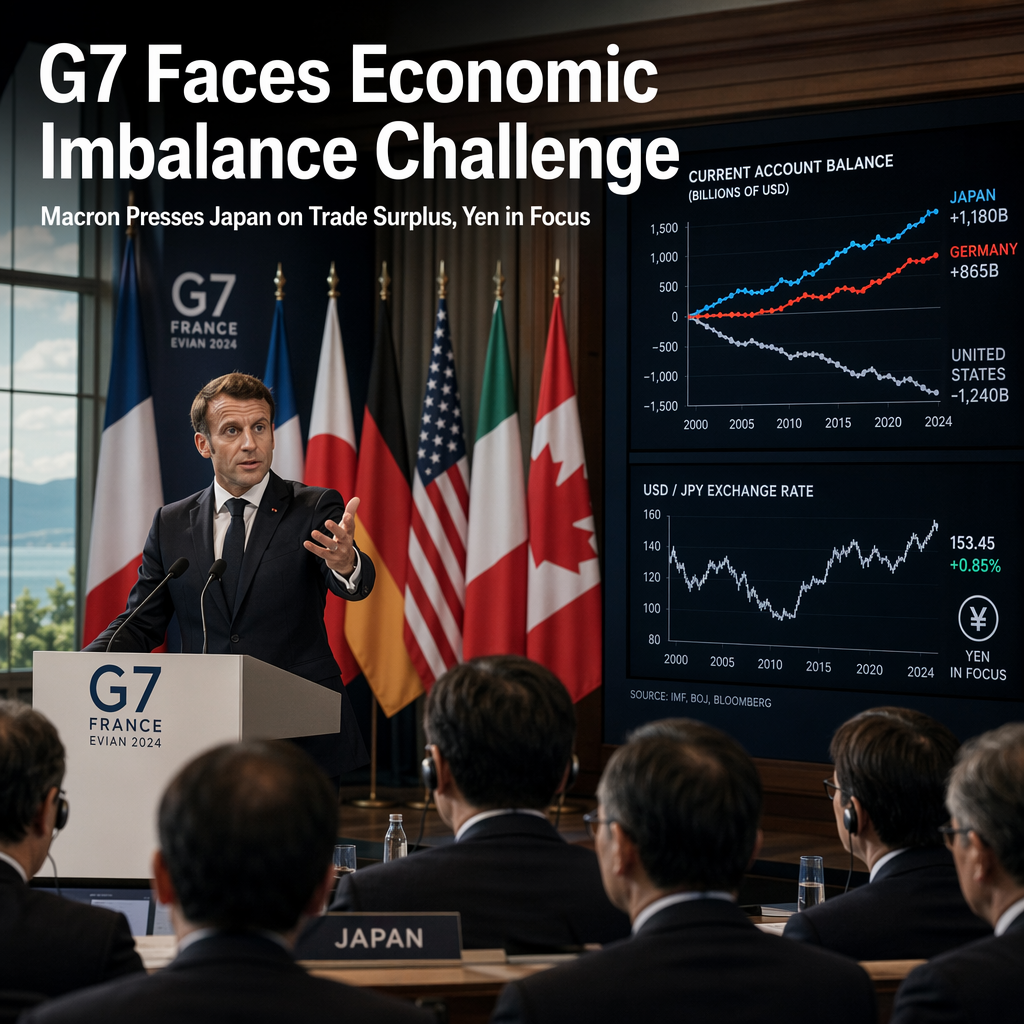
French President Emmanuel Macron has recently brought global economic imbalances to the forefront, emphasizing their significance for both Europe and Japan during the Group of Seven (G7) summit held in Evian, France, on June 16 [1]. Macron argued that persistent current-account disparities pose risks to global financial stability and called for coordinated action among G7 nations to address these issues [1]. He specifically highlighted the need for countries with large surpluses, such as Germany and Japan, to stimulate domestic demand, while deficit countries should focus on improving competitiveness and fiscal discipline [1].
Japan's current-account surplus, attributed to weak domestic demand and reliance on exports, was cited as a structural challenge. Japanese policymakers have echoed Macron's concerns, seeking ways to boost domestic consumption and reduce dependence on external markets [1]. The summit discussions also underscored the importance of addressing trade imbalances with China and India, warning that large and persistent surpluses and deficits could fuel protectionist sentiment and undermine the global trading system [1].
Market analysts noted that Japanese exporters have benefited from a weaker yen, which has exacerbated trade imbalances. Technical analysts identified support levels for the yen at 160 per U.S. dollar and resistance near 150, suggesting that currency movements remain a key indicator of Japan's competitiveness and trade balance [1]. Traders are closely monitoring for policy signals that could affect currency markets, trade flows, and Japanese equities, although no immediate trading advice has been issued by officials [1].
Japanese officials have indicated their willingness to cooperate with international partners, including France, to address supply chain vulnerabilities—particularly in rare earths—and reduce reliance on China. This aligns with broader de-risking strategies discussed during pre-summit talks [1]. Market sentiment remains cautious amid ongoing geopolitical tensions and uncertainty regarding future G7 actions [1].
CONCLUSION
Macron's call for G7 action on global economic imbalances has resonated with Japanese policymakers, highlighting the need for structural reforms and coordinated international efforts. While market sentiment is cautious and no immediate trading advice has been issued, traders are watching for policy shifts that could impact currency and equity markets. The summit underscored the importance of addressing trade imbalances to ensure global financial stability.