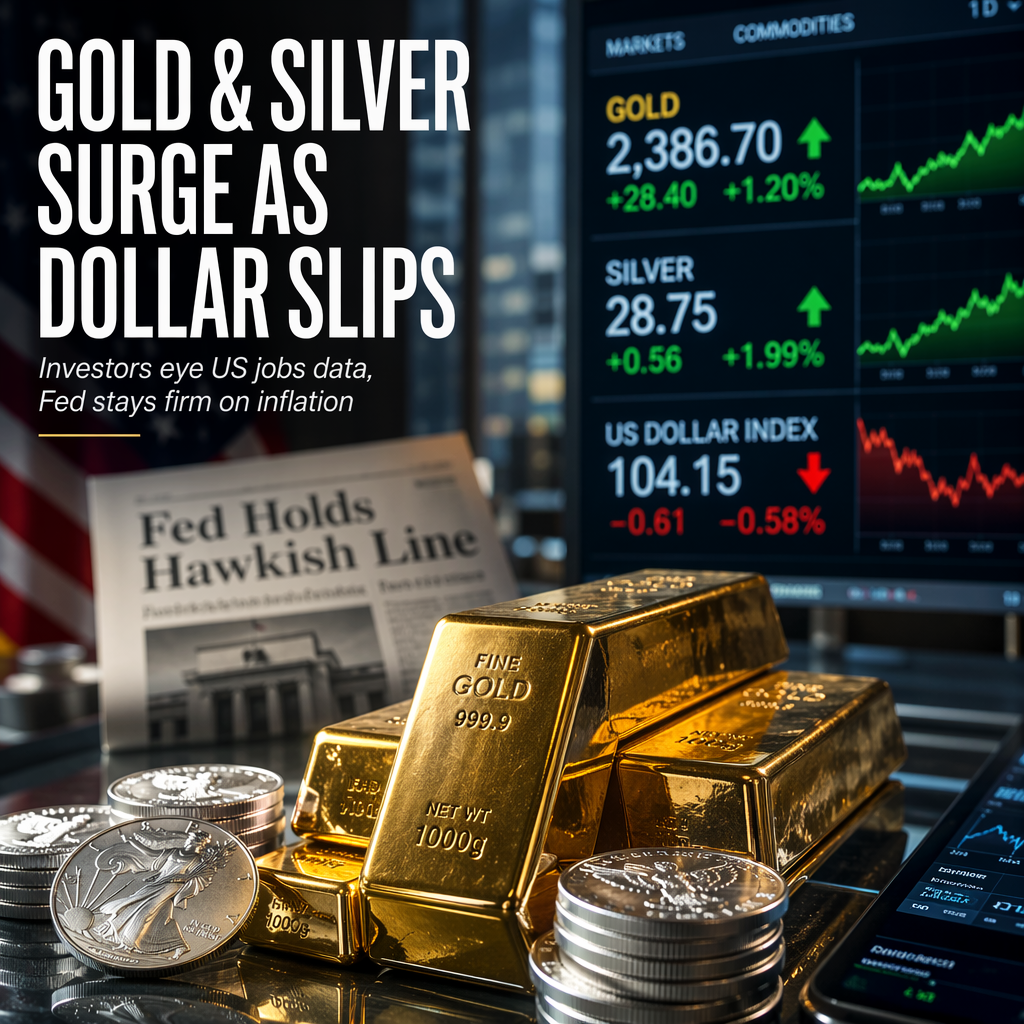
Gold (XAU/USD) and Silver (XAG/USD) both attracted buyers during the Asian session on Thursday, buoyed by a softer US Dollar (USD) following weaker-than-expected US macroeconomic data and a less hawkish tone from Federal Reserve (Fed) Chair Kevin Warsh at the ECB Forum on Central Banking [1][2][3]. Gold traded with a positive bias for the second consecutive day, while Silver rose above $60.00 per troy ounce, marking its third straight day of gains and trading around $60.20 [1][2].
The US Dollar Index (DXY) edged lower to near 101.35 as investors awaited the US Nonfarm Payrolls (NFP) report for June, which is expected to show 110K new jobs versus 172K in May, with the unemployment rate seen steady at 4.3% and average hourly earnings estimated to rise to 3.5% YoY from 3.4% [3]. Recent US data releases contributed to the Dollar's subdued performance: the ADP Employment Change report showed private sector job growth of 98K in June, missing the 113K consensus and down from 122K in May, while the ISM Manufacturing PMI fell to 53.3 from 54.0, and the Prices Paid Index dropped to 73 from 82.1 [1][2][3].
Despite the softer data and easing inflation expectations, the CME FedWatch Tool indicates that markets are still pricing in a 64% chance of a Fed rate hike in September and nearly 85% probability of a move by year-end [1][3]. Fed Chair Warsh reiterated the central bank's commitment to the 2% inflation target and institutional independence, stating that anyone expecting tolerance for inflation above 2% will be disappointed [1][2][3]. Warsh refrained from providing explicit forward guidance for the July policy decision, emphasizing a data-dependent approach and noting that the Fed must assess whether the AI boom is inflationary [2][3].
Geopolitical developments also influenced market sentiment. While Gold found support from ongoing tensions, including Russia's missile and drone attacks on Kyiv and inconclusive US-Iran talks in Qatar [1], Silver benefited from a sharp downturn in crude oil prices and diplomatic progress between Washington and Tehran, which lowered geopolitical risk premiums across commodities [2].
Technical analysis for Gold suggests that further gains would require surpassing the 38.2% Fibonacci retracement level and the 100-SMA on the 4-hour chart [1]. Both metals' near-term trajectories are seen as highly sensitive to the upcoming US NFP report, which remains a key driver for Fed policy expectations and, consequently, for the USD and precious metals prices [1][2][3].
CONCLUSION
Gold and Silver prices have risen on the back of a weaker US Dollar and softer US economic data, while the Federal Reserve maintains a hawkish stance with a firm 2% inflation target. Market participants are closely watching the upcoming US Nonfarm Payrolls report for further direction on Fed policy and precious metals prices. The overall sentiment is cautiously optimistic, with the potential for further volatility depending on labor market data.