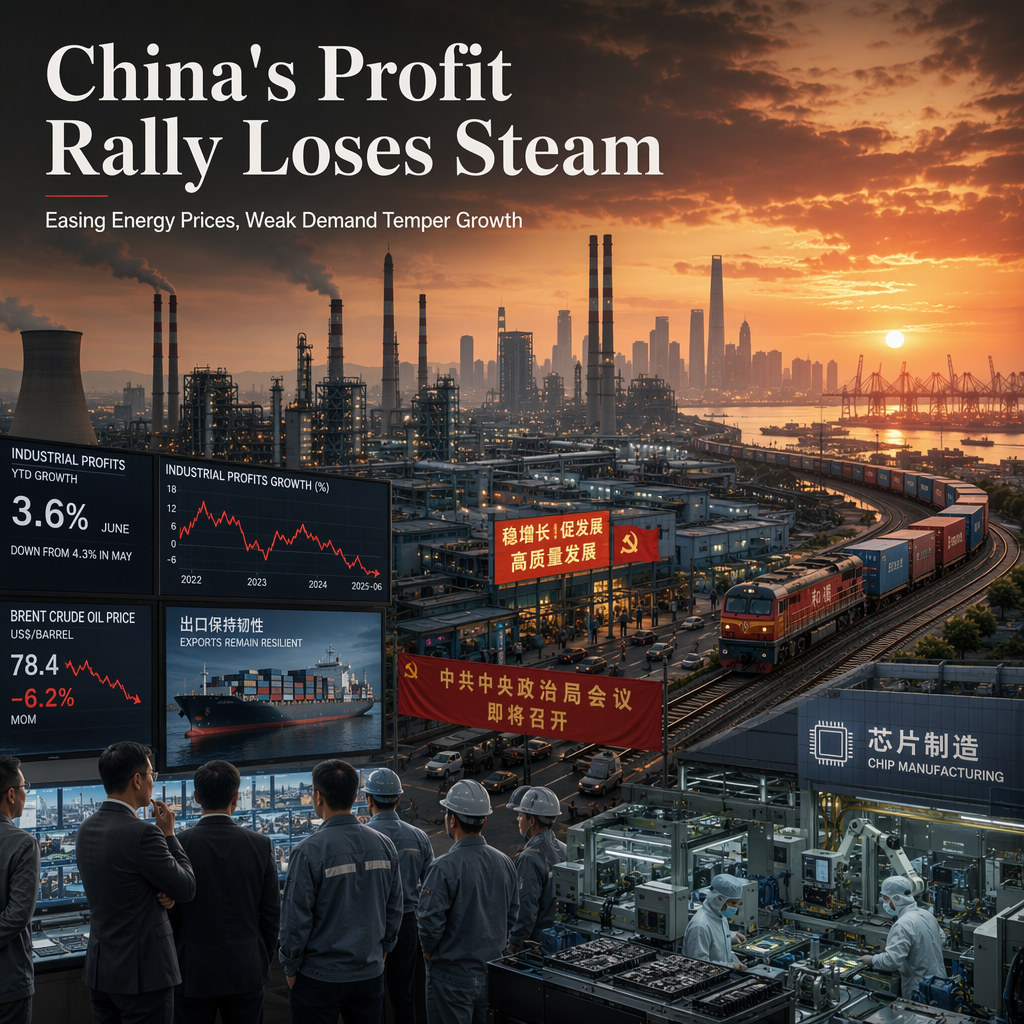
China's industrial profits increased by 15.1% in June 2026 compared to a year earlier, according to data from the National Bureau of Statistics, marking a slowdown for the second consecutive month as falling energy prices reduced the earnings boost that had fueled this year's recovery [1]. This deceleration follows a 21.1% gain in May, which was the first slowdown since November, and brings first-half profit growth to 18.7%, slightly down from the 18.8% pace recorded in the January-May period [1].
The rebound in industrial corporate earnings this year has been notable, shifting from marginal growth in 2025 to double-digit gains, driven by an artificial intelligence-fueled boom in chip and equipment manufacturing and the end of nearly three years of factory-gate deflation [1]. The recovery has also benefited from a low base effect, as earnings had fallen 3.6% in June last year and declined 2.8% in the first half of 2025 [1].
Factory-gate prices rose 3.6% year-on-year in the second quarter, the first positive reading since late 2022, but this reflation appears fragile. Much of the price recovery was attributed to surging global energy costs, while domestic demand remains weak, according to economists [1]. Producer prices fell 0.3% month-on-month in June, the first decline since July 2025, as normalizing tanker flows through the Strait of Hormuz led to lower oil, refined-fuel, and petrochemical prices [1].
Looking ahead, investors are focused on the upcoming Communist Party Politburo meeting, traditionally held in late July, where leaders will review first-half performance and set policy direction for the remainder of the year [1]. Economists expect the Politburo to signal a slightly more urgent policy support stance, prioritizing faster fiscal rollout, but anticipate only a gradual policy ramp-up rather than a large stimulus package, given resilient exports and ongoing efforts to curb excess factory capacity [1]. Robin Xing, chief China economist at Morgan Stanley, stated, "Growth should stay resilient thanks to exports, even as domestic demand lags," citing the AI-driven investment cycle and a broader Asian industrial capex super-cycle [1].
CONCLUSION
China's industrial profit growth is slowing, primarily due to easing energy prices and subdued domestic demand, despite ongoing strength in exports and AI-driven manufacturing. Market participants are now watching for potential policy signals from the upcoming Politburo meeting, with expectations centered on gradual, rather than aggressive, fiscal support. The overall market sentiment remains cautiously optimistic, supported by resilient export performance.