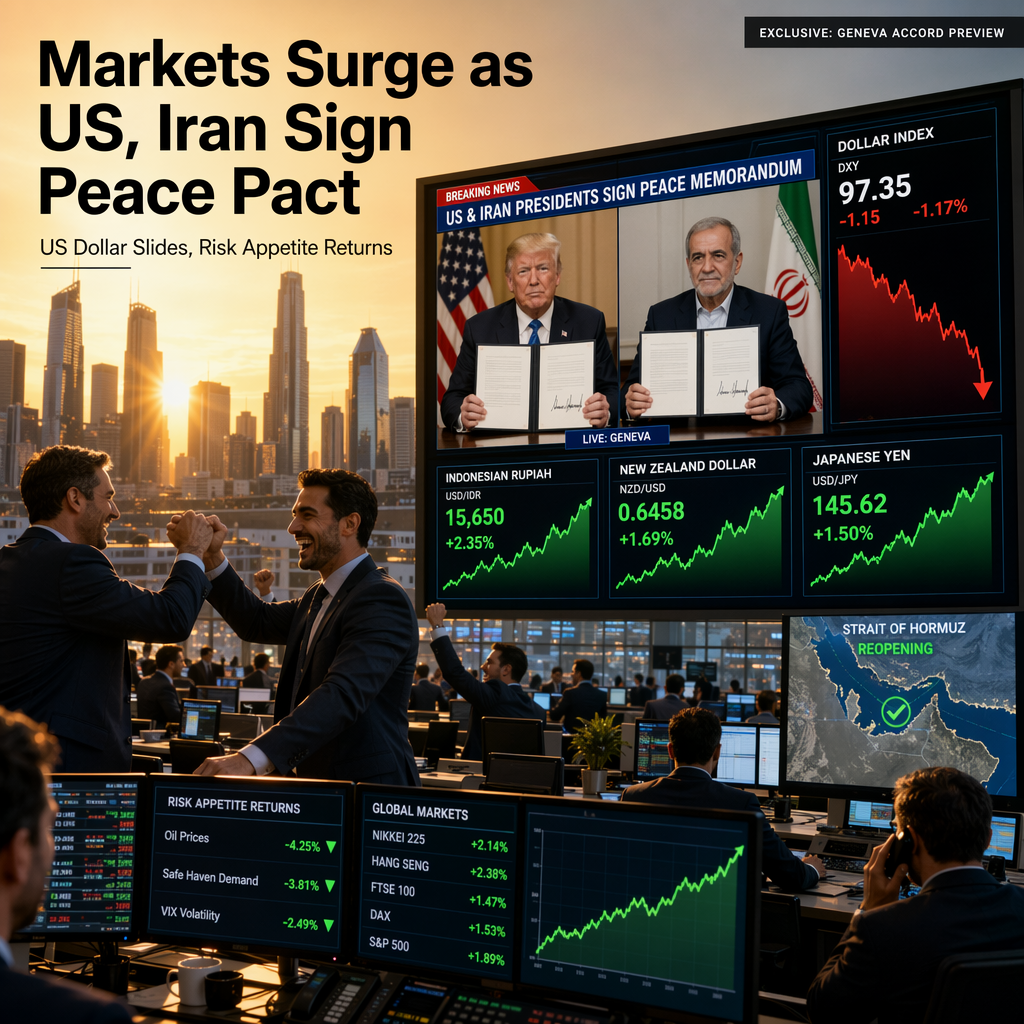
A significant development occurred as US President Donald Trump and Iranian President Masoud Pezeshkian electronically signed a preliminary memorandum of understanding (MoU) aimed at ending the US-Israel war on Iran, according to reports from the White House and Reuters. This agreement, which follows the electronic signing of the initial framework by US Vice President JD Vance and Iranian Parliamentary Speaker Mohammad Bagher Ghalibaf, is expected to be formally signed on Friday in Geneva. Both sides have stated that the deal is already in effect, and the agreement includes provisions to reopen the Strait of Hormuz. President Trump also clarified that the 60-day negotiation period for a final agreement on Iran's nuclear program is not a hard deadline, which has further boosted investor confidence and improved risk sentiment in global markets [1][2][3][4].
The immediate market reaction saw the US Dollar (USD) weaken across several major pairs. The US Dollar Index (DXY) pulled back from an 11-week high of 100.57 to trade around 100.30 during Asian hours, as safe-haven demand for the Greenback eased following the peace deal news [3]. The USD/IDR pair broke lower, trading around 17,880, as the Indonesian Rupiah found support ahead of Bank Indonesia’s policy meeting, with traders pricing in a possible 25-basis-point rate hike to 5.75% after a surprise hike last week. This move was in response to Indonesia's annual inflation rate rising to 3.08% in May, nearing the upper limit of the central bank's target range [1].
The New Zealand Dollar (NZD) gained ground against the USD, with NZD/USD trading near 0.5790. This was supported by upbeat New Zealand GDP data, which showed a 0.8% quarter-on-quarter expansion in Q1 2026 and a 1.5% annual growth, both beating expectations. Improved risk sentiment following the US-Iran agreement also contributed to the NZD's strength [2].
In Japan, the USD/JPY pair held steady above the mid-160.00s, consolidating recent gains. The US Dollar's pullback, combined with intervention fears and repeated warnings from Japanese authorities about speculative moves, provided support to the Japanese Yen. The Bank of Japan's recent rate hike to the highest level since 1995 also helped cap further JPY losses, despite the wide interest rate differential with the US, as the Federal Reserve signaled the possibility of at least one rate hike this year after maintaining its benchmark rate at 3.5%-3.75% [4].
Forward-looking statements from the Federal Reserve indicate that half of FOMC members expect at least one rate hike in 2026, with Chairman Kevin Warsh emphasizing the committee's commitment to restoring price stability. However, the easing of geopolitical tensions and resilient labor market data are currently weighing on the USD, with analysts suggesting that any corrective pullback in USD/JPY should be bought into due to ongoing carry trade dynamics [1][3][4].
CONCLUSION
The signing of a preliminary peace agreement between the US and Iran has triggered a broad-based weakening of the US Dollar, boosted risk sentiment, and supported several major currencies, including the Indonesian Rupiah, New Zealand Dollar, and Japanese Yen. Central bank policy decisions and forward guidance remain in focus, but the immediate market takeaway is a positive shift in risk appetite and a reduction in safe-haven demand for the USD.