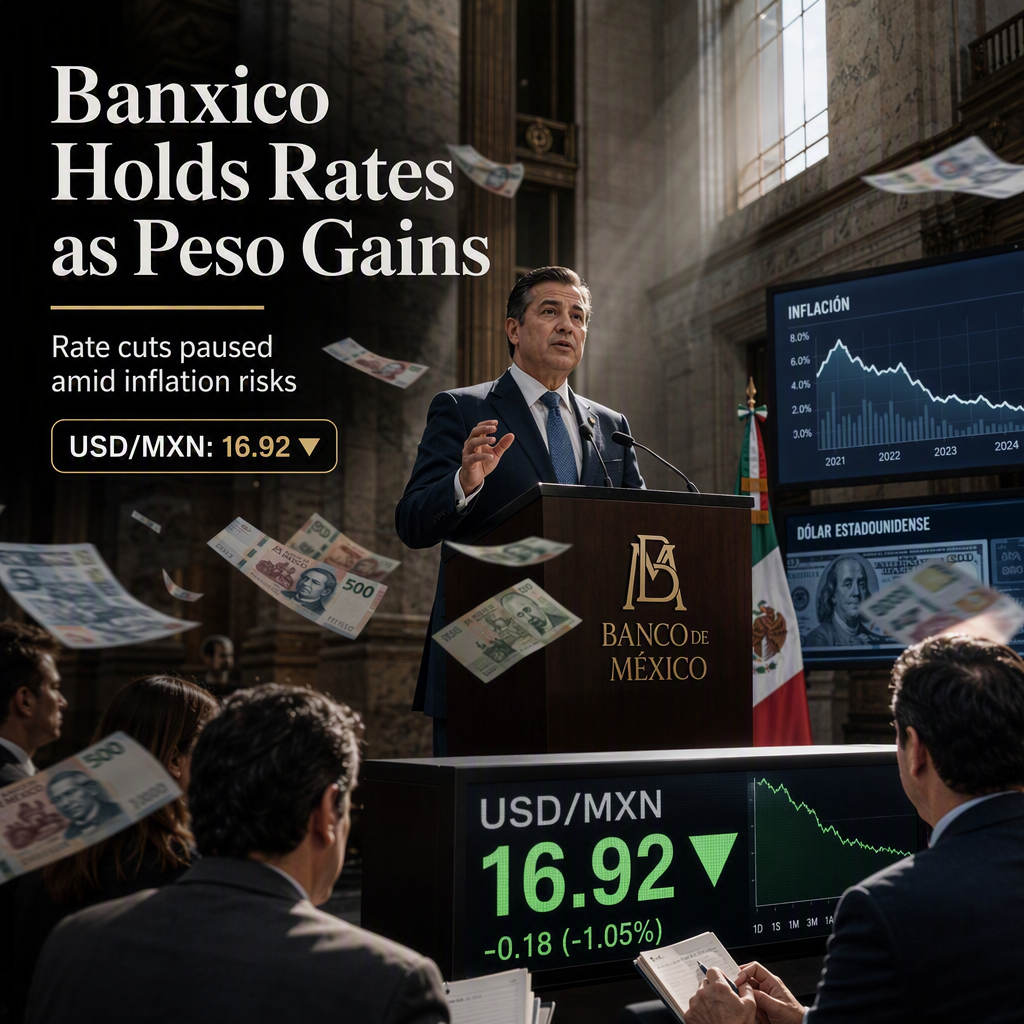
Bank of Mexico (Banxico) Deputy Governor Jonathan Heath stated that the central bank can wait before reducing interest rates, indicating that further easing is possible but likely only in about a year or more. Heath described the current monetary policy stance as 'appropriate' and emphasized that rate cuts would only be considered if core inflation converges to Banxico’s 3% target. He noted that while the disinflation process has progressed, headline inflation has dropped mainly due to non-core components, which are volatile and less influenced by monetary policy. Heath highlighted persistent inflation in services and sees inflation risks tilted to the upside [1][2].
On Wednesday, Heath reiterated that Banxico should not cut rates in the near term, supporting a pause in the easing cycle for about a year. He stated, 'Where we are now, it is appropriate to stop,' and would only support a rate cut if core inflation meets the central bank’s 3% goal [2].
In the foreign exchange market, the Mexican Peso appreciated against the US Dollar on Thursday, with USD/MXN trading at 16.92, down 0.32%. This movement was attributed to a dovish tilt by US Federal Reserve Governor Waller and speculation about FX market intervention to support the Japanese Yen. Wall Street ended Thursday positively as Waller suggested holding rates unchanged if the disinflation process continues, but warned of a possible rate hike if upcoming US CPI data is strong. US Initial Jobless Claims rose to 206K, above estimates, while the ISM Services PMI for August improved to 54.4. Input costs in the US services sector rose to their highest since May 2022, partly due to energy prices, while employment remained in contraction [2].
Technical analysis of USD/MXN shows the pair trading at 16.9254, extending its decline below key moving averages clustered around 17.2648. The near-term bias remains bearish, with the Relative Strength Index at 33.25, just above oversold territory, suggesting that downside momentum may be slowing. Resistance is seen near 17.0838 and 17.2648, while the pair remains vulnerable to further declines unless it recovers above the SMA cluster [2].
In Mexico, Consumer Confidence (seasonally adjusted) rose to 46.1 in August from 45, but this data was largely ignored by market participants [2].
CONCLUSION
Banxico’s cautious stance on rate cuts, with a likely pause for about a year, underscores ongoing concerns about persistent core inflation. Meanwhile, the Mexican Peso has strengthened against the US Dollar, supported by dovish signals from the US Federal Reserve and technical bearishness in USD/MXN. Market participants are expected to closely monitor upcoming US economic data and Banxico’s inflation outlook for further direction.