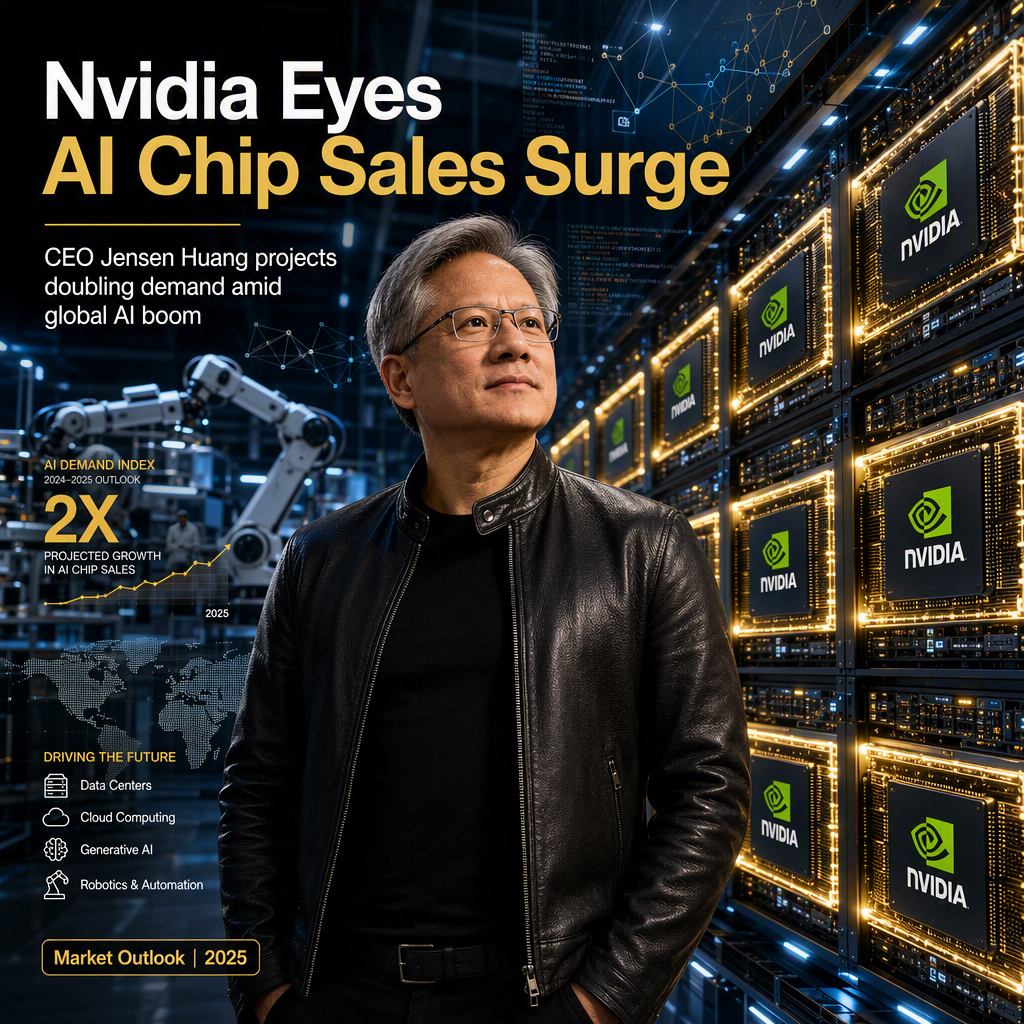
Nvidia CEO Jensen Huang announced that the company expects to double its chip sales next year, citing strong global demand for artificial intelligence (AI) technologies [1]. Huang stated, "I expect Nvidia to sell twice as many chips as this next year as we do this year," during a media briefing ahead of a summit with the U.K.'s King Charles III in Scotland [1]. This forecast follows Nvidia's recent projection of 70% growth for the fiscal year ending in January 2028, which would amount to approximately $673 billion, significantly raising analyst expectations [1].
Nvidia's product portfolio includes data center graphics processing units (GPUs) such as the Blackwell and Rubin chips, as well as central processors (CPUs), switch chips, chips for optical networking, chips for laptops, Jetson chips for robots and cars, and the chip inside Nintendo's Switch 2 gaming console [1]. While Nvidia does not disclose the total number of chips sold, Huang previously mentioned that the company shipped 6 million Blackwell GPUs in four quarters as of last fall [1].
Huang attributed the anticipated growth to AI's widespread benefits across various industries and economies, noting, "AI has, has so much contribution to the benefits of different industries, different economies, and you can see that in almost every single country that we're in, people want to invest in AI" [1]. The CEO's remarks come amid heightened public discourse on AI safety, with Huang emphasizing the importance of withholding unsafe products until they are properly engineered [1].
The announcement has significant market implications, as it signals continued robust demand for Nvidia's AI chips and related products, reinforcing the company's leadership position in the semiconductor industry [1].
CONCLUSION
Nvidia's projection to double chip sales next year and its 70% growth forecast for the fiscal year ending January 2028 highlight the company's strong momentum in the AI sector. The announcement is likely to boost investor confidence and further elevate market expectations for Nvidia's performance.