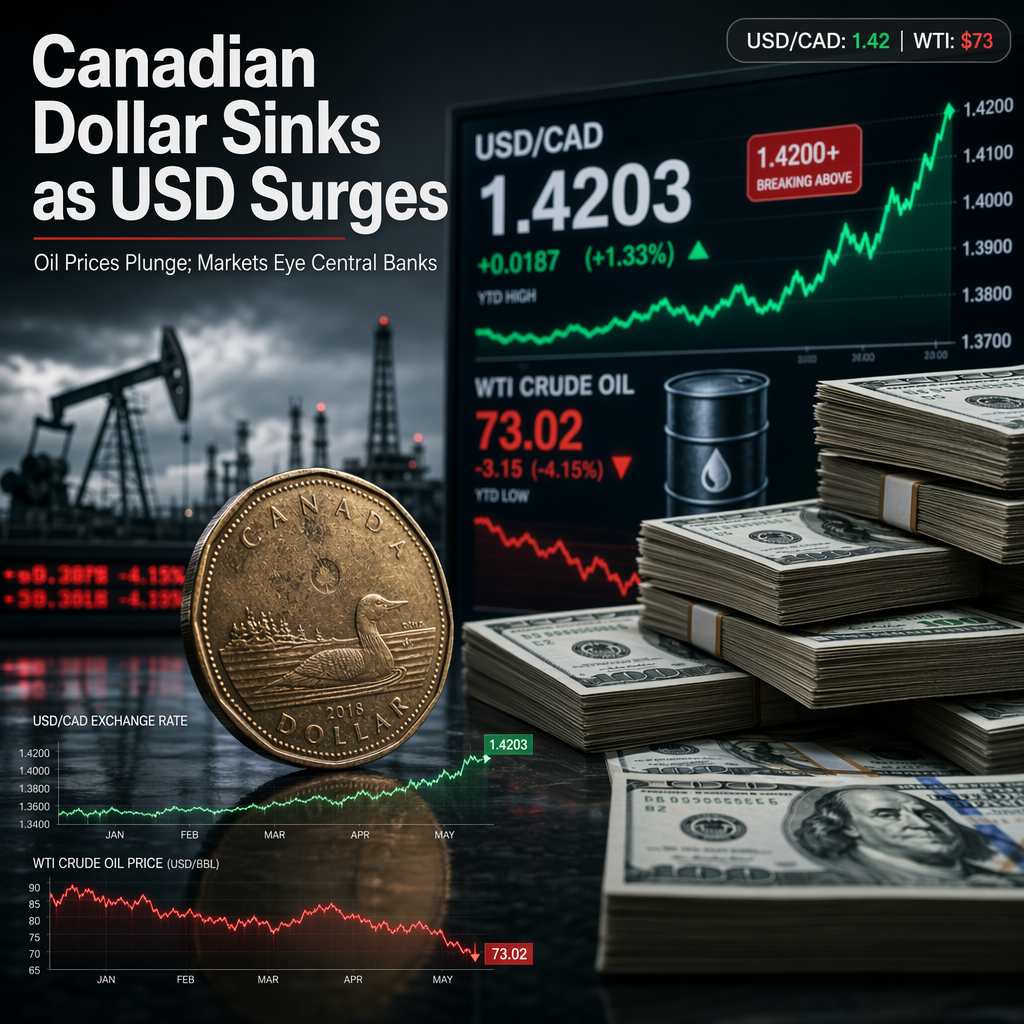
The Canadian Dollar (CAD) registered a loss of 0.40% on Tuesday, driven by a combination of US Dollar (USD) strength and declining oil prices, with the USD/CAD pair trading above 1.4200 for the first time since April 2025 [1]. The risk-off sentiment in global markets, exacerbated by a sharp decline in tech shares and speculation around high valuations and end-of-period flows, further supported the Greenback. The US Dollar Index (DXY) gained over 0.36% to reach 101.36 [1].
US economic data contributed to the USD's rally, as the S&P Global Manufacturing PMI for June rose to 55.7 from 55.1 in May, surpassing expectations of 54.8. The report highlighted improved activity as companies accelerated orders to avoid shortages and rising prices, partly attributed to the US-Iran war energy shock [1]. In contrast, the Canadian economy faced headwinds from falling oil prices, with WTI crude dropping over 1.40% to $73.00 per barrel on Tuesday [1].
Bank of Canada Governor Tiff Macklem noted that the latest inflation report showed price increases concentrated in energy, while food inflation remained a concern. Despite Canada's inflation rising more than expected to 3.2% in May, the core inflation print was more subdued. Money markets currently assign a 57.4% probability of a rate hike by the Bank of Canada by December, indicating limited expectations for near-term policy tightening [1].
Looking ahead, market participants are awaiting speeches from BoC officials Rogers and Breeden, as well as upcoming US housing data and Thursday's release of the Fed's preferred inflation gauge (Core PCE), Q1 2026 GDP, and initial jobless claims for the week ending June 20 [1]. Technical analysis shows USD/CAD trading at 1.4211, maintaining a strong bullish bias above key moving averages, though the Relative Strength Index at 88 signals overbought conditions and potential vulnerability to a corrective pullback if buying interest wanes [1].
CONCLUSION
The Canadian Dollar's decline reflects a combination of USD strength, positive US data, and falling oil prices, with technical indicators suggesting the USD/CAD rally may be stretched. Market focus now shifts to upcoming central bank communications and key US economic releases, which could influence the pair's next move.