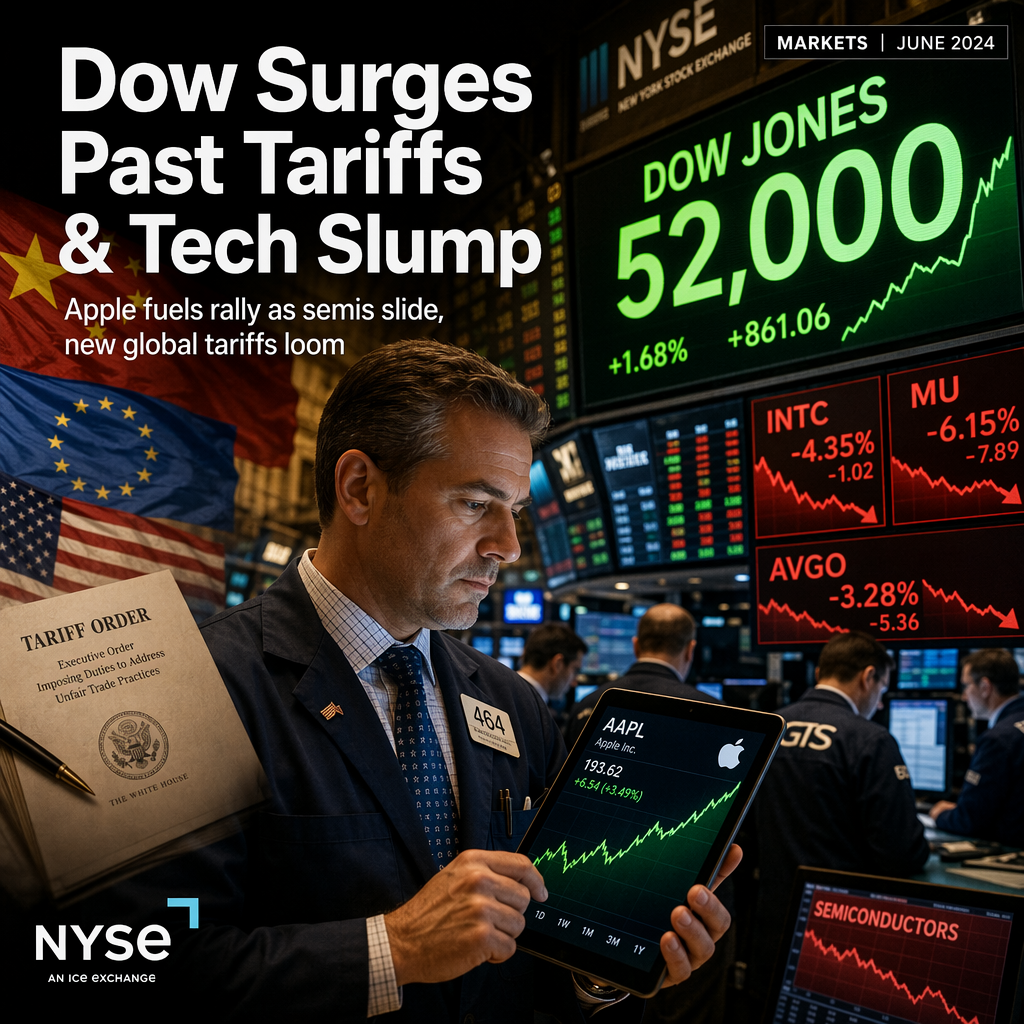
The Dow Jones Industrial Average traded near 52,000 on Friday, up approximately 325 points, following a wire report suggesting Pakistan is seeking to revive stalled US-Iran talks at China's urging. However, the same report cited three sources who cautioned that significant obstacles to American engagement remain high, casting doubt on the likelihood of progress [1]. Crude oil prices responded sharply to the news, with Brent crude falling roughly 4% toward $96.00 after previously exceeding $100.00 this week, and West Texas Intermediate settling near $88.50 [1].
The equity rally was notably driven by Apple (AAPL), which contributed a 3% gain to the index. All S&P 500 sectors closed higher, with real estate and communication services leading. However, the semiconductor sector faced significant declines: Intel (INTC) fell 4% despite a second-quarter beat due to spending concerns, Alphabet (GOOGL) dropped 6% on Thursday, Micron Technology (MU) lost 5%, Broadcom (AVGO) declined around 2%, and Advanced Micro Devices (AMD) slipped about 1%. The benchmark chip fund also retreated by 2%. The Dow's limited exposure to semiconductors insulated it from the sector's broader weakness, as most of its constituents are focused on physical goods [1].
Amid the market moves, a major shift in US trade policy occurred largely unnoticed. The temporary 10% worldwide tariff expired at 12:01 a.m. Friday and was replaced by new duties of 10% to 12.5% on 60 trading partners, covering 99% of American imports. These tariffs, imposed under Section 301 of the Trade Act of 1974, target countries accused of insufficient enforcement against goods made with forced labor. Canada, the European Union, India, and the United Kingdom face the lower rate, while China, Japan, and South Korea are subject to the higher rate. The new tariff regime is expected to have a lasting impact, as it is based on a statute with a strong legal precedent, unlike the emergency-powers tariffs struck down by the Supreme Court in February [1].
June import prices were already up 7.1% year-over-year, the largest annual increase since August 2022, even though the index excludes tariffs. The article notes that exporters are not absorbing these costs, implying that US buyers will face higher prices, with the passthrough effect expected to arrive with a lag [1].
CONCLUSION
The Dow Jones rallied on optimism around potential US-Iran talks and strong performance from Apple, despite a significant selloff in semiconductor stocks and the introduction of a new, enduring tariff regime. The market appears to have largely overlooked the potential inflationary impact of the new tariffs, which could raise costs for US buyers in the coming months.