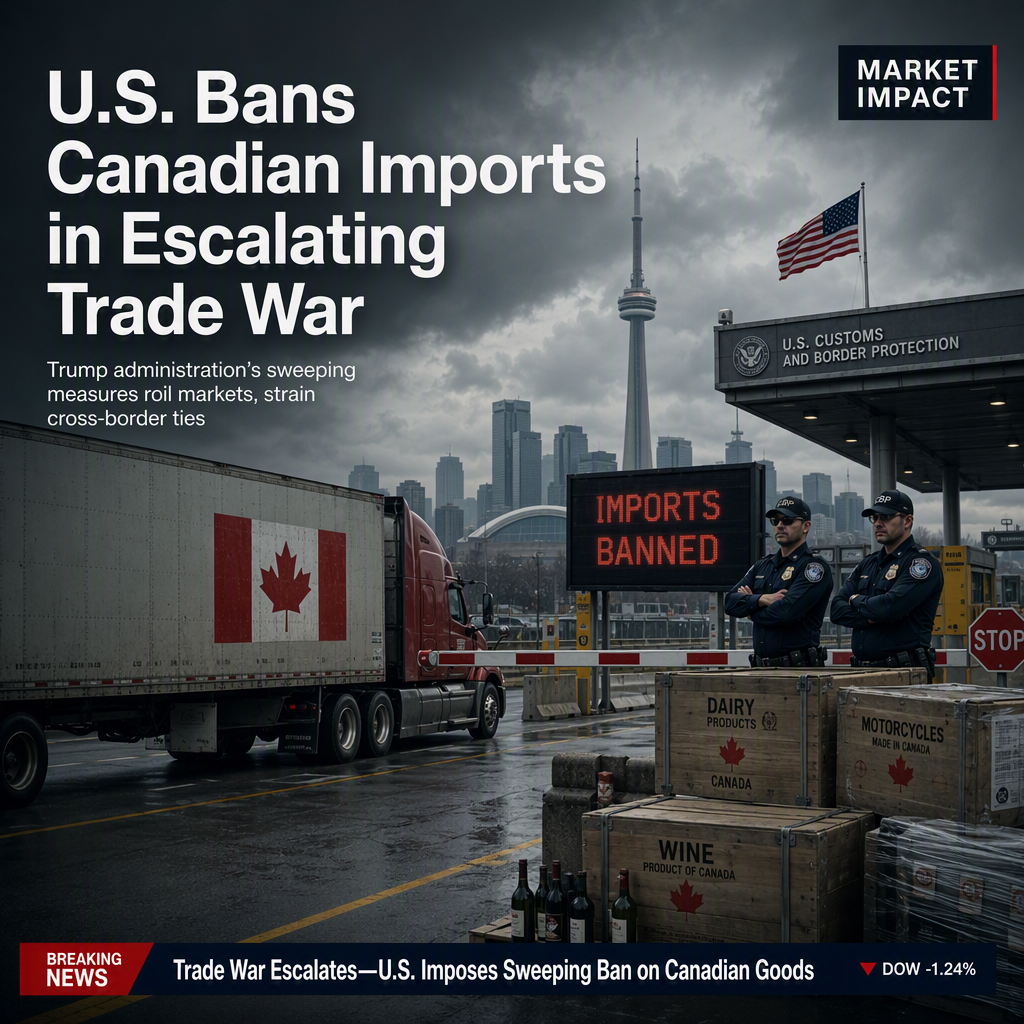
On Tuesday, President Donald Trump announced a sweeping ban on Canadian imports, including dairy products, most alcoholic beverages, motorcycles, and some autos, marking a significant escalation in the ongoing trade dispute between the United States and Canada [1][2]. The White House stated that these restrictions will take effect in three weeks, specifically on September 29, 2026 [1][2]. The move was made in direct response to Canada’s retaliatory tariffs on $20 billion worth of U.S. imports, which took effect at 12:01 a.m. Tuesday [1][2][3].
The measures were signed into law under Section 338 of the Tariff Act of 1930, a statute previously unused until Trump implemented new tariffs on Canada in late August [2]. In addition to the import bans, the Trump administration completed 'housekeeping' on existing tariffs, removing duties on cement, road salt, and hospital pads, and replacing them with new tariffs on all-terrain vehicles, some cheeses, and motor boats [2]. Trump’s plan for 50% duties on cars and trucks remains under consideration, with a threat to impose them on January 1 [2].
The trade conflict intensified after Canada’s Prime Minister Mark Carney ended negotiations with the U.S., citing 'uneconomic' and 'unfair' demands from American officials [2]. Trump administration officials disputed this characterization [2]. In a symbolic move, Trump renamed Lake Ontario as 'Lake America,' but Canadian officials have stated they will ignore this change [2].
A focal point of the dispute is Canadian aerospace giant Bombardier (BBD). Trump declared that Bombardier would not be allowed to sell in the U.S. unless it builds its products domestically [3]. Bombardier responded by highlighting its extensive U.S. footprint, with direct employment in more than 20 states and plans to expand its defense activities and service network, including a new facility in Fort Wayne, Indiana [3]. Republican Senator Jerry Moran of Kansas emphasized Bombardier’s significant contributions to the local workforce in Wichita, Kansas [3].
U.S. Commerce Secretary Howard Lutnick blamed Canada for 'blowing up' a nearly complete trade deal for political reasons, while Prime Minister Carney indicated Canada would resume trade talks 'when the Americans are ready' [3].
CONCLUSION
The Trump administration’s sweeping ban on Canadian imports and threats against Bombardier signal a sharp escalation in the U.S.-Canada trade war, with both sides imposing significant tariffs and restrictions. The measures are expected to have a high market impact, particularly for affected industries and companies like Bombardier. Ongoing tensions and stalled negotiations suggest continued uncertainty for cross-border trade relations.