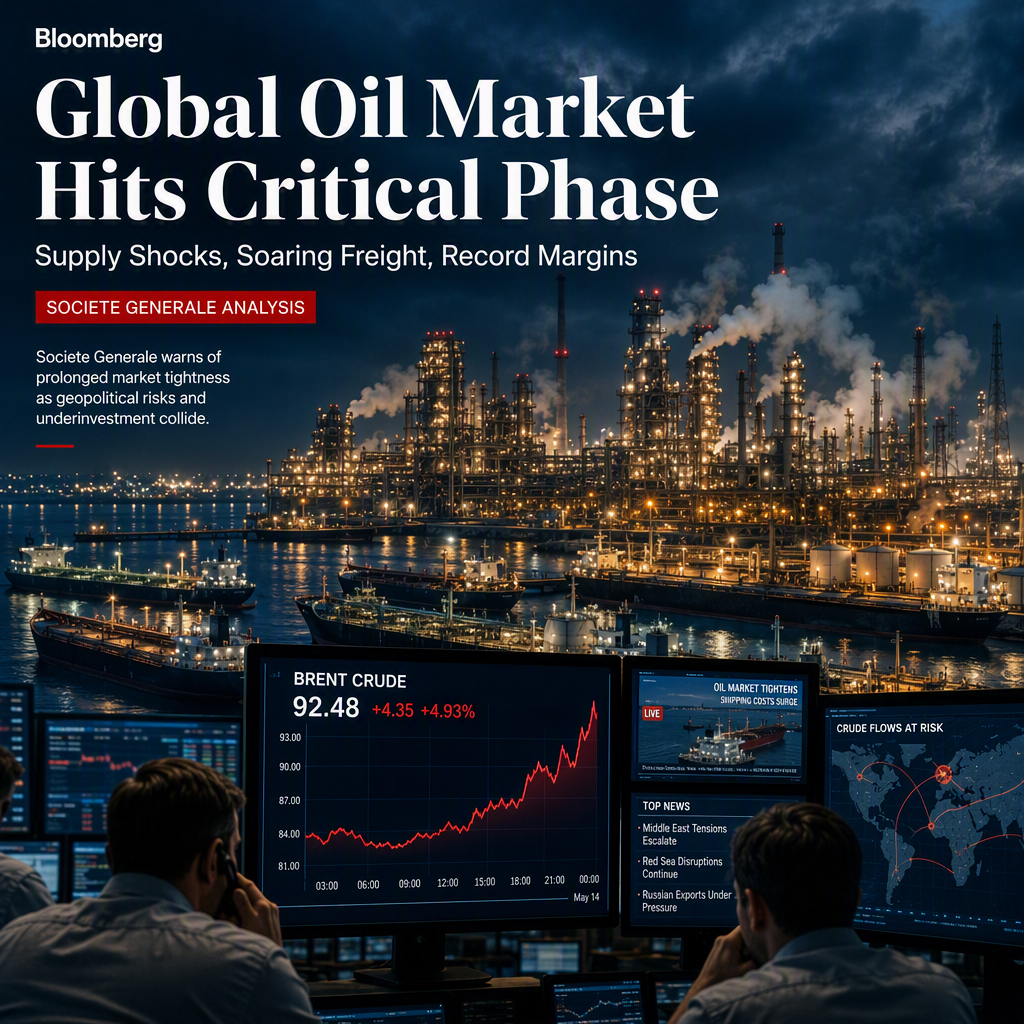
Societe Generale strategists Michael Haigh and Jeremy Sellem report that global oil product markets have shifted from a state of tightness to a critical phase, citing a combination of East-West pipeline disruptions, Russian refinery outages, elevated freight rates, and low inventories as key factors constraining supply [1]. The strategists highlight that refining margins are exceptionally high, reflecting stressed crude and product balances, and warn that current market conditions leave little buffer against further shocks [1].
The report details that global product balances are under significant strain, with evidence including declining inventories, weaker exports, lower refinery supply, and rising refinery outages, all contributing to an increasingly constrained global market [1]. Freight rates have surged, increasing by as much as tenfold on some key routes, and these higher costs are being passed on to end-user prices [1]. Despite weaker demand in two major consuming regions, product markets remain exceptionally tight, underscoring the impact of ongoing supply disruptions, refinery outages, and constrained exports [1].
Societe Generale's analysis indicates that refining margins remain well above historical averages across the US, Europe, and Asia, suggesting that the global refining system is struggling to replace lost supply, rebuild inventories, and meet demand simultaneously [1]. The strategists also note that recent attacks have escalated regional conflicts, increasing the vulnerability of energy infrastructure and raising the likelihood of a severe supply shock [1].
Looking ahead, Societe Generale warns that if military tensions continue to intensify and disruptions become prolonged, Brent crude prices could rise well beyond current levels and potentially exceed $150 per barrel [1].
CONCLUSION
Societe Generale identifies a critically tight global oil market driven by supply disruptions, high freight rates, and low inventories. The risk of a severe supply shock has increased, with the potential for Brent prices to surpass $150 per barrel if current tensions persist. Market participants should remain alert to further shocks and escalating price volatility.