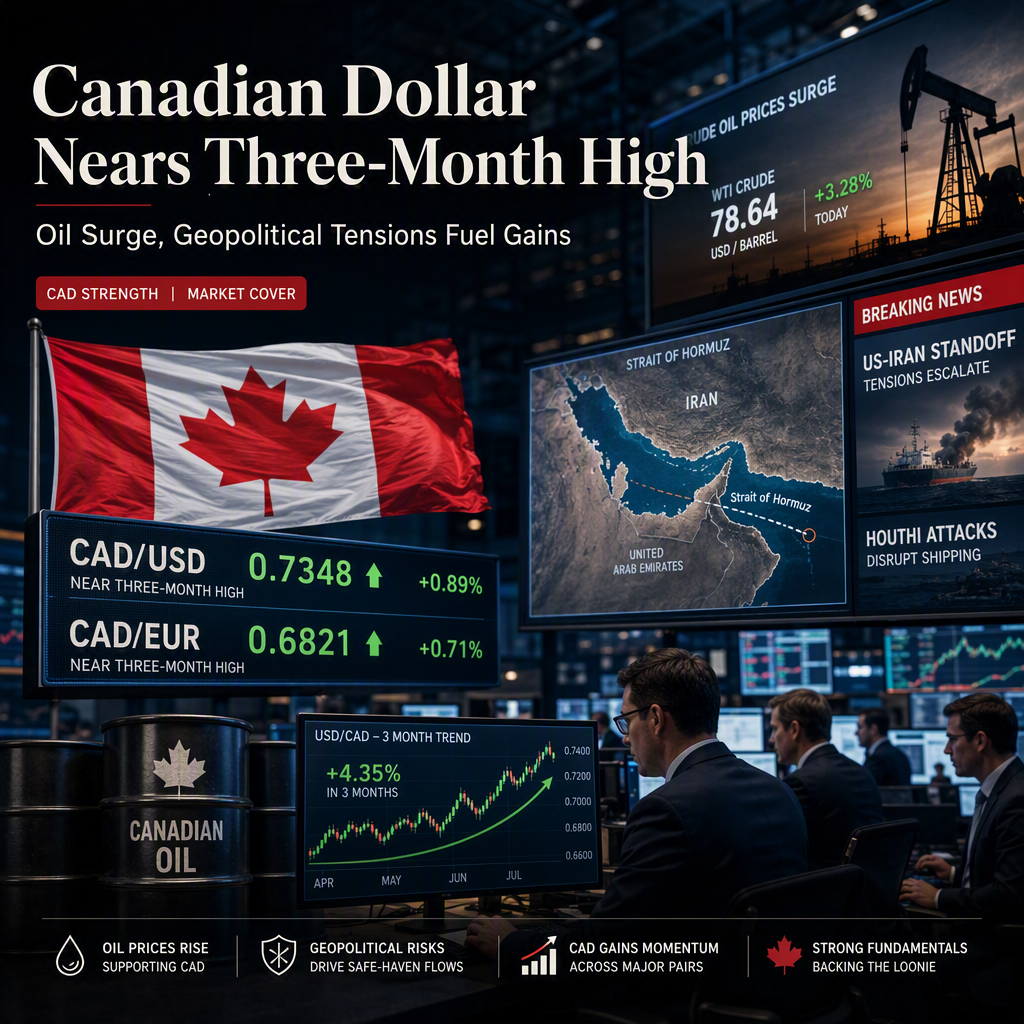
The Canadian Dollar (CAD) has maintained its strength, trading near a three-month high against the US Dollar (USD) and extending gains versus the Euro (EUR) as of Friday's European session [1][2]. The USD/CAD pair has experienced selling pressure for the third consecutive day, hovering just above the mid-1.3700s, and is on track for its fourth straight week of losses, marking the sixth decline in the past seven weeks [1]. Similarly, the EUR/CAD cross has depreciated for the second day in a row, trading around 1.6100, as the Euro remains under pressure following weaker-than-expected German PMI data [2].
A key driver behind the CAD's resilience is the surge in crude oil prices, which are holding near a three-week high. This rise is attributed to escalating geopolitical tensions, particularly the US-Iran standoff over the Strait of Hormuz and Yemen’s Houthi group claiming attacks on eight oil tankers since late July, raising the risk of broader regional conflict [1][2]. Analysts at Nordea highlight that the Strait of Hormuz remains largely closed, with no clear path to de-escalation, keeping upward pressure on energy markets [2].
On the US side, recent inflation data indicated easing price pressures, reducing expectations for an immediate Federal Reserve rate hike. Traders are now pricing in a higher probability that the Fed will keep rates steady at its September meeting, which has contributed to the USD Index (DXY) remaining near its lowest level since May 14 [1]. However, the minutes from the July 28-29 FOMC meeting revealed that Fed officials still see the need to raise rates soon unless inflation shows more progress in declining, which could limit further USD losses [1].
In Europe, Germany's flash HCOB Composite PMI for August fell to 51.0, below the expected 51.3, with the Services PMI dropping to 48.5 from 49.8, missing the 50.1 estimate. The Manufacturing PMI, however, rose to 54.1, beating forecasts [2]. The weaker services data weighed on the Euro, contributing to EUR/CAD's decline [2].
Looking ahead, markets are awaiting the release of Canadian Retail Sales data and US flash PMIs for further direction [1]. Additionally, formal details of new US economic measures against Iran are expected on Monday, which could further impact oil prices and, by extension, the CAD [2].
CONCLUSION
The Canadian Dollar's recent strength is underpinned by rising oil prices amid heightened geopolitical risks and a broadly weaker US Dollar. Market participants are closely watching upcoming economic data and geopolitical developments for further cues, with volatility likely to persist in the near term.