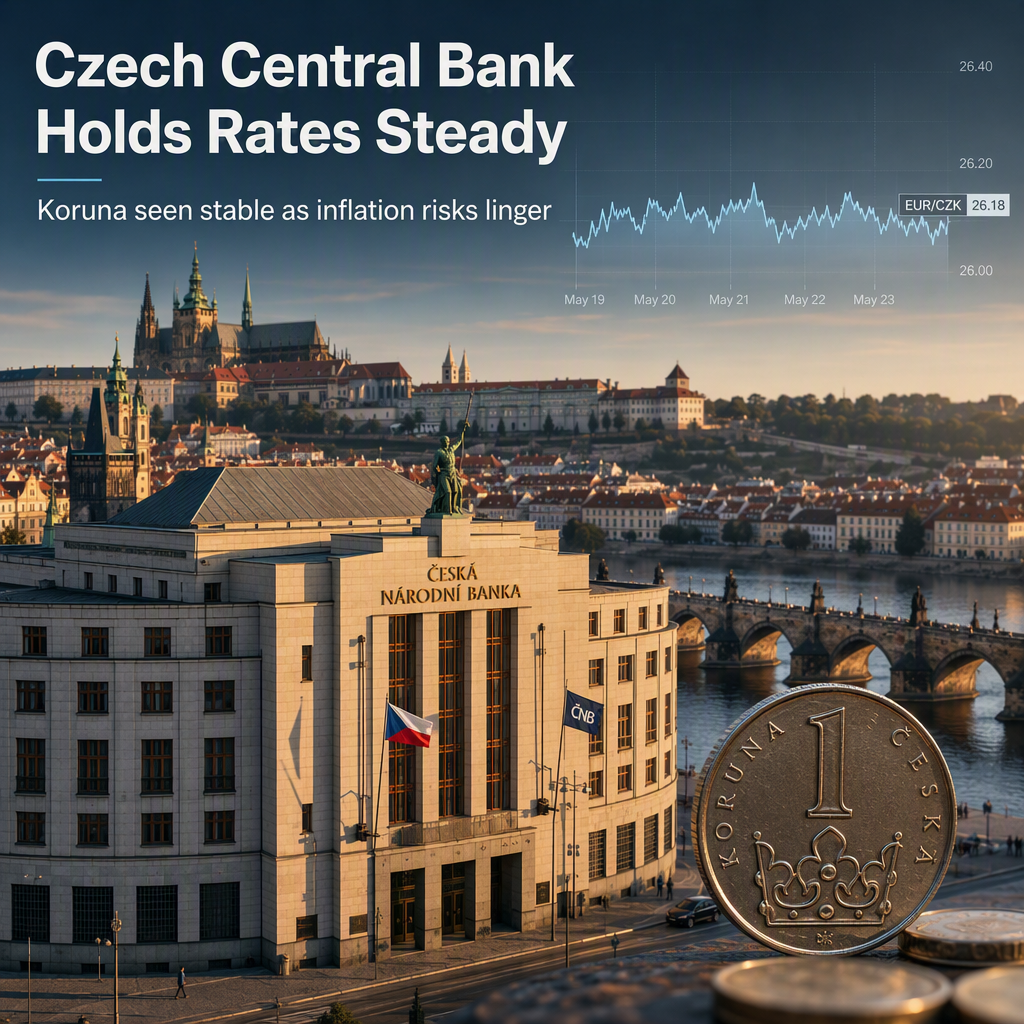
The Czech National Bank (CNB) is unanimously expected to keep its policy rate unchanged at 3.75%, following a 25 basis point hike in June that was characterized by board members as 'fine-tuning' rather than the start of a new tightening cycle [1]. Governor Ales Michl has maintained a hawkish stance on domestic inflation risks, while other board members, including Jan Kubicek and Jakub Seidler, have indicated that there is no need for rapid further action, suggesting that one more hike by year-end could be sufficient [1].
Recent inflation data shows that July headline inflation rose to 1.7% year-on-year from 1.5% year-on-year, matching expectations and remaining within the CNB's target range. The increase was primarily driven by fuel prices, which rose an estimated 3.6% month-on-month, reflecting global trends [1]. Despite these developments, the CNB is seen as able to wait before making further moves, provided it does not adopt a dovish tone. Lending growth remains robust, nominal wage growth is likely still strong, and house prices continue to be a focus for the board [1].
Commerzbank's Tatha Ghose expects the EUR/CZK exchange rate to trade sideways around 24.20 over the coming month, given the current constructive news backdrop. However, the analysis notes that if geopolitical risks related to Iran do not subside, pro-inflationary pressures could increase, making further rate hikes very likely [1].
Overall, the market reaction is expected to be muted, with the Czech koruna likely to remain stable against the euro in the near term, barring any escalation in external risks [1].
CONCLUSION
The CNB's decision to hold rates and its cautious communication are expected to keep the Czech koruna stable against the euro in the short term. While inflation remains within target, external risks could prompt further tightening if necessary. For now, market impact is limited and the outlook remains steady.