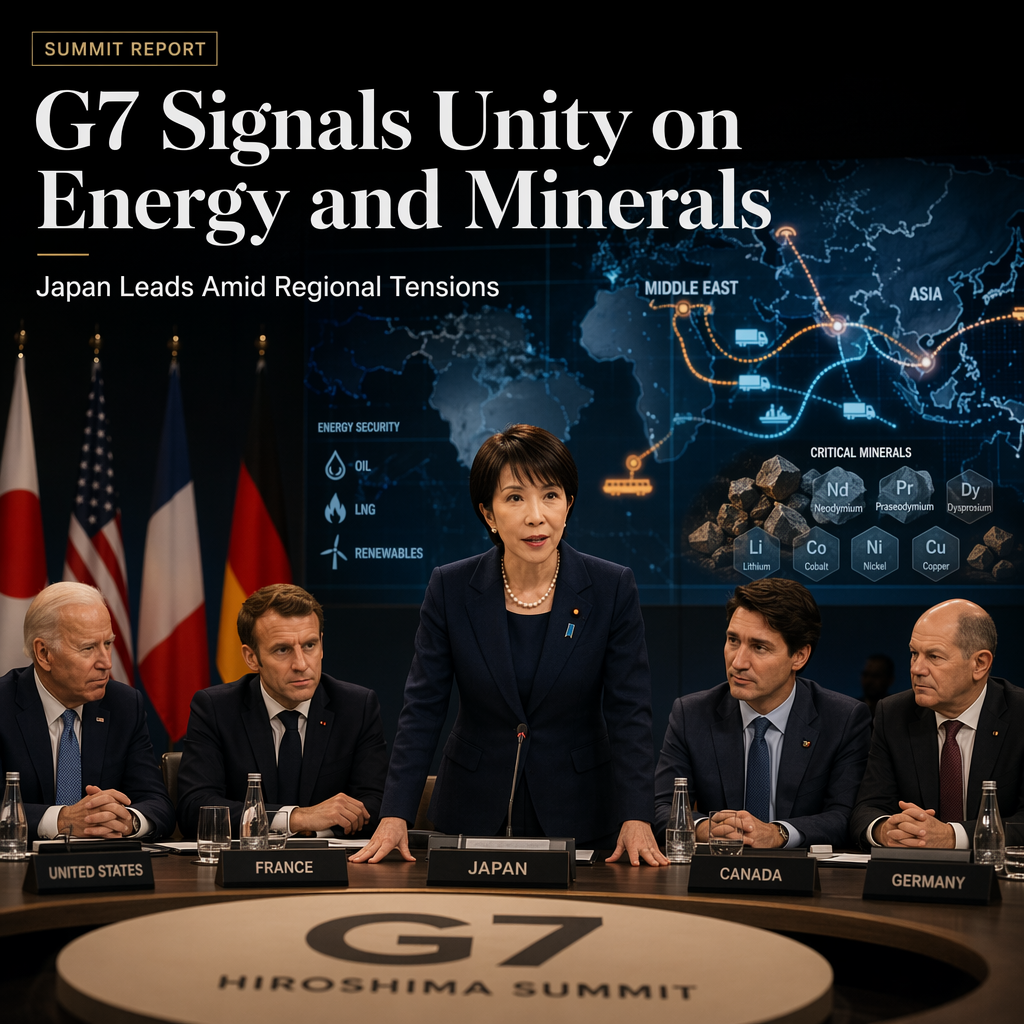
Japanese Prime Minister Sanae Takaichi announced the results of the Group of Seven summit, emphasizing the unified stance of G7 leaders on energy security and the supply chains for critical minerals, including rare earth elements [1]. Takaichi described the summit's joint statements as evidence of the group's resolve to address economic and security challenges, stating, 'We were able to send a clear and united message to the world on energy security. Its significance is immense.' [1]
Takaichi noted that Asia, particularly resource-poor Japan, has been most affected by oil supply disruptions resulting from the U.S.-Israeli war against Iran. Japan relies heavily on the Middle East for crude oil imports [1]. She indicated that Japan must carefully assess the situation in the Strait of Hormuz before deciding on a possible deployment of the Self-Defense Forces, whose mine-sweeping capabilities could be utilized if necessary. This decision would depend on the security situation following a U.S.-Iran agreement to end hostilities. Britain and France have suggested a multinational naval mission to safeguard shipping through the waterway if the ceasefire holds [1].
Progress was reported on Takaichi's proposal for coordinated stockpiling of critical minerals, with fellow G7 leaders supporting closer cooperation in this area [1]. The Japanese leader also raised concerns about regional security, including issues involving China and North Korea's nuclear and missile programs, as well as Pyongyang's past abductions of Japanese citizens. Summit participants engaged in 'extremely frank' discussions on these topics [1].
Regarding strained Japan-China relations following Takaichi's parliamentary remarks last November about a potential Taiwan contingency, she reiterated Japan's goal of building 'constructive and stable' relations with China, emphasizing that dialogue remains open and Japan will respond calmly and appropriately from the perspective of national interests [1]. On domestic policy, Takaichi mentioned ongoing discussions about temporarily reducing the consumption tax on food and beverages to 1 percent, as part of broader social security reform deliberations. The government is closely monitoring these discussions as parties work toward an interim report based on competing policy proposals [1].
CONCLUSION
The G7 summit produced a unified message on energy security and critical minerals, with Japan playing a key role in advancing cooperation. While regional security concerns and strained relations with China remain, Japan is committed to constructive dialogue and careful policy responses. Market implications are medium, given the focus on supply chain resilience and potential changes in domestic tax policy.