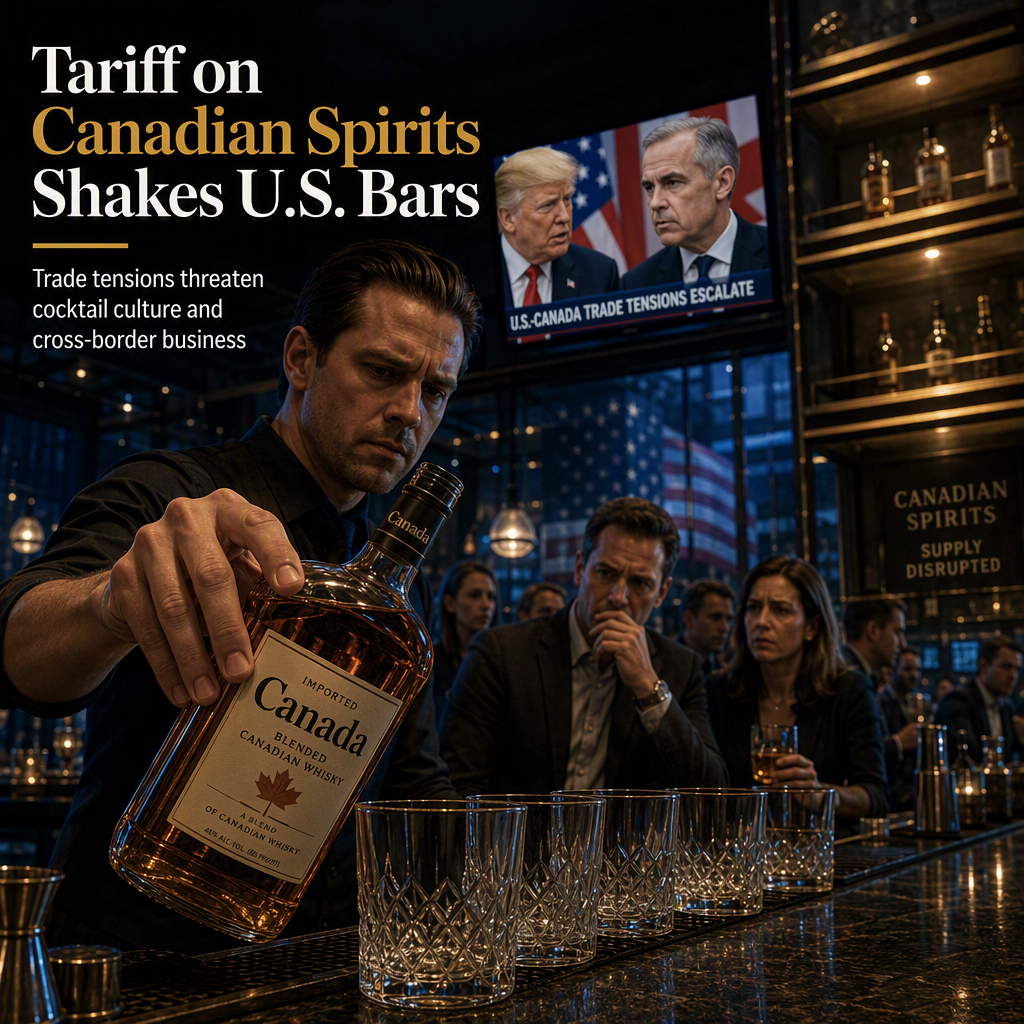
President Donald Trump is threatening to impose a 50% tariff on Canadian spirits, a move that has U.S. bars, restaurants, and liquor stores concerned about the potential impact on their cocktail menus and business operations [1]. The tariff would affect Canadian whisky, vodka, gin, rum, wine, and beer, as well as other imports such as dairy products, vehicles, and hockey equipment, covering approximately $20 billion in Canadian goods [1]. This escalation follows earlier trade tensions, during which Canadian provinces retaliated by removing American spirits from store shelves, causing U.S. spirits exports to Canada to plummet [1].
Chris Swonger, president and CEO of the Distilled Spirits Council, highlighted the severity of the situation, noting that the U.S. industry has lost 73% of its American distilled spirits exports to Canada due to the provincial ban [1]. Canada was previously a $250 million annual market for American distillers, but it dropped from the second-largest destination for U.S. spirits to sixth in 2025. From March through December, exports fell from $203 million in 2024 to $60 million in 2025, representing a $143 million decline [1]. Kentucky, which produces 95% of the world's bourbon and supports over 23,000 industry jobs, has been particularly affected by the fallout [1].
Swonger expressed hope that the threat of steep tariffs could serve as leverage to persuade Canadian officials to reopen their market to U.S. producers, stating, "Considering applying a 50% tariff on Canadian distilled spirits would hopefully be the trigger, the forcing mechanism to get the Canadian province leaders to put American spirits back on the shelves" [1]. Trump and Canadian Prime Minister Mark Carney held last-minute talks on Tuesday in an effort to avert the tariffs before the midnight deadline [1].
The implications of the proposed tariffs extend beyond the distillers, impacting American consumers and hospitality businesses that rely on Canadian spirits for their cocktail offerings [1]. The ongoing trade dispute has already caused significant disruption, and the looming tariffs threaten to further escalate tensions and economic consequences for both countries [1].
CONCLUSION
The proposed 50% tariff on Canadian spirits by President Trump has already caused a sharp decline in U.S. spirits exports to Canada and threatens to further disrupt the hospitality industry and cross-border trade. With last-minute negotiations underway, the market remains highly sensitive to the outcome, as both sides seek a resolution to restore access and stabilize the industry.