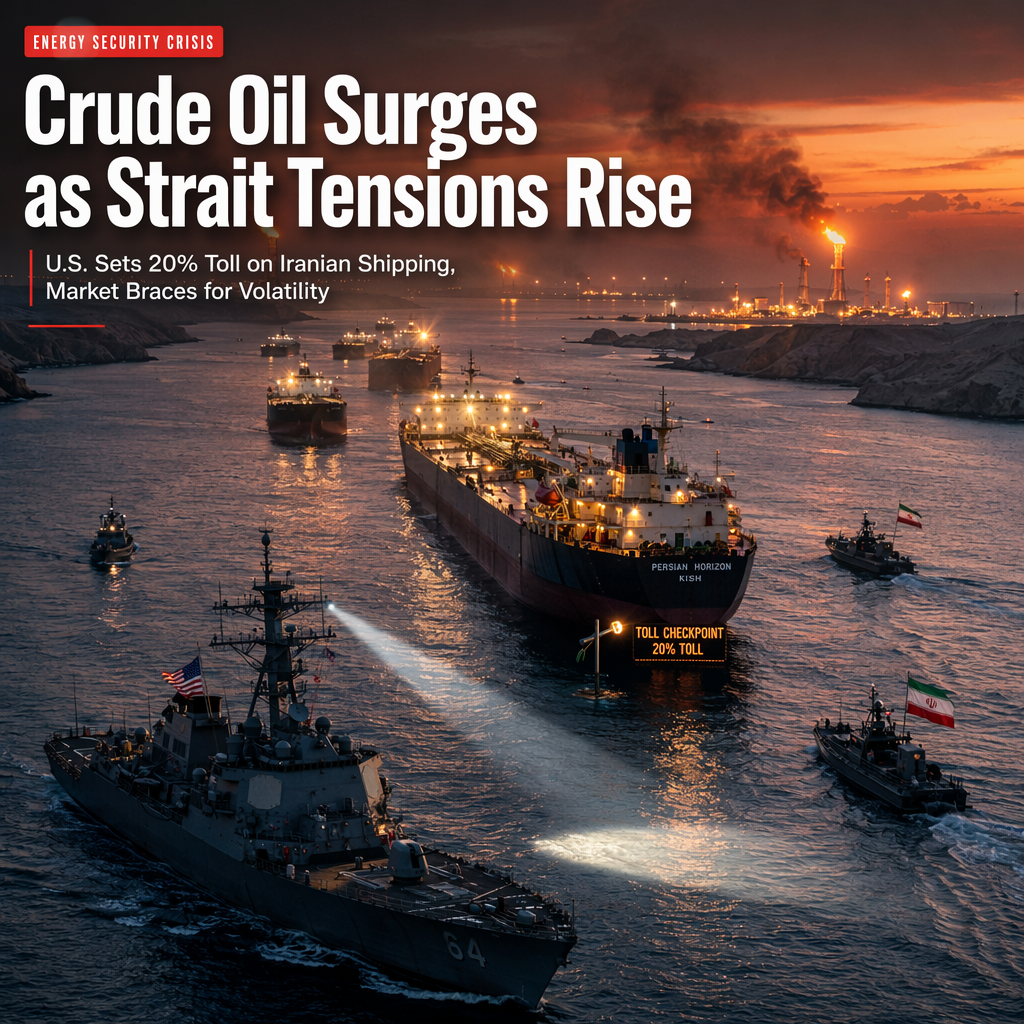
Crude oil markets experienced a sharp repricing following the announcement by former President Trump that the United States will reinstate its blockade of Iranian shipping and impose a 20% toll on every cargo permitted to pass through the Strait of Hormuz [1]. West Texas Intermediate (WTI) crude traded near $75.00 per barrel, marking an increase of close to 5%, while Brent crude approached $80.00. This surge comes after oil prices had recently fallen back to pre-war levels near $67.00 per barrel, as the market had previously priced in three weeks of partial normalization; the latest developments have now reversed nearly all of that normalization [1].
The legal and diplomatic context is complex. A memorandum of understanding (MOU) signed in mid-June explicitly barred Tehran from charging commercial ships for passage through the Strait, a clause that Washington had strongly defended. Oman submitted its position to the International Maritime Organization (IMO), asserting that international law prohibits tolls for passage through the Strait, and the IMO's secretary-general recently stated that charging for Hormuz passage has no legal basis. These arguments were initially directed at Iran's plans to impose fees, but the U.S. announcement mirrors those same plans, raising questions about the legality and long-term implications of the toll [1].
The market reaction is not solely about the 20% levy itself, but rather the breakdown of a rules-based framework for safe passage through the Strait. The announcement signals that neither the U.S. nor Iran is adhering to previously agreed norms, transforming the situation from a temporary war-risk premium to an ongoing revenue dispute with no clear resolution in sight [1]. Freight rates for tankers transiting the Strait are already roughly double those for similar voyages outside the region, due to war-risk insurance premiums. Currently, traffic through the waterway is running at about one-third of its normal pace, and Iranian forces reportedly fired warning shots at two ships attempting passage on Monday morning. Additionally, strikes reached Khuzestan, Iran's main oil-producing province, increasing risks both at the Strait and at the source of supply [1].
The Strategic Petroleum Reserve (SPR) is also at a critical low, sitting at 319.5 million barrels as of the week ending July 3, its lowest level since April 1983. This follows weekly draws of nearly 6 million barrels as part of a 172 million barrel pledge made in coordination with the International Energy Agency's release of 400 million barrels. The SPR now holds less than half its capacity, further heightening concerns about supply security in the event of prolonged disruptions [1].
CONCLUSION
Crude oil prices have surged as the U.S. imposes a 20% toll on Iranian shipping through the Strait of Hormuz, signaling a breakdown in the rules-based framework for international passage. With tanker traffic severely reduced, heightened risks on both sides of the Strait, and the Strategic Petroleum Reserve at historic lows, the market is bracing for ongoing volatility and uncertainty.