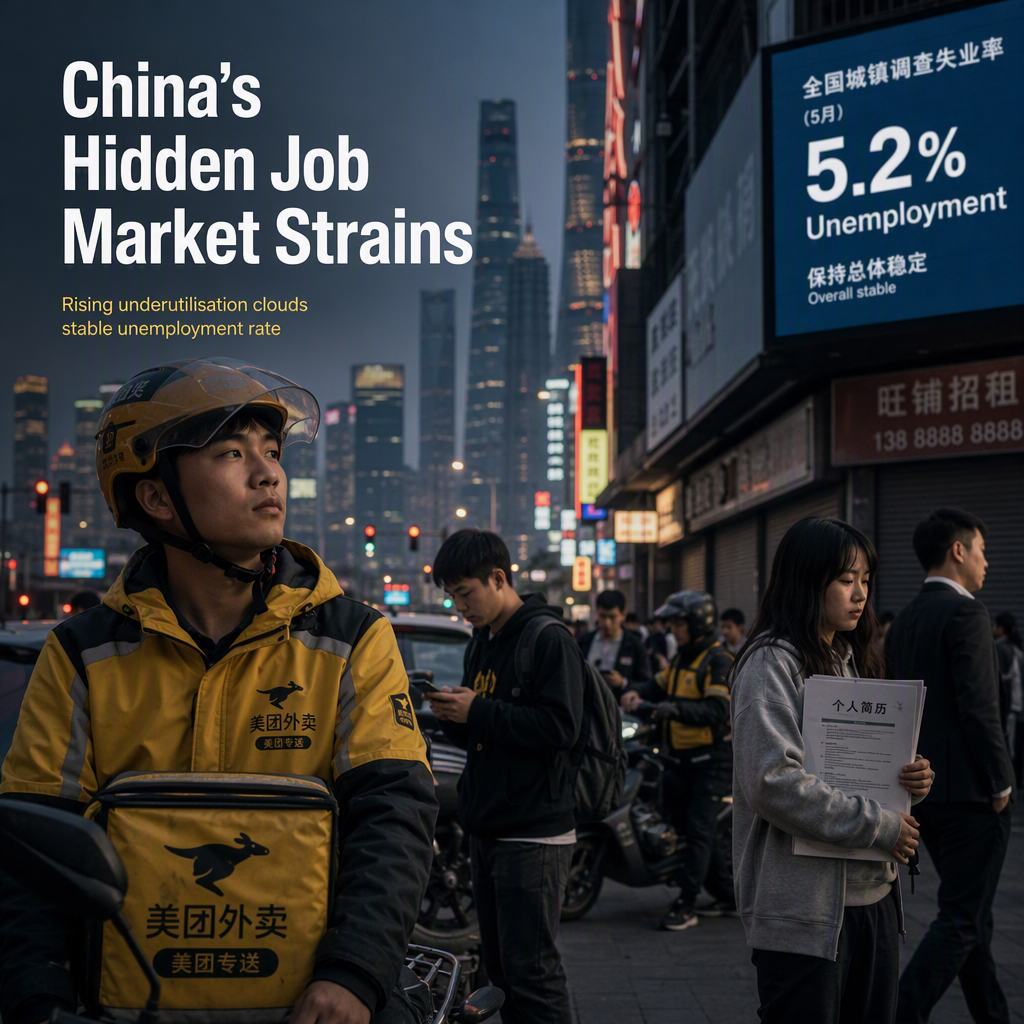
Standard Chartered economists Hunter Chan and Shuang Ding report that China's urban surveyed unemployment rate has remained within a narrow 5.0-5.4% range over the past three years, even as the country experiences slower growth momentum, a prolonged property downturn, and elevated external uncertainty [1]. Despite this apparent stability, the economists highlight that broader labour underutilisation has increased, with their estimate placing the rate at 7.1% in 2024. This broader measure includes not only the unemployed but also discouraged workers who have stopped seeking employment due to perceived lack of opportunities, similar to the U-4 measure in the United States [1].
The report notes that persistently weak consumer confidence, soft consumption growth, and elevated youth unemployment indicate that the headline unemployment rate may not fully capture the extent of job-market challenges in China [1]. The rise in discouraged workers and underemployment is seen as a significant factor weighing on household consumption growth. Additionally, the number of flexible workers—such as delivery riders, ride-hailing drivers, and gig workers—is projected to reach 280 million in 2025. While these workers are officially counted as employed, they often face lower income stability, weaker labour protection, and incomplete social security coverage compared to those in traditional employment, which likely dampens their consumption appetite [1].
Standard Chartered's economists suggest that improving labour protection and social security coverage for flexible workers could help reduce precautionary savings and support consumption. They also recommend vocational training and reskilling initiatives to mitigate the impact of economic transformation and advancements in artificial intelligence on the workforce [1].
CONCLUSION
Although China's official unemployment rate appears stable, broader labour underutilisation and the challenges faced by flexible workers are exerting downward pressure on household consumption. Addressing these structural issues through enhanced social protection and workforce development could be key to supporting future consumption growth.