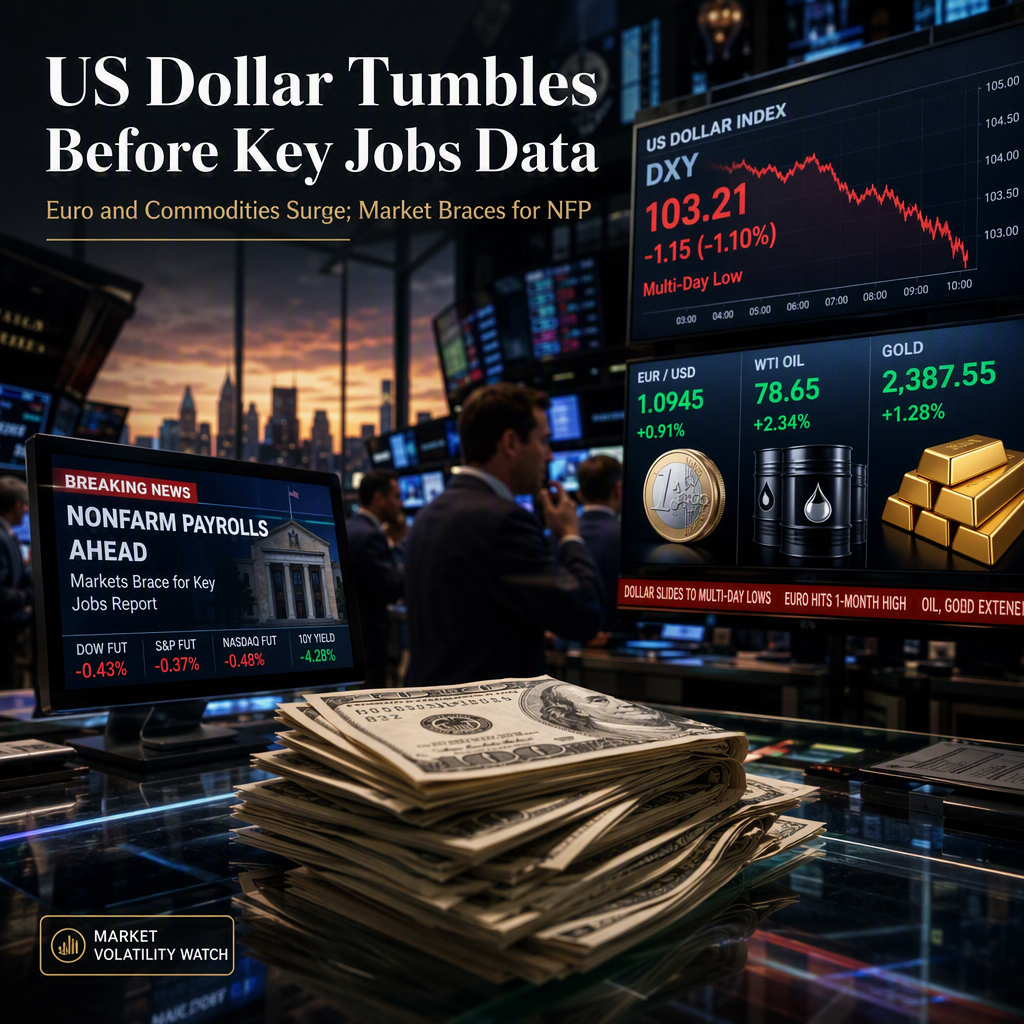
The US Dollar (USD) continued its decline, extending losses from Wednesday and falling to multi-day lows, breaching below its key 200-day simple moving average (SMA) and the 99.00 support level on the US Dollar Index (DXY) [1]. This retracement is attributed primarily to increased market speculation about an imminent rate hike by the Bank of Japan (BoJ), which has overshadowed ongoing geopolitical concerns and caution ahead of the US Nonfarm Payrolls (NFP) data release [1].
The EUR/USD pair saw significant gains, surpassing the 1.1600 mark to reach four-day highs, driven by the pronounced weakness in the US Dollar [1]. Similarly, GBP/USD rebounded to reclaim the 1.3550 region, hitting two-day highs after two consecutive days of losses [1]. The USD/JPY pair collapsed to levels last seen in early August near 155.00, reflecting rising bets on a BoJ rate hike at its next meeting [1]. The AUD/USD also advanced, marginally exceeding the 0.7200 level to challenge multi-week highs amid the ongoing downward trend in the US Dollar [1].
Commodities responded strongly to the dollar's weakness. WTI crude oil prices surged above $93.00 per barrel for the first time since late July, supported by escalating tensions on the US-Iran-Hormuz front and the marked sell-off in the Greenback [1]. Gold prices broke above the key $4,500 per troy ounce level, benefiting from the US Dollar's retracement, declining US Treasury yields, and persistent jitters in the Middle East [1].
Looking ahead, the market's focus is firmly on the upcoming US Nonfarm Payrolls, Unemployment Rate, and wage inflation data, which are expected to be the main drivers at the end of the week [1]. Additional economic releases include Germany's Factory Orders, S&P Global Construction PMI for Germany and the euro area, and Retail Sales data in the eurozone. In the UK, the S&P Global Construction PMI and the Bank of England's Decision Maker Panel (DMP) survey are due, while Japan will see Household Spending figures and advanced economic indexes. Australia will release its Consumer Confidence index and housing data on September 8 [1].
CONCLUSION
The US Dollar's sharp decline has fueled gains in major currencies and commodities, with markets now awaiting the pivotal US Nonfarm Payrolls data. The anticipation of a BoJ rate hike and ongoing geopolitical tensions are adding to market volatility. Investors are closely monitoring upcoming economic releases for further direction.