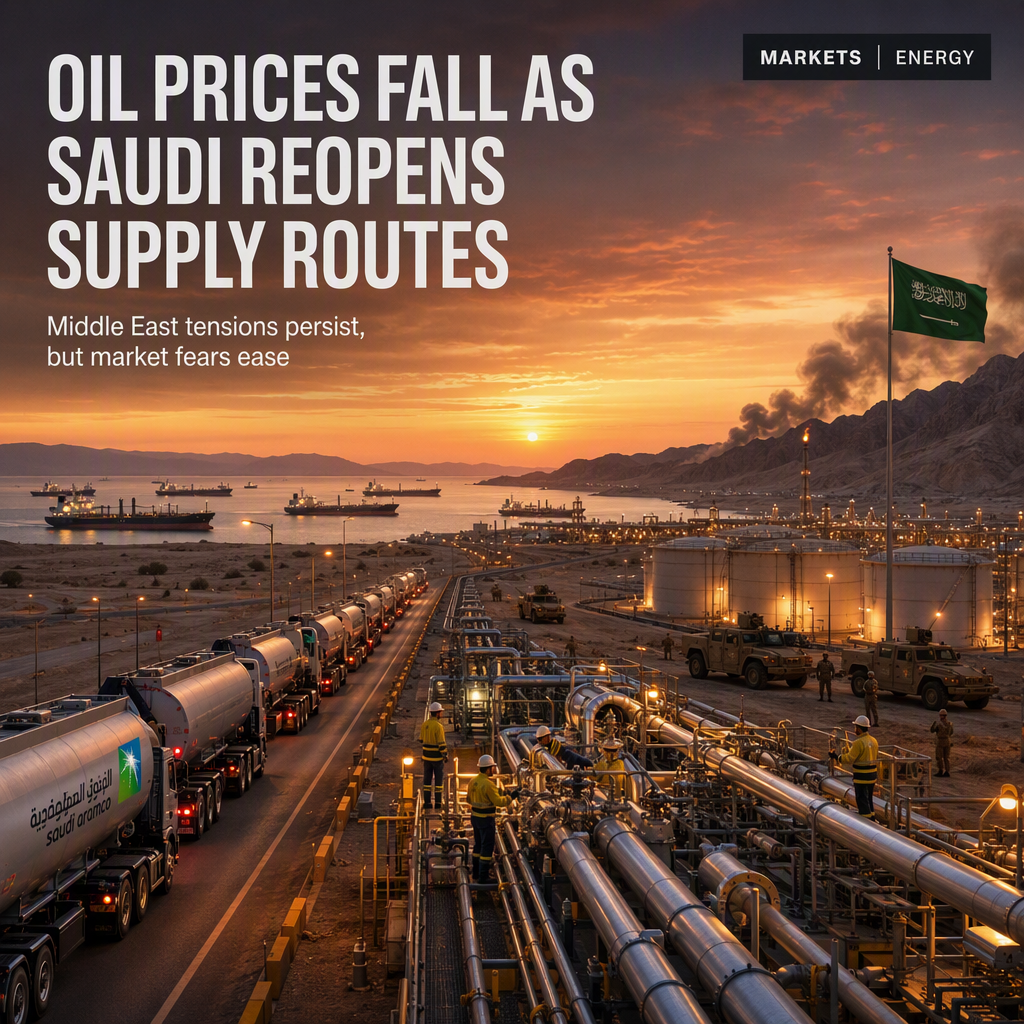
Oil prices declined on Friday as concerns over Middle East supply disruptions eased, despite ongoing conflict between Saudi Arabia and Yemen's Iran-backed Houthi militants [1][2]. West Texas Intermediate (WTI) crude traded around $96.40 per barrel during Asian hours, marking its third consecutive day of subdued performance [1]. U.S. WTI futures were down 0.88% to $101.01 per barrel, while Brent crude futures fell 0.94% to $103.83 per barrel [2].
The easing of supply fears was attributed to Saudi Arabia's efforts to restore its energy infrastructure, specifically targeting the recovery of roughly half the capacity of its East-West pipeline within days and aiming for a full return to operations within six weeks [1]. In the interim, Saudi Arabia has rerouted some crude exports through the Strait of Hormuz using shuttle vessels, and has also found alternative delivery routes to Asian buyers via Oman [1][2]. These logistical improvements have reduced the market's assessment of supply risk, leading to a partial unwinding of the geopolitical risk premium in oil prices, according to Simon-Peter Massabni, head of business development at XS.com [2].
Despite these measures, the Middle East supply network remains vulnerable. Fresh attacks between Saudi Arabia and the Houthis on Thursday raised concerns about further disruptions, especially given the region's sensitivity around key export routes such as the Strait of Hormuz [2]. Diplomatic efforts are ongoing, with reports that China has urged Iran to restrain Houthi militants following an appeal from Riyadh, and U.S. President Donald Trump stating he is evaluating whether to resume military attacks on Iran ahead of a meeting with Gulf leaders [1].
Strategists at Societe Generale noted that lower oil and gas prices provided some relief to the bond market following a hawkish Federal Reserve rate hike, with 10-year U.S. Treasury yields dipping to 4.94% before recovering to 5.02% in Asia [1]. Looking ahead, Massabni expects oil prices to remain highly sensitive to geopolitical developments rather than traditional supply-and-demand factors. Continued Saudi crude flows to Asia and progress in restoring the East-West pipeline could further pressure prices downward, while renewed disruptions could quickly revive the risk premium [2].
CONCLUSION
Oil prices have fallen as Saudi Arabia's efforts to restore and reroute crude shipments have eased immediate supply concerns, despite ongoing regional conflict. Market sentiment remains cautious, with prices expected to stay highly responsive to geopolitical developments and the pace of infrastructure recovery.