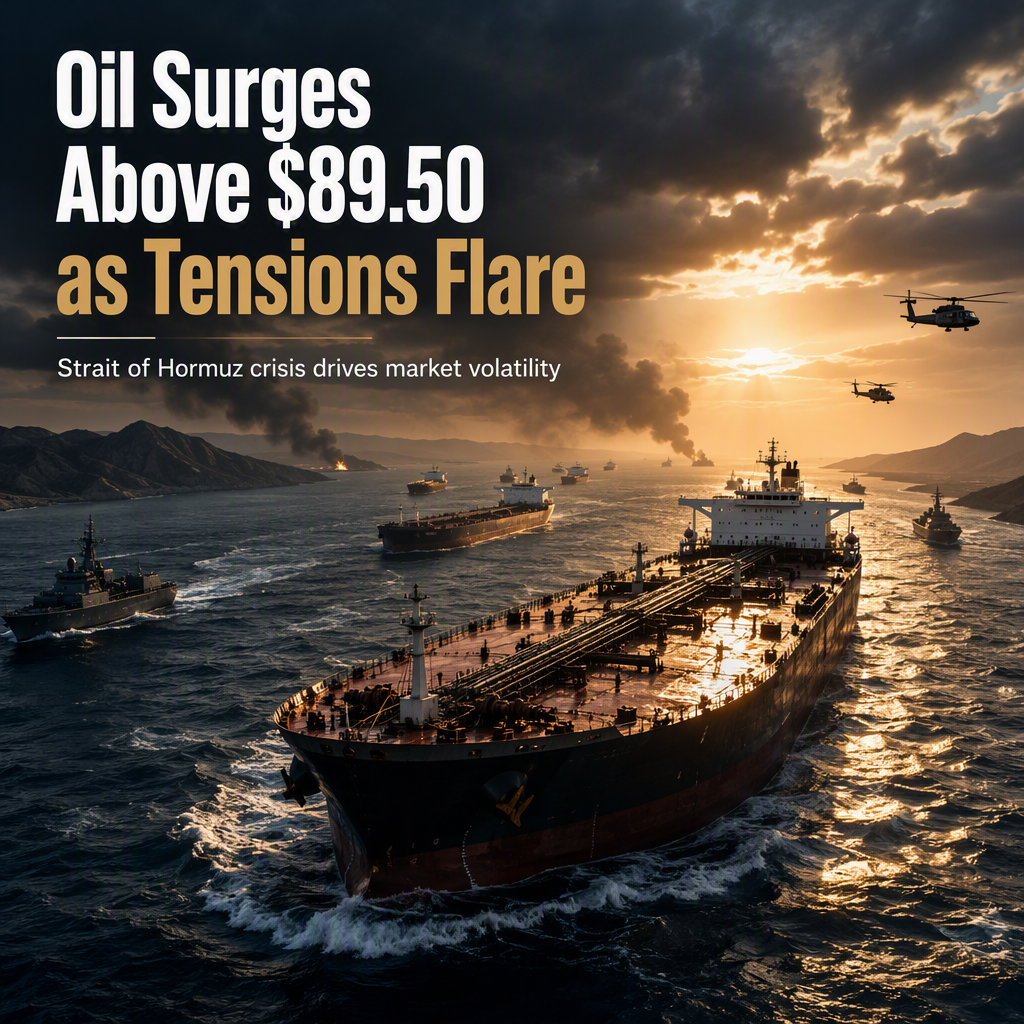
West Texas Intermediate (WTI) oil prices rebounded, trading around $89.60 during Asian hours on Thursday, after previous losses. This recovery is attributed to renewed hostilities in the Middle East, particularly around the strategic Strait of Hormuz, a critical chokepoint for global oil shipments [1]. US President Donald Trump announced fresh strikes against Iranian targets near the Strait of Hormuz, describing them as retaliation for Tehran’s attempts to lay mines in the waterway and a prior attack on a US military base. Trump warned that the US is prepared for a significantly larger military response if Iran retaliates. In response, Iran claimed to have already targeted US bases across the region and launched missiles toward Jordan [1].
US Treasury Secretary Scott Bessent stated that Iran’s economy has entered an 'acceleration phase' of bankruptcy, but emphasized that 17 million barrels of crude oil passed through the Strait of Hormuz on Monday, indicating that Tehran does not control the vital trade corridor [1]. Strategists at BNY highlighted that the latest US action marks the first time the US has targeted Iranian tankers in retaliation for attacks on ships in the Strait of Hormuz, rather than for violating a naval blockade. This shift in policy has contributed to a surge in geopolitical risk premia embedded in benchmark oil prices [1].
The market implications are significant, as the escalation in the Strait of Hormuz—a passageway for a substantial portion of the world’s oil supply—has heightened concerns over potential supply disruptions. The increase in geopolitical risk has been directly reflected in the recent gains in WTI oil prices [1].
No forward-looking statements or analyst opinions beyond the BNY strategists' commentary on the policy shift and its impact on risk premia were provided in the article [1].
CONCLUSION
WTI oil prices have surged above $89.50 as renewed US-Iran hostilities in the Strait of Hormuz raise concerns over global oil supply security. The US's new approach of targeting Iranian tankers marks a significant policy shift, amplifying geopolitical risk and driving up oil prices. Market participants are closely monitoring the situation for further escalation and its potential impact on energy markets.