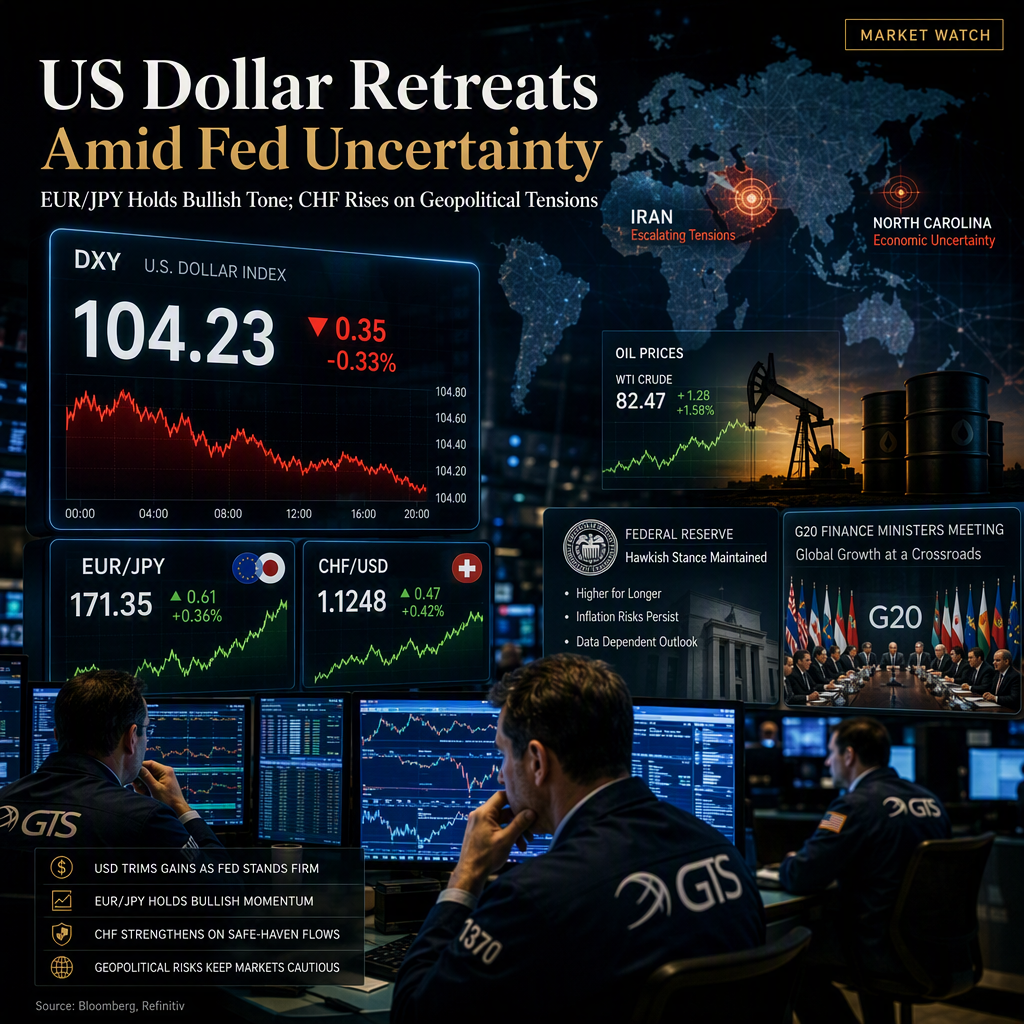
On Monday, the US Dollar Index (DXY) retreated from Friday's two-week high, trading just above the mid-99.00s and down nearly 0.15% for the day, as sellers emerged at the start of the European session [2]. The recent rally was driven by unexpectedly hawkish remarks from Federal Reserve Chair Kevin Warsh at the Jackson Hole Symposium, where he stated that policymakers have 'work to do' to bring inflation towards the 2% target [3]. This shifted market perceptions, with a September Fed rate hike now seen as considerably more likely, although Commerzbank's Thu Lan Nguyen cautioned that it is 'by no means a done deal,' advising against 'jumping on the USD euphoria too quickly' [3]. Technical analysis shows the DXY faced resistance at the 99.70-99.75 confluence, which includes the 100-day SMA and the 38.2% Fibonacci retracement, while the MACD turned slightly positive and the RSI hovered near 47, indicating stabilizing momentum but not enough to overcome overhead resistance [2].
The EUR/JPY cross extended losses for the second consecutive day, trading around 185.20 during European hours, and remained below the nine-day EMA near 185.50 [1]. Despite the pullback, EUR/JPY maintains a mildly bullish near-term bias, holding above the 50-day EMA, with the 14-day RSI at 53.17 suggesting a constructive upside tone as long as trend support holds [1]. Immediate resistance is at the nine-day EMA of 185.30, and a rebound above this level could target the all-time high of 187.95 set on April 17, followed by the upper boundary of the ascending channel at 188.90 [1]. On the downside, support is at the lower boundary of the ascending channel at 185.10 and the 50-day EMA at 184.81; a break below could trigger a bearish reversal toward the nine-month low of 179.37 recorded on August 3 [1]. The Euro was the weakest against the Japanese Yen among major currencies on Monday [1].
The Swiss Franc (CHF) edged up from 0.8100 as the US Dollar trimmed Friday’s gains, reflecting moderate CHF strength in early European trading [3]. While rising tensions in Iran and higher oil prices are supporting the safe-haven US Dollar, USD/CHF bulls lost momentum as traders reassessed the likelihood of a September Fed rate hike following Warsh's comments [3]. Market focus is shifting to geopolitical developments, including the G20 meeting in North Carolina and US Treasury Secretary Scott Bessdent's efforts to persuade leading economies to sever ties with Iran [3]. Upcoming Swiss economic data, such as Retail Sales, CPI, and Q2 GDP, are expected to be watched closely but are unlikely to alter expectations that the Swiss National Bank will keep rates steady at 0% [3].
Across major currencies, the US Dollar was strongest against the Australian Dollar, while the Euro was weakest against the Japanese Yen on Monday [1][2]. The broader backdrop remains unchanged since the last Fed meeting, and analysts note that upcoming US data releases and developments in the Iran conflict could further influence Dollar strength [3].
CONCLUSION
The US Dollar's rally following hawkish Fed comments is losing steam as market participants reassess the likelihood of a September rate hike. EUR/JPY remains mildly bullish but faces technical resistance, while the Swiss Franc gains moderately amid geopolitical uncertainty. Market sentiment is cautious, with analysts emphasizing the importance of upcoming US data and geopolitical developments for future currency moves.