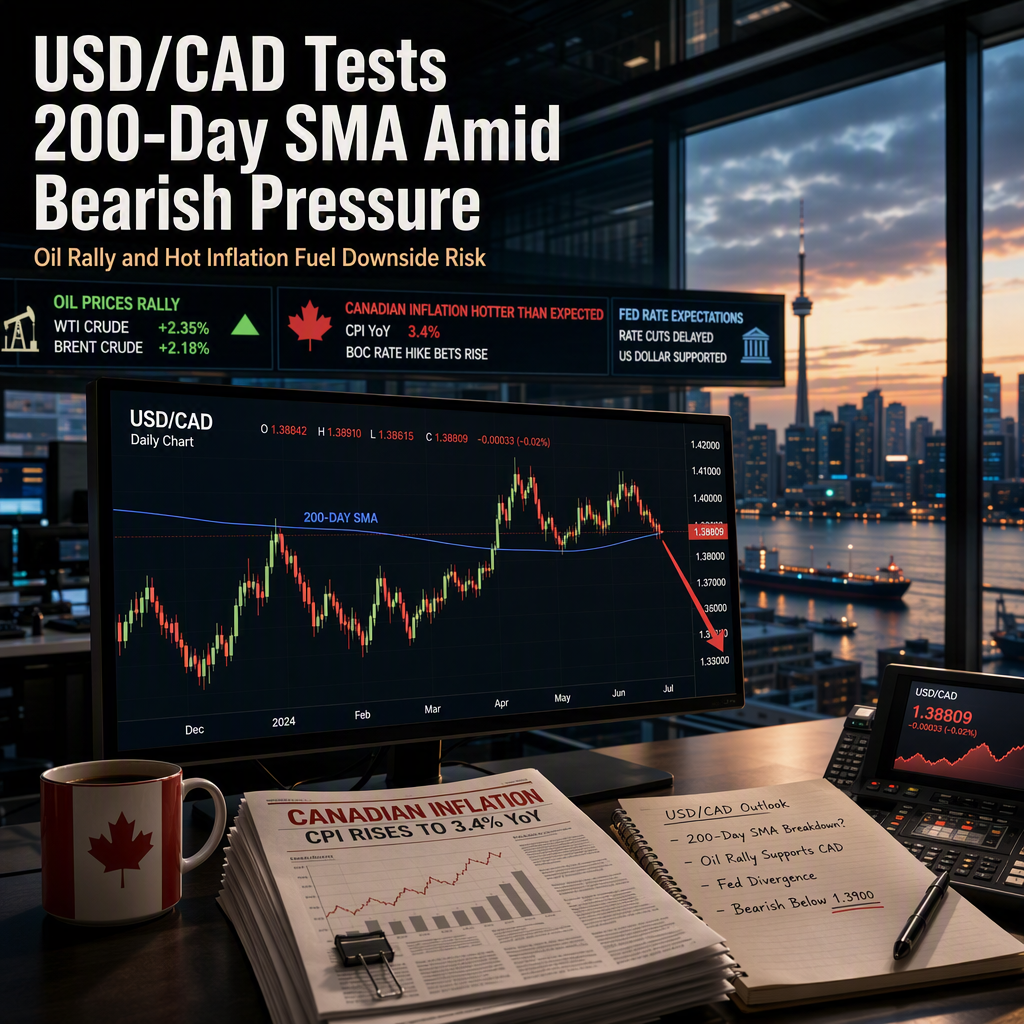
The USD/CAD currency pair is consolidating below the 1.3900 level, trading in a narrow range around 1.3870-1.3875 during the early European session on Tuesday, after failing to build on its overnight bounce from the lowest level since June 3 near 1.3845, which aligns with the 200-day Simple Moving Average (SMA) support [1]. The pair's downside is cushioned by a strong US Dollar recovery from a two-month low, driven by expectations of at least one more US Federal Reserve rate hike due to oil-driven inflation risks [1].
Crude oil prices have surged to a more than two-week high amid tensions between the US and Iran over the Strait of Hormuz. This, combined with Monday's hotter-than-expected Canadian consumer inflation data, is supporting the commodity-linked Canadian Dollar and providing a tailwind for USD/CAD [1]. Despite these factors, technical momentum indicators point to a prevailing bearish sentiment: the Relative Strength Index (RSI) is in oversold territory near 29, and the MACD remains negative, reinforcing the negative outlook for the pair [1].
The USD/CAD has found acceptance below the 50% Fibonacci retracement level of the April-June rally, further validating the bearish case. A decisive break below the 200-day SMA at 1.3848 could open the door for deeper losses toward the 61.8% Fibonacci level at 1.3822, with further downside targets at the 78.6% level (1.3708) and the structural floor near 1.3562 [1]. On the upside, resistance levels are seen at 1.3902 (50% retracement), 1.3982 (38.2%), and 1.4081 (23.6%), with the cycle high at 1.4242 as a distant barrier [1].
No explicit analyst opinions or forward-looking statements are provided beyond the technical outlook, but the article notes that the market is watching for a convincing break below the 200-day SMA to confirm further downside [1].
CONCLUSION
USD/CAD remains under pressure below 1.3900, with technical indicators and recent Canadian inflation data supporting a bearish outlook. A break below the 200-day SMA could trigger further declines, while oil price strength and US rate hike expectations continue to influence the pair. Market participants are closely monitoring key technical levels for confirmation of the next move.