
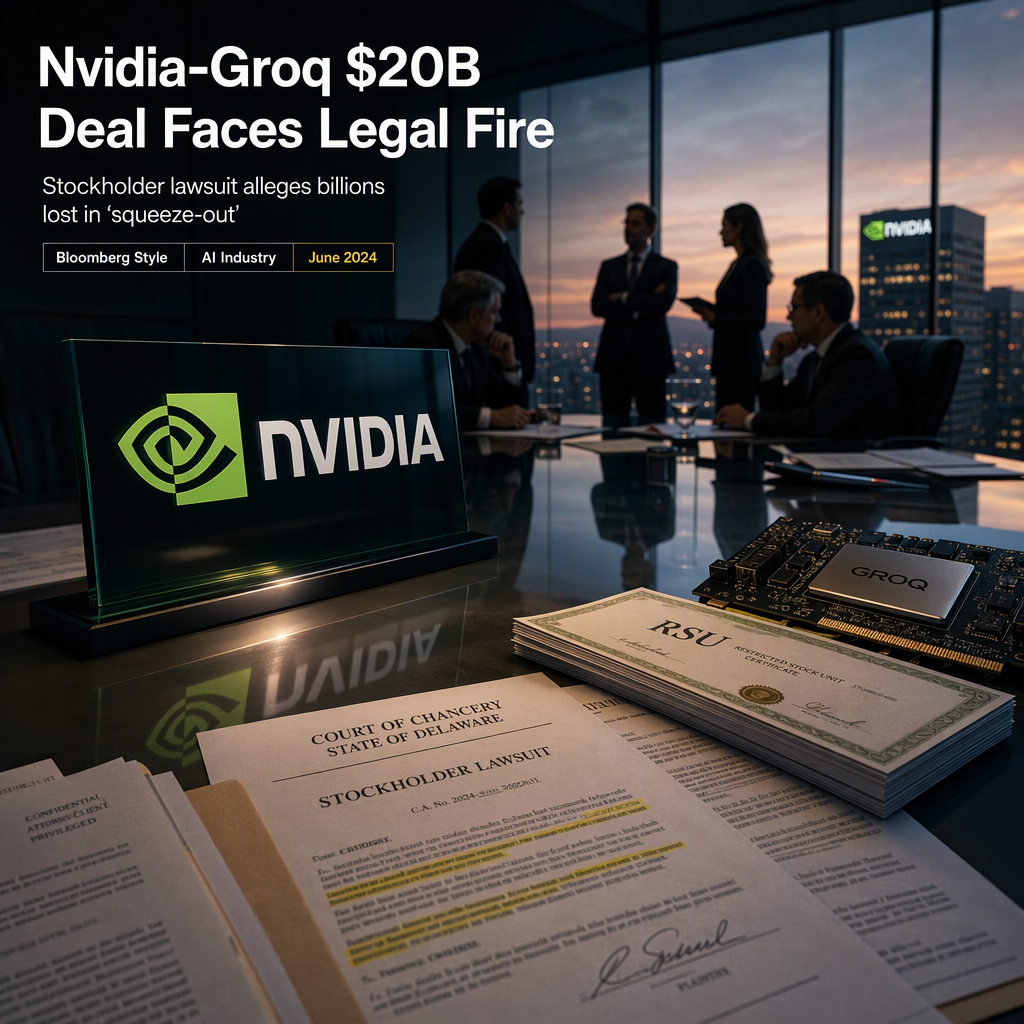
Nvidia's $20 billion deal to acquire assets from Groq, an AI chip designer, is facing legal scrutiny as former Groq engineers Joshua Rubin and Benjamin Serebrin filed a lawsuit alleging that the transaction 'squeezed out' stockholders and cost them 'billions of dollars' [1]. The lawsuit, filed on October 2 at the Court of Chancery of the State of Delaware, claims Groq's board approved the deal without the required stockholder vote and without a process to maximize the value of what Nvidia purchased [1]. Rubin and Serebrin, who left Groq before the deal but held stock in the company, argue that the board's 'conflicted choice' benefited certain investment funds and board members at the expense of other stockholders [1].
The deal itself involved Nvidia allocating $17 billion to a non-exclusive license for Groq's inference technology and an additional $3 billion in Nvidia restricted stock units (RSUs) for Groq employees who transitioned to Nvidia, totaling $20 billion [1]. Approximately 150 to 200 Groq engineers became Nvidia employees as part of the agreement [1]. Groq founder and CEO Jonathan Ross, along with president Sunny Madra and other senior leaders, joined Nvidia, while Groq stated it would continue as an 'independent company' and has raised around $1 billion since June, including investments from Nvidia [1].
Groq's spokesperson responded to the lawsuit, stating, 'Our licensing agreement with NVIDIA delivered exceptional value for Groq, our investors, and our employees. This lawsuit is meritless and we will vigorously defend ourselves against it. We remain focused on serving our customers and building the world's leading AI inference cloud' [1]. Nvidia has been approached for comment, but no response was provided in the article [1].
Nvidia CEO Jensen Huang, in an email to employees, highlighted the strategic benefits of the deal, noting that Groq's low-latency processors would be integrated into Nvidia's AI factory architecture to expand the platform's capabilities for AI inference and real-time workloads [1].
CONCLUSION
The lawsuit against Nvidia and Groq raises significant questions about the fairness and process of the $20 billion deal, with allegations of stockholder disenfranchisement and board conflicts. While Groq defends the agreement as highly valuable, the legal challenge could impact perceptions of Nvidia's acquisition strategy and governance. The market is likely to closely monitor developments, given the scale of the transaction and the involvement of key AI technology and personnel.