
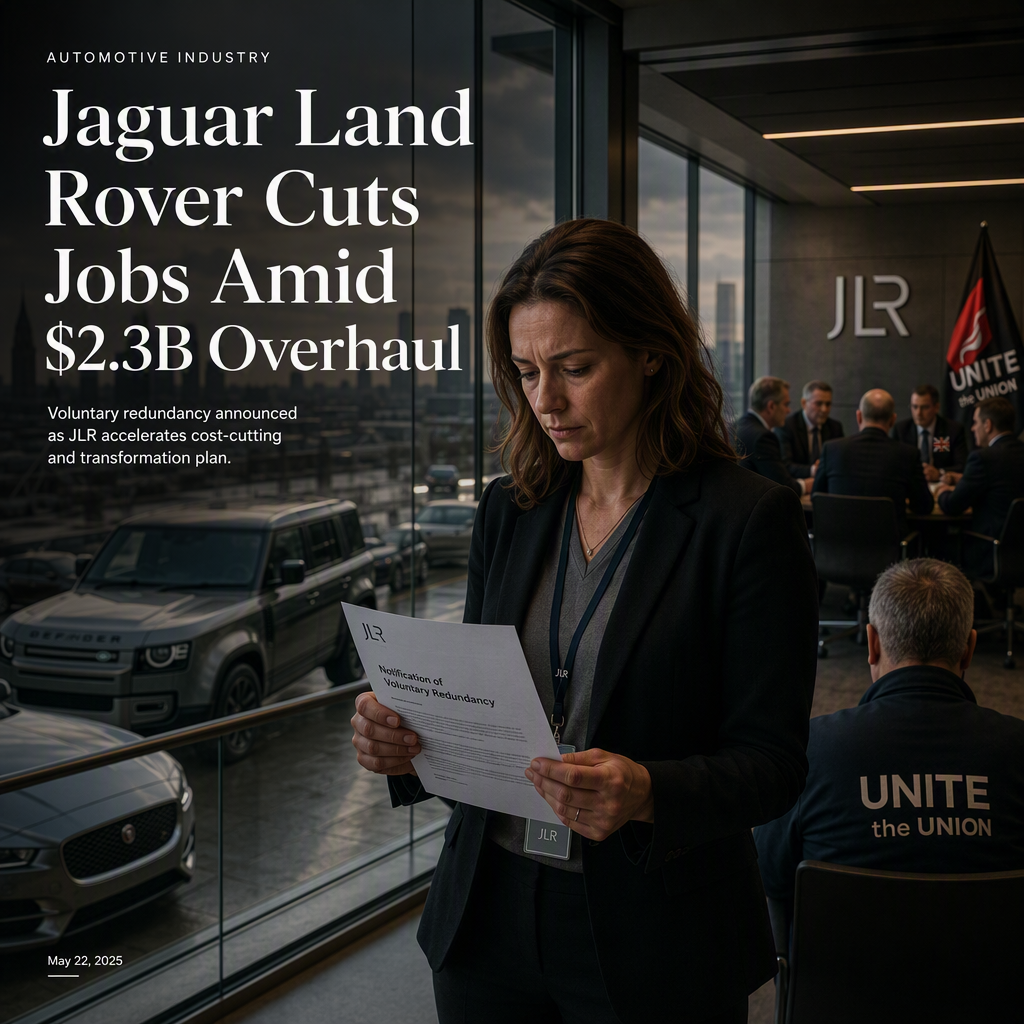
Jaguar Land Rover (JLR), owned by Tata Motors, has initiated a voluntary redundancy program targeting salaried and management staff as part of a multibillion-dollar cost-cutting campaign aimed at lowering its global operational break-even threshold to 300,000 vehicles annually [1]. While British media reports suggest the two-year operational overhaul could affect up to 4,000 non-assembly positions within JLR's 30,000-strong U.K. workforce, the company clarified that hourly assembly line workers at its main manufacturing sites are not included in the program [1].
A JLR spokesperson stated, "To achieve this next phase, we must further simplify our organization, improve efficiency, and build greater resilience while adapting to evolving global market conditions" [1]. The restructuring comes amid mounting financial and operational pressures, including a 10% tariff on U.S. vehicle imports that has squeezed profit margins and increased competition in the U.K. from lower-cost Chinese electric vehicles such as Chery's Jaecoo 7 SUV [1].
The cost-cutting measures follow a significant cyberattack late last year, which forced JLR to temporarily halt production at several international facilities. This incident led to a 27% drop in output and an estimated $2.5 billion (£1.9 billion) negative impact on the broader British economy [1].
U.K. Business Secretary Jonathan Reynolds confirmed plans to meet with JLR CEO PB Balaji and Unite the Union representatives, emphasizing that government support would not be provided to simply bail out the company but would focus on ensuring competitiveness [1]. Unite General Secretary Sharon Graham also stated that union leaders will participate in discussions to protect hourly factory workers from compulsory job losses [1].
CONCLUSION
Jaguar Land Rover's voluntary redundancy program marks a significant step in its $2.3 billion cost-cutting initiative, reflecting ongoing financial pressures and operational challenges. The move is expected to reshape the company's workforce and operational structure, with government and union engagement focused on safeguarding key manufacturing roles and ensuring long-term competitiveness.