
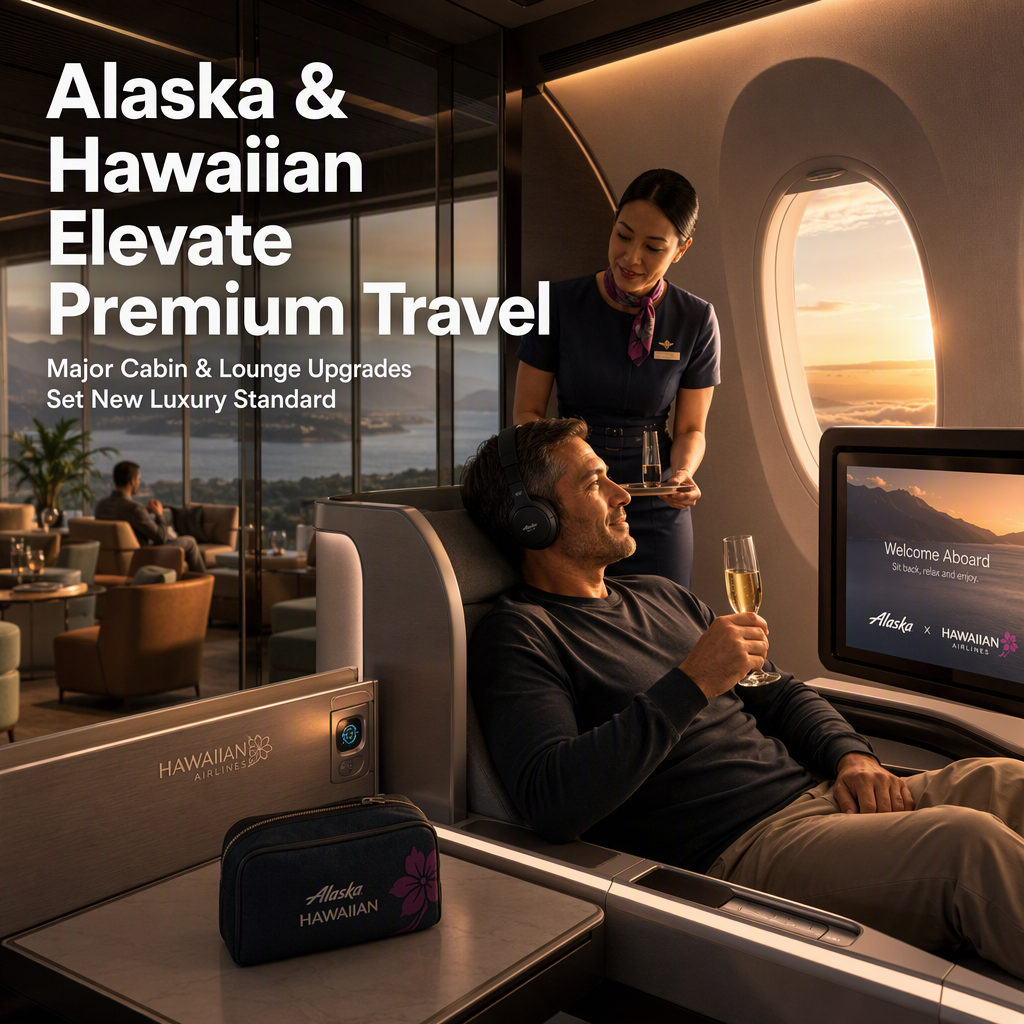
Alaska Airlines has announced a significant overhaul of its Alaska and Hawaiian Airlines cabins, introducing new top-tier suites, a premium-economy class, and expanded airport lounges. This initiative follows the completion of Alaska's merger with Hawaiian Airlines in September 2024, though both airlines will continue to operate as distinct brands [1]. The overhaul is part of a broader industry trend to increase the number of higher-priced seats and enhance premium offerings, aiming to capitalize on travelers' willingness to pay for luxury and boost profits into the next decade [1].
Key details of the upgrade include the introduction of 34 lie-flat Aurora suites and 35 Premium Reserve premium-economy seats on Alaska's Boeing 787-9 and 787-10 aircraft, starting in 2028. Additionally, at least 25 Boeing 737 Max 10s will feature 12 Aurora suites and premium-economy seating to compete on lucrative cross-country routes. Hawaiian Airlines will retrofit its 24 Airbus A330s with 22 new first-class suites with sliding doors and introduce its first premium-economy section with 28 seats, also beginning in 2028 [1].
The carrier is investing in new airport lounges, including a 41,000-square-foot Alaska lounge at Seattle-Tacoma International Airport with dedicated space for Aurora suite flyers, and a nearly 13,000-square-foot lounge in Honolulu's Terminal 1, set to open in early 2028 [1]. Alaska Airlines stated that it is two-thirds of the way toward its goal of $1 billion in added profit from the end of 2024 to the end of 2027. The company forecasts that higher-margin products—such as premium seats, international flights, loyalty programs, and cargo—will account for nearly 60% of total revenue by 2030, up from 53% currently [1].
Investors are expected to closely monitor how these new offerings impact Alaska's co-branded credit card and loyalty program, which have already generated billions for the airline industry. The announcement comes ahead of Alaska's investor day in Seattle, where executives will address questions about the new products, the impact of rising jet fuel costs, and the airline's path to its profit targets [1].
CONCLUSION
Alaska Airlines' and Hawaiian's premium cabin overhaul marks a major strategic investment aimed at capturing higher-margin revenue and enhancing customer experience. With substantial upgrades to aircraft and lounges, and a clear focus on premium offerings, the airlines are positioning themselves for long-term profit growth and competitive advantage in the high-end travel market.