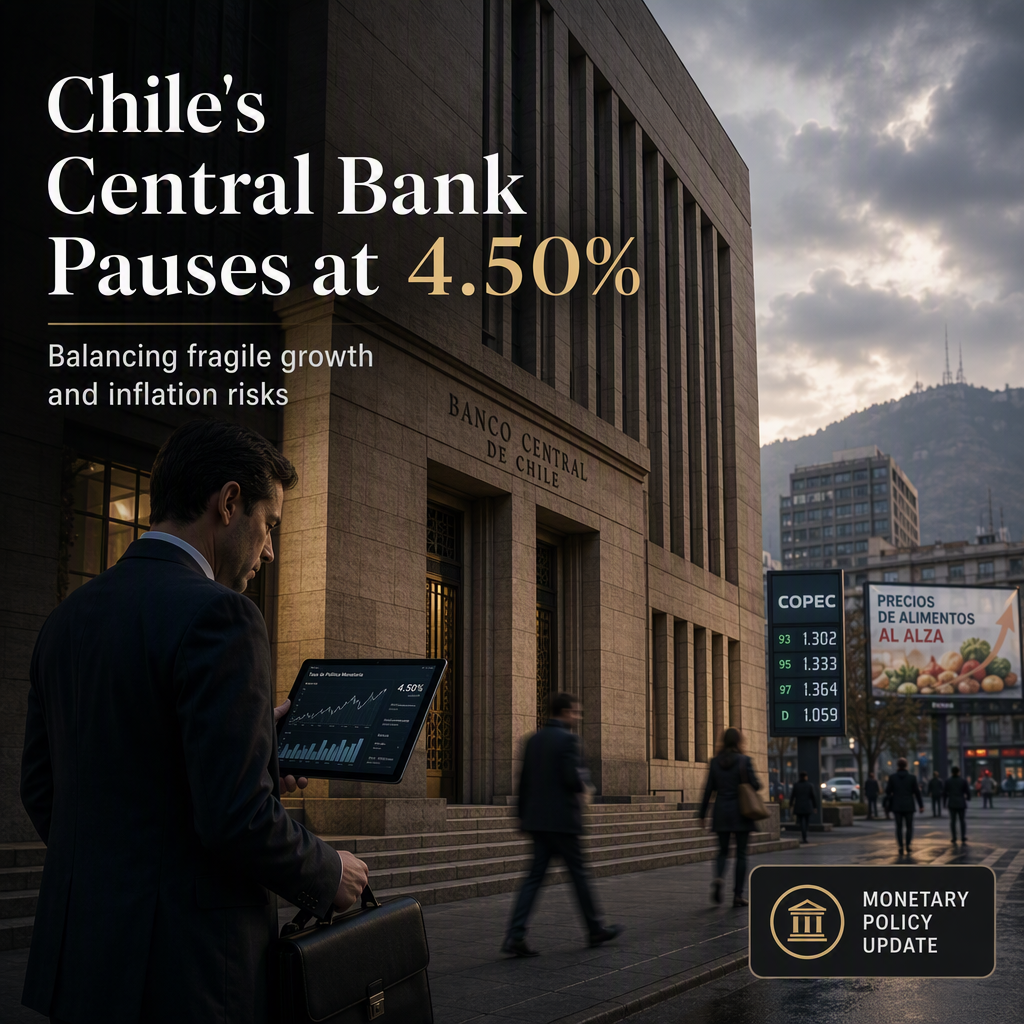
The Central Bank of Chile (BCCh) decided to keep its monetary policy rate (MPR) unchanged at 4.50% during its September meeting, a move that was in line with both Societe Generale's and market consensus expectations [1]. According to Societe Generale’s Dev Ashish, the decision reflects the central bank's response to weak domestic growth, disappointing economic activity, and a deteriorating labor market, despite rising external inflation risks such as higher oil prices and potential tightening by the U.S. Federal Reserve [1].
The BCCh emphasized that inflation expectations remain anchored, and policymakers are opting to wait for greater clarity before making any further adjustments to policy. The tone of the meeting was described as somewhat less dovish than anticipated, indicating a cautious approach in the face of increased risks [1]. Societe Generale expects the central bank to maintain this extended pause at 4.50%, with future policy moves contingent on significant changes in inflation expectations or a clearer recovery in Chilean economic activity [1].
While the risk of future rate hikes remains due to external factors, the persistent weakness in domestic growth and employment suggests that near-term tightening is unlikely. The central bank is expected to continue balancing elevated inflation risks against the backdrop of a still-fragile economy [1].
CONCLUSION
The Central Bank of Chile's decision to hold rates at 4.50% signals a cautious stance amid conflicting pressures from weak domestic growth and rising external inflation risks. Market participants should expect the policy pause to continue until there is a notable shift in inflation expectations or a stronger economic recovery emerges.