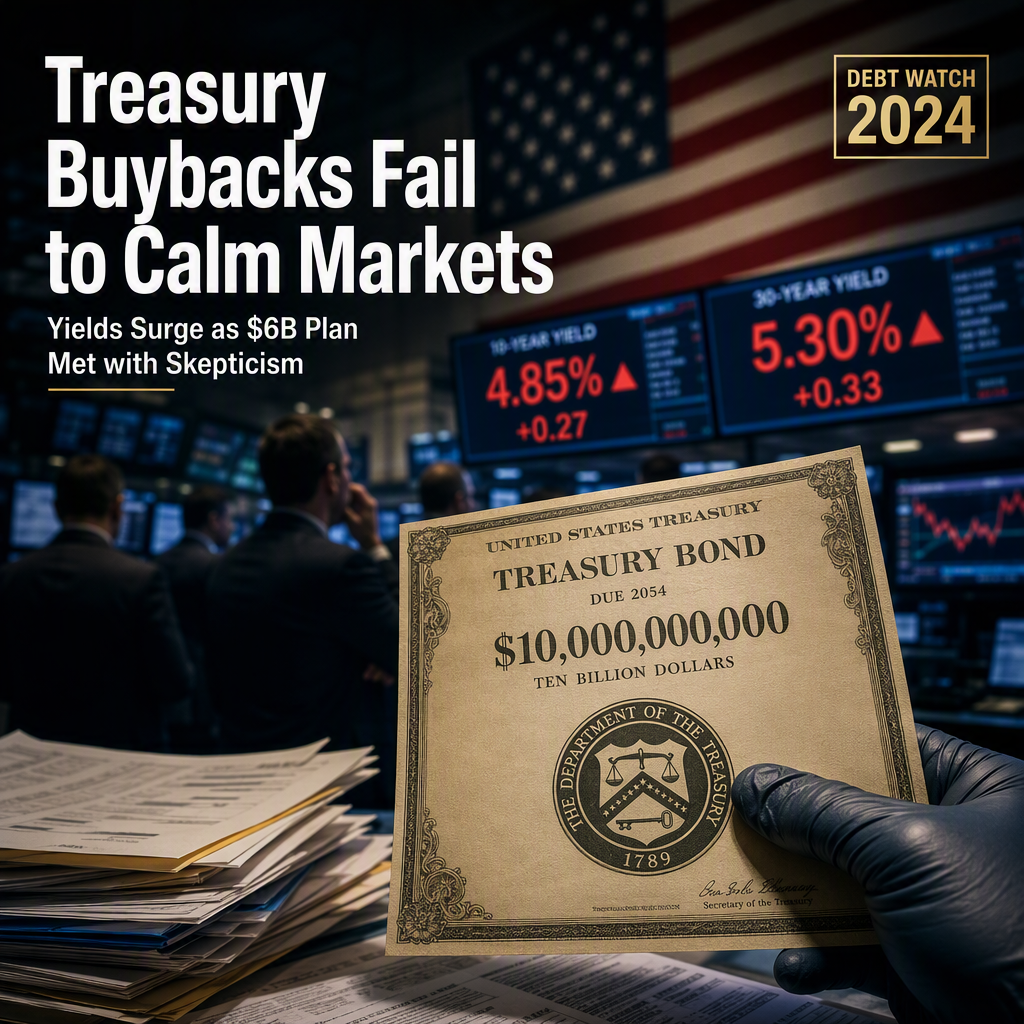
The U.S. Treasury Department announced it will buy back up to $6 billion in longer-dated U.S. debt this week, specifically targeting 10-year notes and 20-year bonds with maturities between February 2037 and August 2046. The operation is scheduled for Thursday from 1:40 p.m. to 2:00 p.m. ET, as revealed by the Bureau of the Fiscal Service [1]. This move follows Treasury Secretary Scott Bessent's earlier statement that buyback operations would be at least $4 billion until early November, a notable increase from the typical $2 billion per operation [1].
Despite the buyback announcement, yields on both the 10-year note and 20-year bond rose, with the 10-year note yield climbing above 4.85%—its highest level since 2023—and the 20-year bond yield rising above 5.3% during Wednesday's trading session [1]. The Treasury has framed these buybacks as a means to "provide greater liquidity support in longer-dated nominal sectors where there is consistent strong sponsorship from market participants" [1].
Market reaction has been skeptical, with Matt Cole, CEO of Strive Asset Management, stating that the buybacks are "very small sizes" compared to the gross national debt of over $40 trillion and the expected continued high levels of debt issuance, with annual deficits projected to rise above $2 trillion [1]. Cole emphasized that the market views the buybacks as insufficient, noting, "There's so much debt out there, and there's so much need over the next couple of years to issue more debt out there, that the market is just saying this is not enough" [1]. He further argued that even increasing buybacks to $12 billion would not address the underlying issues [1].
Cole also highlighted that most developed countries are facing similar debt challenges, and that rising corporate debt issuance—driven in part by financing for artificial intelligence (AI) projects—is competing with Treasury and foreign government debt for investor attention [1]. Treasury Secretary Bessent remarked that if markets were truly concerned about U.S. bonds and default risks, investors would shift to German or Japanese bonds, but the U.S. bond market has outperformed those alternatives [1].
CONCLUSION
The Treasury's planned $6 billion buyback of long-term debt has been met with skepticism from market participants, as yields on key bonds surged to multi-year highs following the announcement. Analysts argue that the scale of the buybacks is insufficient relative to the size of the U.S. debt and ongoing issuance needs, suggesting limited impact on market dynamics. The market's reaction underscores persistent concerns about U.S. fiscal sustainability and the effectiveness of current policy measures.