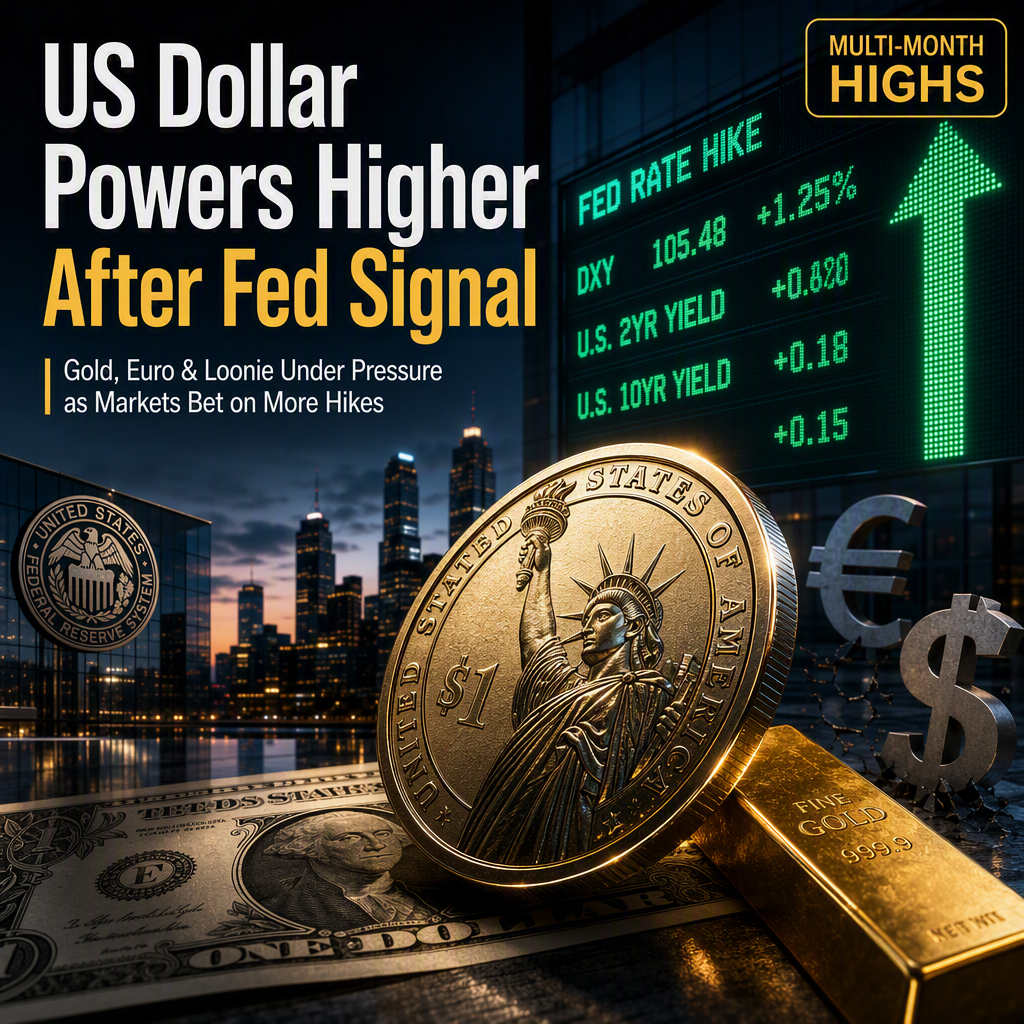
The US Dollar (USD) surged to its highest level since late July following the Federal Reserve's (Fed) decision to raise interest rates for the first time since 2023 at its September policy meeting, a move that was widely anticipated by markets [1][3]. The Fed's unanimous decision was accompanied by a more hawkish outlook, with the dot plot indicating that officials expect at least one more rate hike this year [1]. Chairman Kevin Warsh cited a strengthening US economy, persistent inflation, and geopolitical risks as key factors behind the decision, emphasizing that inflation remains too high and that stabilizing consumer prices is crucial for economic growth [1][3]. The yield on the benchmark 10-year US Treasury hovered near the 5.0% psychological mark, close to its highest level since April 2007, further supporting the Greenback [1].
In currency markets, the Canadian Dollar (CAD) fell to a five-week low against the USD, with the USD/CAD pair reaching near 1.4000 during the Asian session on Thursday [3]. The US Dollar Index (DXY) traded firmly near Thursday’s high at around 100.33 [3]. The Fed's hawkish stance led to increased market expectations for further tightening, with the CME FedWatch tool showing the odds of at least two more rate hikes by year-end rising to 88.7% from 79% before the announcement [3]. A pause in the oil price rally, with prices struggling to extend above $100, also weighed on the CAD, as Canada is a net energy exporter [3].
Gold (XAU/USD) attracted some buyers during the Asian session but struggled to recover above the $4,300 mark, remaining close to a six-week low touched the previous day [1]. The strong USD and elevated US bond yields acted as headwinds for gold, despite ongoing geopolitical tensions in the Middle East, including intensified fighting between Iran-backed Houthi rebels and Saudi Arabia [1]. Technical analysis indicated that gold maintains a bearish near-term bias below the $4,315-$4,320 resistance zone, with immediate support at $4,226 and further downside levels at $4,100 and $3,940.20 [1].
Elsewhere, the EUR/JPY cross slipped below 179.00, trading around 178.90 after three days of gains, as bearish momentum prevailed [2]. Technical indicators such as the 14-day RSI at 32 suggested lingering downside pressure, with the cross trading within a descending channel [2]. Strategists at Scotiabank noted that overnight Euro volatility firmed modestly ahead of the FOMC, but implied moves were below recent peaks, suggesting markets may have largely priced in a hawkish Fed outcome [2].
Currency heat maps from the sources showed the USD as the strongest major currency this week, with notable gains against the NZD (+1.64%), JPY (+1.61%), and EUR (+1.22%) [3]. The Euro was the weakest against the Australian Dollar on the day [2].
CONCLUSION
The Federal Reserve's rate hike and hawkish outlook have propelled the US Dollar to multi-month highs, pressuring gold and major currencies such as the Canadian Dollar and Euro. Market participants have increased their expectations for further Fed tightening, while technical indicators across asset classes point to continued bearish pressure. Geopolitical risks and commodity price movements remain key factors to watch in the near term.