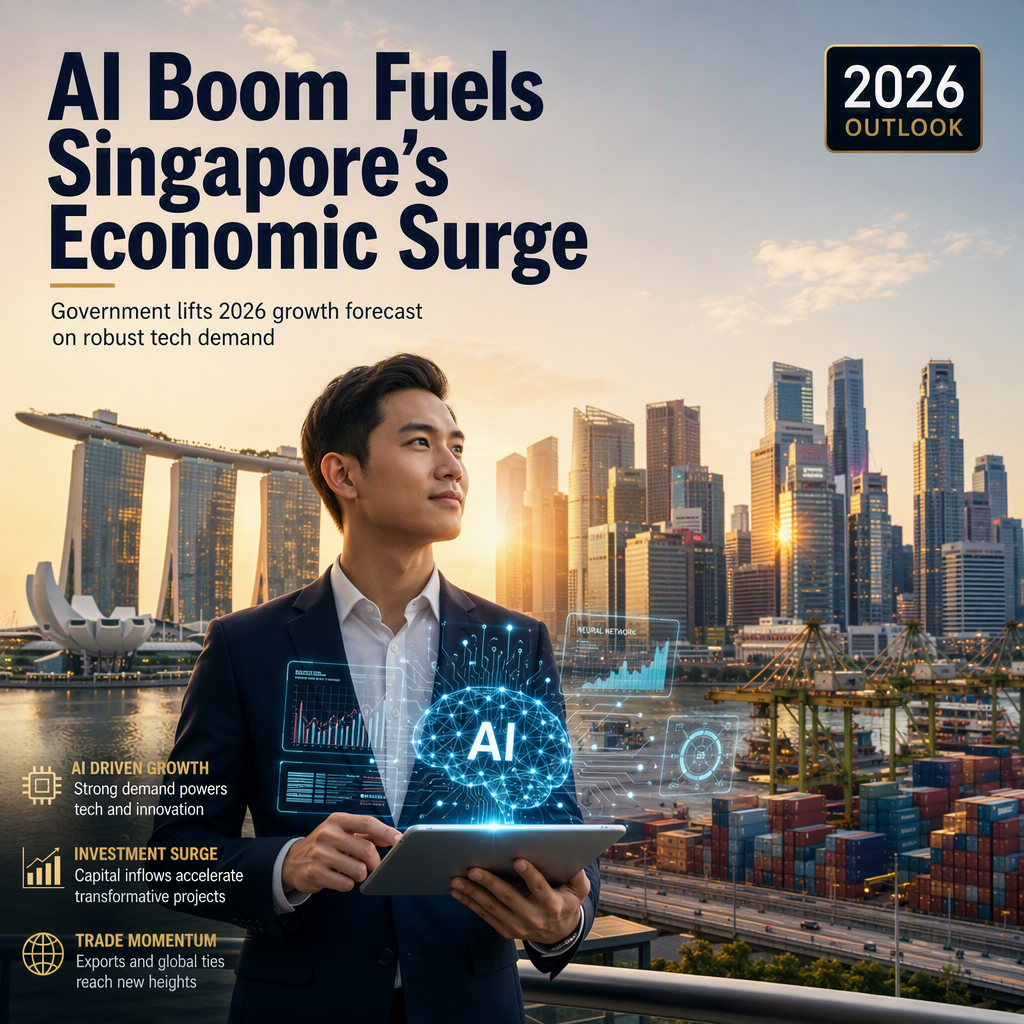
Singapore's economy experienced significant growth in the first half of 2026, with GDP expanding by 6.1% year-on-year, according to Standard Chartered Bank economists Edward Lee and Jonathan Koh [1]. The strong performance was largely attributed to robust demand in AI-related sectors, which offset weaker results in the energy sector [1]. In the second quarter alone, GDP grew by 5.9% year-on-year [1].
Reflecting this momentum, the Singaporean government raised its 2026 GDP growth forecast to a range of 4.5-5.5%, up from the previous 2-4% projection [1]. Standard Chartered also revised its own 2026 GDP forecast upward to 4.9% from 3.9% [1]. The economists anticipate more moderate growth in the second half of 2026, citing less favorable base effects in the electronics sector [1].
On the expenditure side, investments—particularly private investment in machinery and equipment—were a key driver, contributing one percentage point to H1 GDP growth [1]. Exports continued to rise at a double-digit pace, though increased imports meant that net exports made a slight negative contribution to overall Q2 GDP growth [1].
The report underscores that AI-related demand was the main growth engine, while the drag from oil-related sectors was less significant than previously expected [1].
CONCLUSION
Singapore's economy is benefiting from strong AI-driven demand, prompting both the government and Standard Chartered to raise their 2026 growth forecasts. While growth is expected to moderate in the second half of the year, the outlook remains positive, with investments and exports supporting continued expansion.