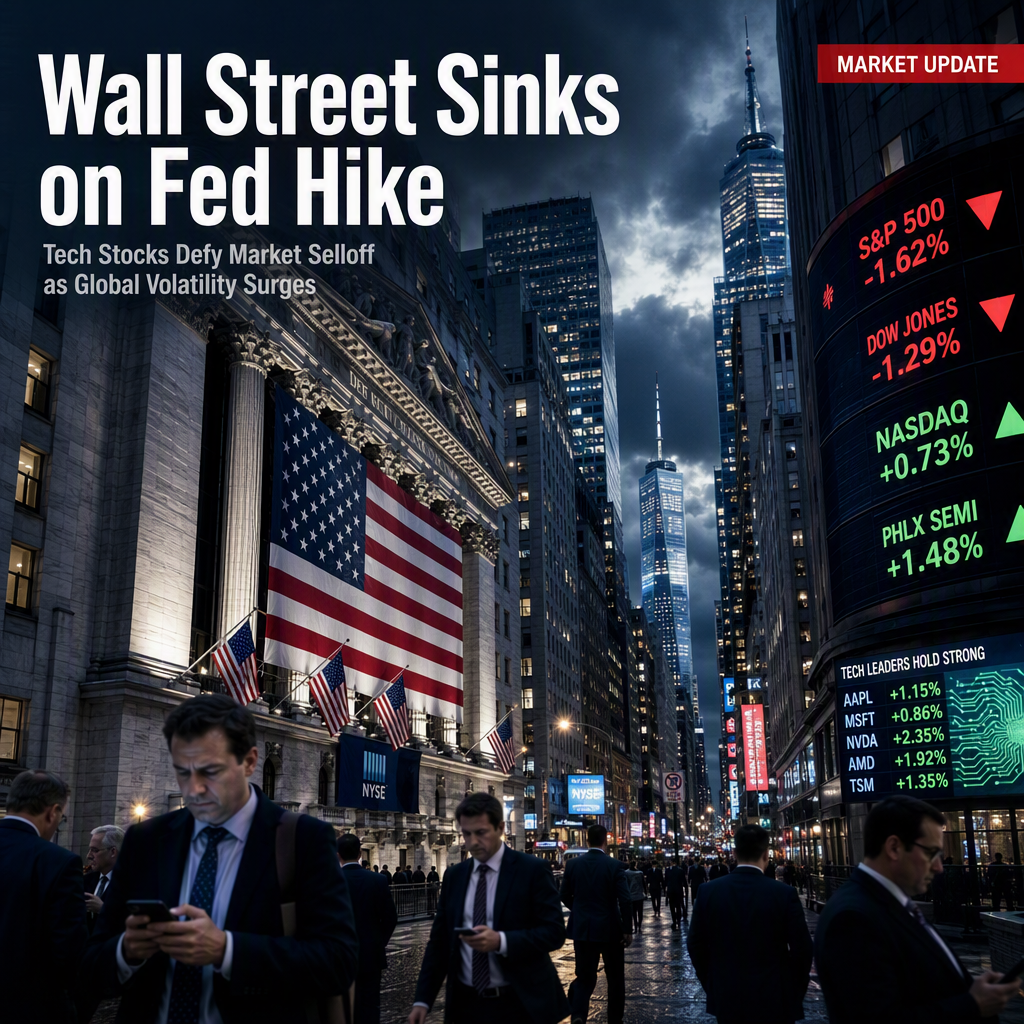
US equities came under pressure following the Federal Reserve's first rate hike since 2023 and a more hawkish dot plot, according to Deutsche Bank analysts. The S&P 500 fell to its lowest level since July, closing down 0.45% after briefly trading higher earlier in the day, aided by a decline in oil prices [1]. Blue-chip stocks and banks were particularly hard hit, with the Dow Jones dropping 1.21% to a three-month low, banks falling 2.30%, and energy stocks declining 2.97% within the S&P 500 [1].
In contrast, technology stocks demonstrated resilience, helping to limit the overall market decline. The Nasdaq edged down just 0.01%, the Mag-7 slipped 0.11%, and the Philly Semiconductor Index advanced 0.63% [1]. Overnight, market sentiment showed tentative improvement, with S&P 500 futures rising 0.60% and NASDAQ futures up 0.69% [1].
Asian markets presented a mixed picture: Japan’s Nikkei 225 gained 0.15%, South Korea’s KOSPI rose 0.89%, and Australia’s S&P/ASX 200 increased 0.35%. However, Chinese equities remained under pressure, with the Hang Seng leading losses at -0.75% after the Hong Kong Monetary Authority raised rates by 25 basis points to 4.25%, mirroring the Fed's move. The Shanghai Composite and CSI 300 also posted modest declines of 0.35% and 0.36%, respectively [1].
European equities rebounded from multi-week lows, with the Stoxx 600 up 0.46%, DAX up 0.53%, CAC 40 up 0.62%, and FTSE 100 up 0.28%. Meanwhile, yields on European government bonds fell from recent multi-year highs, with the 10-year bund yield down 3.1 basis points, OAT down 4.0 basis points, and BTP down 5.4 basis points [1].
CONCLUSION
The Federal Reserve's rate hike and hawkish outlook triggered a broad sell-off in US equities, particularly impacting blue-chip and banking stocks, while technology shares showed relative strength. Global markets responded with mixed performance, and European equities rebounded as yields eased. The market remains cautious but showed signs of stabilization in futures trading.