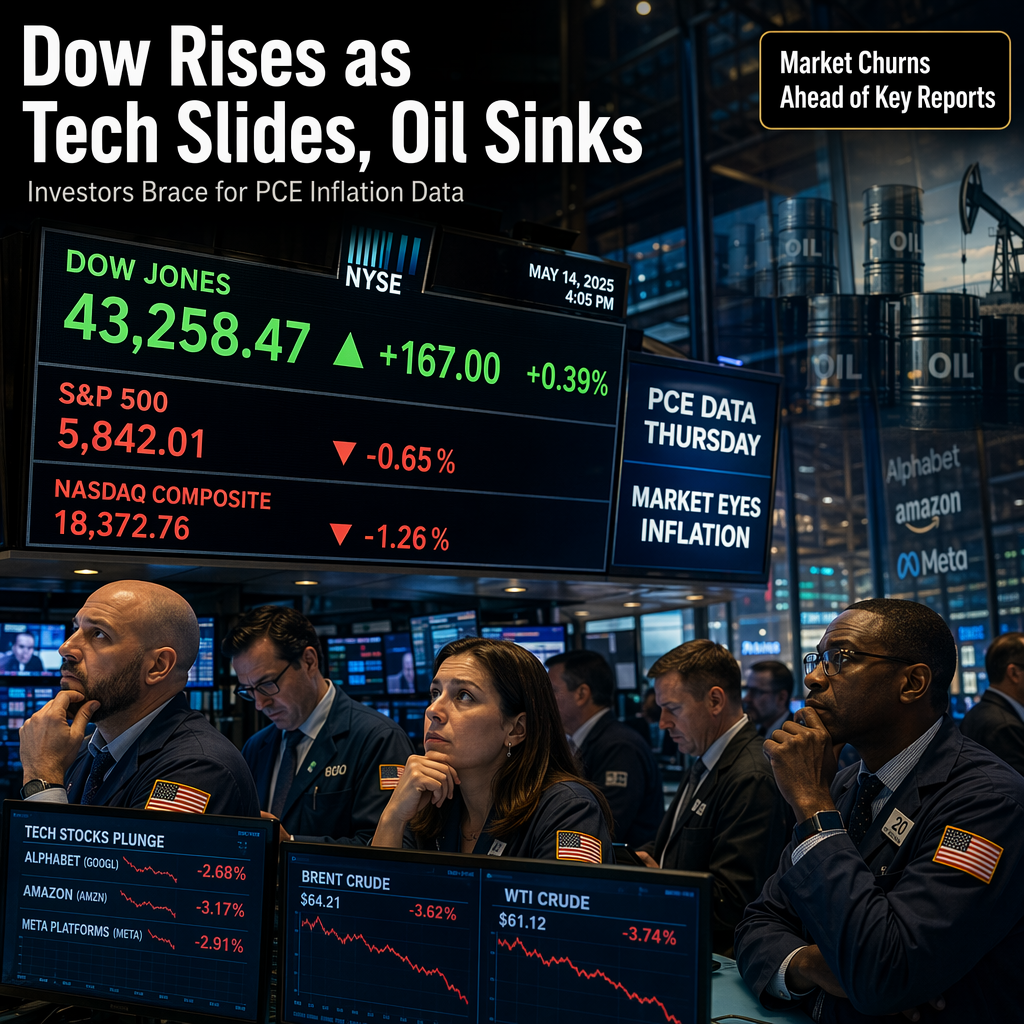
The Dow Jones Industrial Average (DJIA) closed higher on Monday, adding approximately 167 points or 0.3%, finishing near 51,750 after a volatile session. This positive performance contrasted with declines in the S&P 500, which slipped 0.3%, and the Nasdaq Composite, which fell 1.1% [1]. The DJIA's gains were attributed not to broad market strength but to its lower exposure to mega-cap technology stocks, which experienced significant selloffs. Alphabet dropped 6% amid concerns over artificial intelligence talent departures, Amazon fell 4%, Meta lost 3%, and SpaceX declined 8% for the third consecutive session. Microsoft, a Dow component, also fell 2% but did not pull the index into negative territory, highlighting a rotation from tech into value stocks [1].
Crude oil prices also declined, with Brent falling over 3% toward $77 and WTI dropping more than 2% to near $74. This was triggered by reports that mediators Qatar and Pakistan indicated Washington and Tehran had agreed on a roadmap toward a final deal within 60 days, and the U.S. Treasury cleared Iranian crude oil sales for the same period. While cheaper energy benefits Dow's industrial and transport names, the article notes that the roadmap is not a finalized agreement, and talks have already faced delays due to renewed fighting in Lebanon [1].
Market action reflected skepticism, as futures dipped to session lows near 51,500 overnight before climbing to a high close to 51,900, only to retreat and settle near 51,750. The Stochastic Relative Strength Index (Stoch RSI) ended around 49.5, indicating a lack of strong momentum in either direction and suggesting a market that is churning rather than breaking out [1].
Looking ahead, the market's focus is on Thursday's release of the May Personal Consumption Expenditures Price Index (PCE) and the third estimate of first-quarter Gross Domestic Product (GDP). Core PCE is expected to rise to 3.4% year-over-year from 3.3%, with the monthly pace seen at 0.3% versus 0.2% previously. The headline PCE is projected at 4% year-over-year. These data points are particularly important following last week's hawkish Federal Open Market Committee (FOMC) decision [1].
CONCLUSION
The Dow's gains were driven by a rotation out of technology stocks and a drop in oil prices, rather than broad-based market strength. Investors remain cautious, with attention turning to upcoming PCE inflation data and GDP figures, which are expected to influence market direction following recent Fed policy signals.