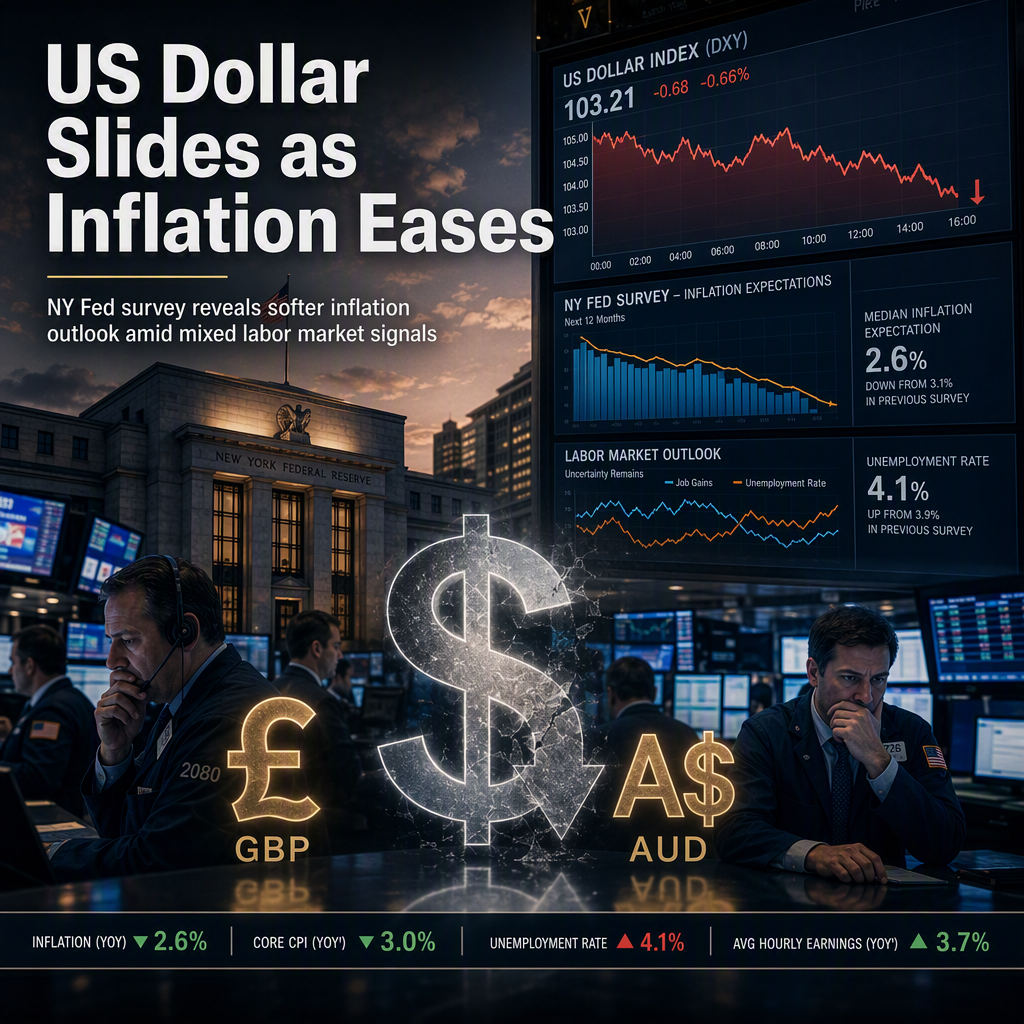
The New York Federal Reserve released its August Survey of Consumer Expectations, revealing that households' inflation expectations have eased in the medium-term. Specifically, one-year inflation expectations dropped to 3.58% in August from 3.63% in July, slightly below the forecast of 3.6%. Three-year-ahead expected inflation also declined to 3.2% from 3.3%, while five-year expectations remained unchanged at 3.0% [1][3]. Despite this inflation relief, labor market expectations were mixed, with projections of higher unemployment reaching their highest level since April 2020. Job finding prospects deteriorated, but expectations regarding job losses and quits improved. Additionally, consumers anticipated higher future gasoline prices and reported a deterioration in their current and future personal financial situations [1].
Market reactions to the survey were muted, as traders focused on upcoming US inflation data releases. The US Dollar struggled to gain traction, with the US Dollar Index (DXY) trading near its lowest level in more than two weeks at 98.82, after briefly reclaiming the 99.00 mark. The USD was strongest against the New Zealand Dollar, up 0.38%, but generally showed a negative tone against other major currencies [1][3]. The British Pound edged higher, registering modest gains of over 0.08% against the USD, as Bank of England Governor Andrew Bailey calmed recession fears during testimony, stating the UK is not "on the verge of a recession" and noting a softening jobs market due to a decline in hiring rates [2]. Meanwhile, the Australian Dollar held firm, supported by the Reserve Bank of Australia's hawkish stance and positive domestic data, with strategists highlighting that Australia's inflation and growth figures are running ahead of RBA projections [3].
Forward-looking statements from analysts and policymakers indicate that expectations for a Federal Reserve rate hike have increased, with markets pricing in around a 60% chance of a 25-basis-point hike at the September 15-16 meeting, following a stronger-than-expected US employment report and higher oil prices adding to inflation risks [3]. On the Australian side, the RBA has raised rates three times this year and may tighten policy again at its September 28-29 meeting, with a 70% probability priced in for a 25bps hike to 4.60%. However, strategists caution that the RBA could wait until November to assess additional inflation data [3].
Overall, the NY Fed survey suggests a slightly more optimistic outlook on inflation, but persistent concerns about the labor market and personal finances remain. The muted market reaction reflects traders' anticipation of upcoming US inflation data, which could be pivotal for the Fed's next policy move [1][2][3].
CONCLUSION
The NY Fed's August survey signals easing inflation expectations but highlights ongoing labor market concerns. The US Dollar weakened against most major currencies, with market participants awaiting key US inflation data that could influence the Federal Reserve's rate decision. Forward-looking analyst opinions suggest a moderate probability of a Fed rate hike, while central banks in the UK and Australia remain cautious amid mixed economic signals.