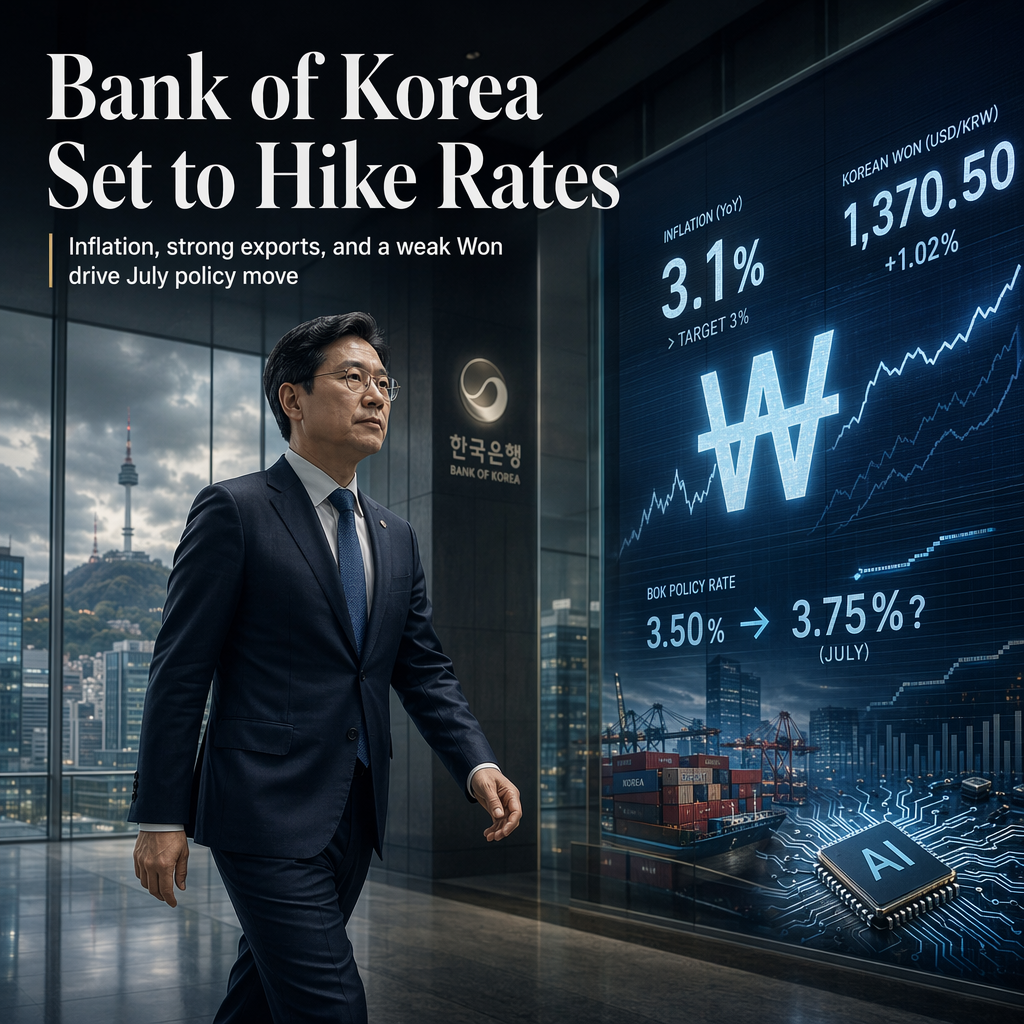
DBS economists Radhika Rao and Mo Ji anticipate that the Bank of Korea (BoK) will raise its base rate from 2.50% to 2.75% in July, citing several supporting factors. Chief among these is the persistence of consumer price index (CPI) inflation, which has remained above 3% year-over-year for two consecutive months through June and is expected to stay at this level for the rest of the year. This ongoing inflation is attributed to lingering cost pass-through, elevated inflation expectations, and second-round effects [1].
The economists also point to robust export performance and strong investment, particularly linked to the artificial intelligence (AI) boom, as evidence of resilient economic growth. Despite a recent decline in oil prices due to easing tensions in the Middle East, the BoK signaled in June that it remains prepared to tighten monetary policy further [1].
Additionally, the persistent weakness of the Korean Won (KRW) and ongoing portfolio capital outflows are highlighted as further justification for a rate hike. These factors, combined with the inflationary environment and solid growth data, reinforce the expectation that the BoK will move to tighten policy in July [1].
No specific market reactions or analyst opinions beyond the DBS economists' outlook are mentioned in the article. Forward-looking statements are centered on the expectation that inflation will remain elevated and that the BoK will respond with a rate increase [1].
CONCLUSION
DBS economists expect the Bank of Korea to raise its base rate to 2.75% in July, driven by persistent inflation, strong exports, and a weak Korean Won. The anticipated rate hike reflects ongoing inflationary pressures and capital outflows, signaling a continued tightening stance by the BoK.