
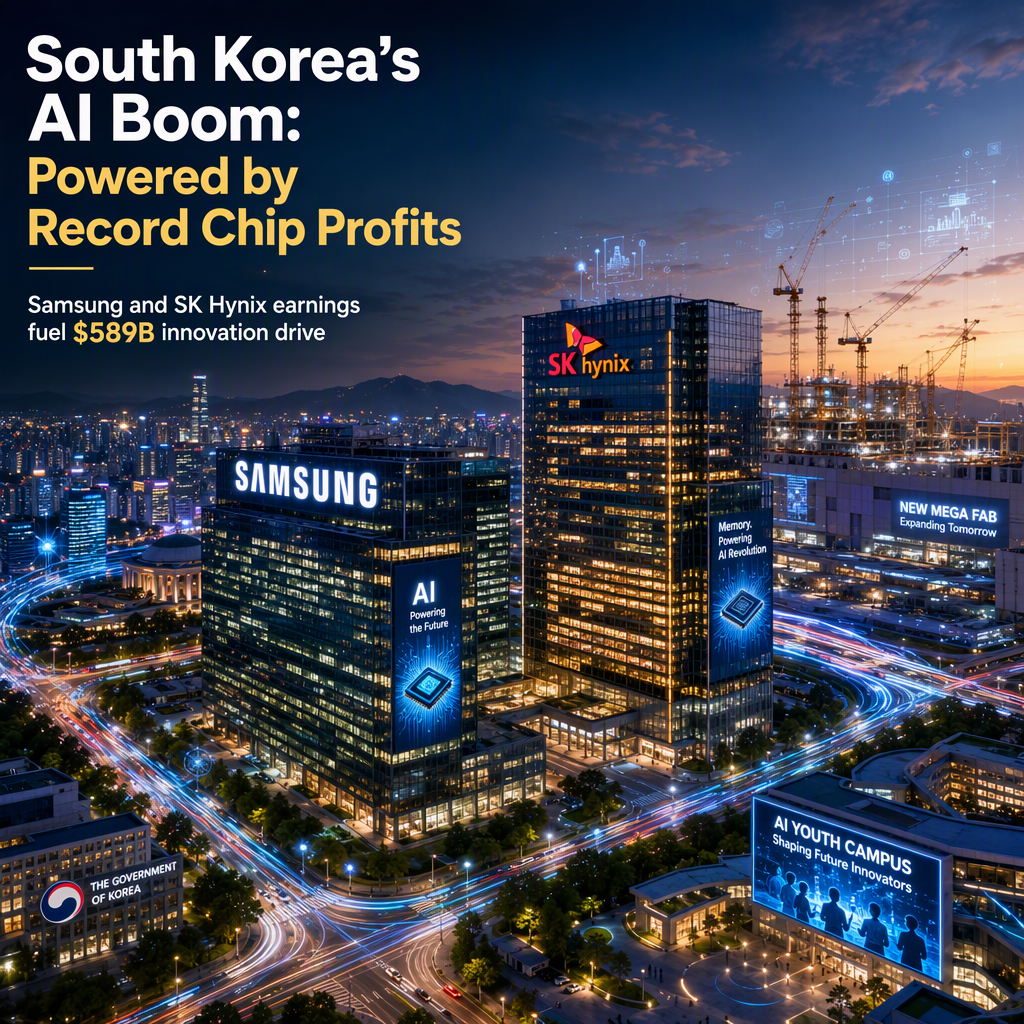
Samsung Electronics and SK Hynix have reported record earnings fueled by the artificial intelligence boom, significantly boosting South Korea's resources for industrial and technological development [1]. Samsung's Q3 profit soared nearly nine times to $80 billion, underscoring robust demand for AI-related semiconductors [1]. SK Hynix's CEO remains optimistic about the market outlook, dismissing concerns of memory chip oversupply and predicting a supply crunch to persist until the end of 2030 [1].
The surge in profits has led to increased tax contributions from both companies, which the South Korean government is leveraging to accelerate its $589 billion AI hub plans [1]. These funds are being reinvested into future growth sectors, including artificial intelligence and youth development, with the aim of reinforcing the country's industrial base and supporting technological innovation [1].
Samsung is rapidly expanding its manufacturing capacity by constructing a new factory near Seoul to meet growing demand [1]. The company is also broadening its international footprint, opening an AI chip R&D hub in Japan focused on advanced packaging collaboration and investing $5 billion to enhance Vietnam's position in the semiconductor value chain [1].
Market analysts caution that increasing memory chip production alone may not resolve all AI bottlenecks, but the strategic investments by Samsung and SK Hynix, combined with government support, are positioning South Korea as a global leader in the semiconductor and AI industries [1].
CONCLUSION
Record earnings from Samsung and SK Hynix are fueling South Korea's ambitious investments in AI and industrial innovation. The government's reinvestment of windfall tax contributions and the companies' strategic expansions are expected to strengthen South Korea's leadership in the global semiconductor and AI sectors.