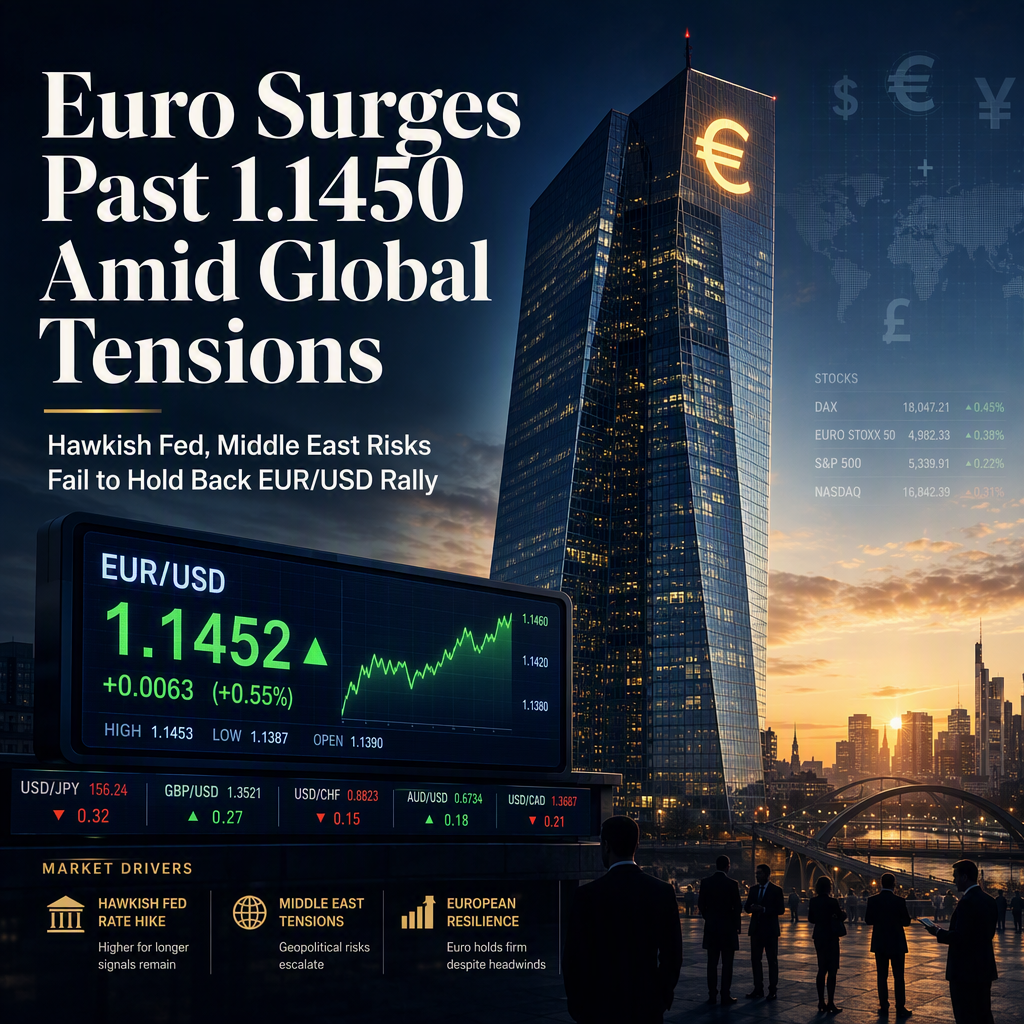
The EUR/USD pair posted modest gains, trading near 1.1485 during the early Asian session on Monday, despite the US Federal Reserve's hawkish stance following its recent policy meeting [1]. The Federal Reserve raised interest rates by a quarter-percentage point at its September meeting and signaled the possibility of further hikes in the coming months, with new Fed Chair Kevin Warsh joining a unanimous decision to lift rates and officials projecting one more increase later this year [1]. This hawkish tone from the Fed could support the US dollar and act as a headwind for the euro, especially amid ongoing geopolitical tensions in the Middle East, where Iran issued new retaliation threats against US military bases and US President Donald Trump warned of potential fresh US strikes [1].
On the European side, European Central Bank (ECB) President Christine Lagarde is scheduled to speak later on Monday, while ECB Vice President Boris Vujcic noted that market expectations for further rate hikes are being driven largely by higher energy prices, though policymakers will consider a broader set of economic indicators in their decisions [1]. Money markets are currently pricing in another three or four ECB rate increases by the end of next year, with the next hike possibly as soon as October, potentially raising the deposit rate to 3.25% or 3.50% [1]. Strategists at Scotiabank observed that the outlook for relative central bank policy appears to be stabilizing, with policymakers remaining overwhelmingly hawkish due to energy-related inflation concerns and growth considerations [1].
On the data front, fundamental releases have been limited, with stronger-than-expected German Producer Price Index (PPI) data reinforcing caution among ECB officials, even as policy expectations between the ECB and the Fed become more balanced [1]. Meanwhile, the Fed's Kashkari delivered a slightly softer tone, emphasizing that inflation remains too high but highlighting the resilience of the American economy and improving productivity, suggesting that inflation can be reduced without derailing economic expansion [1]. Kashkari also clarified that the bond market is the responsibility of the Treasury, keeping the Fed's focus on inflation and the labor market [1].
CONCLUSION
The euro's modest gains above 1.1450 come amid a hawkish Fed and ongoing geopolitical risks, with both the Fed and ECB signaling further tightening ahead. Market participants are closely watching upcoming central bank communications and economic data for further direction, as policy expectations between the ECB and Fed appear to be stabilizing.