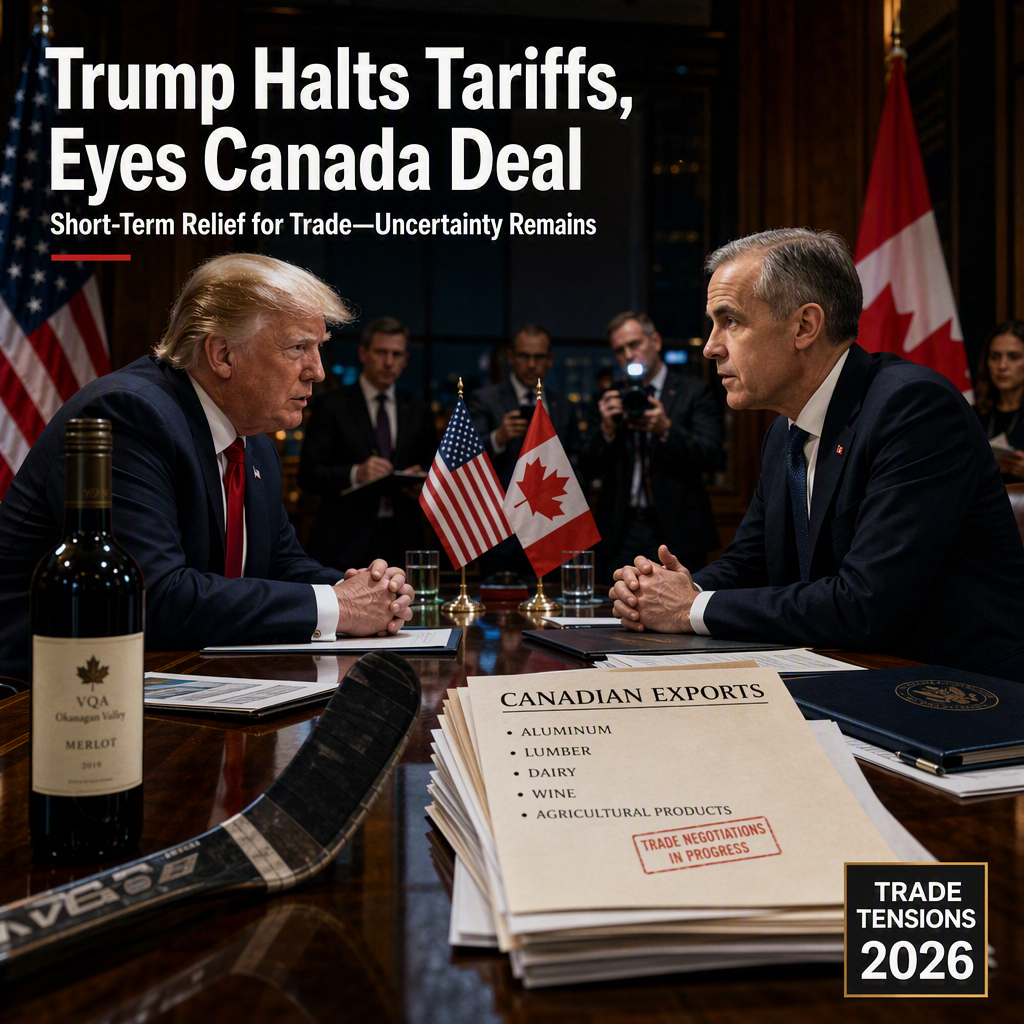
President Donald Trump announced a three-day pause on the scheduled imposition of 50% tariffs on certain Canadian imports, just hours before the duties were set to take effect at midnight on August 18, 2026 [1]. Trump stated on Truth Social that the pause was due to a 'deal' reached with Canada, pending the finalization of documents, following trade talks with Canadian Prime Minister Mark Carney [1].
The proposed tariffs, unveiled last month, targeted products such as hockey sticks, wine, and other Canadian goods, and were a response to what the Trump administration described as Canadian trade discrimination in the motor vehicle, alcohol, and dairy sectors [1]. The tariffs, authorized under Section 338 of the Tariff Act of 1930—a rarely used law—would have affected approximately $20 billion worth of Canadian imports, a significant portion for the targeted industries, though only a fraction of the $382 billion in total U.S. imports from Canada last year [1].
Dan Kelly, president of the Canadian Federation of Independent Business, warned that a 50% tariff would render many products uneconomic to sell in the U.S., with some Canadian businesses already experiencing a slowdown in U.S. orders in anticipation of the tariffs [1]. He emphasized that these tariffs would particularly harm small businesses, as many of the affected goods are consumer-oriented [1].
Trump also hinted at the possibility of reviving the Keystone XL pipeline project, which had previously been canceled by former President Joe Biden in 2021 [1]. Additionally, the Trump administration has imposed other tariffs on Canadian exports such as metals, lumber, and auto parts, and recently announced it would not renew the USMCA trade agreement, raising uncertainty about future North American trade relations [1].
CONCLUSION
The temporary pause on the 50% tariffs provides short-term relief for Canadian exporters and U.S. importers, but significant uncertainty remains pending the finalization of the trade deal. The situation poses substantial risks for small businesses and raises questions about the future of broader U.S.-Canada trade relations.