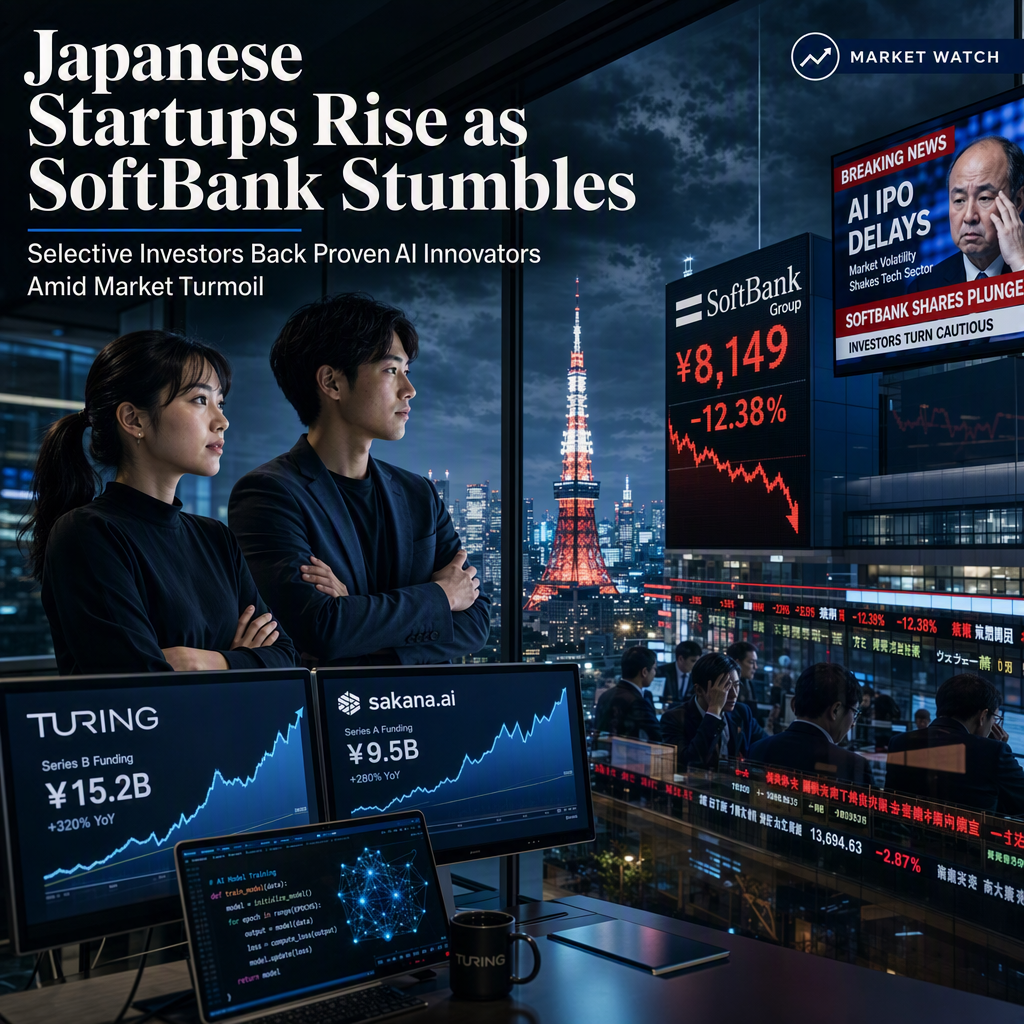
Japanese startup funding has seen a notable shift, with investors becoming increasingly selective and directing capital toward established tech companies with proven track records. In the first half of the year, large fundraising deals in Japan reached a record high, even as seed-stage investments declined by 40% due to heightened risk aversion among investors [1]. Startups specializing in autonomous driving and artificial intelligence, such as Turing and Sakana AI, have emerged as major beneficiaries of this trend, attracting substantial investment rounds thanks to their scalable business models and revenue traction [1]. According to a Tokyo-based venture capitalist, 'Investors in Japanese startups have become much more selective, focusing on companies with proven track records and scalable technologies,' indicating that the bar for funding has risen but opportunities remain significant for those who meet investor criteria [1].
Meanwhile, SoftBank Group experienced a sharp market reaction, with its shares plunging 11% following OpenAI's announcement that it would delay its initial public offering and join calls to slow the development of advanced AI models [2]. This news, coupled with rising concerns about AI safety voiced by industry leaders such as Anthropic CEO Dario Amodei and OpenAI's Sam Altman, contributed to broader volatility in tech sector shares across Asia [2]. The sell-off in SoftBank shares was exacerbated by a break below key technical support levels, with analysts warning of further downside risk if sentiment remains weak [2]. Market participants cited the combination of negative AI headlines and a spike in oil prices as factors eroding confidence in risk assets, leading to cautious trading across Asian equity markets [2].
Market analysis from both sources suggests that the Japanese startup ecosystem is undergoing consolidation, with winners emerging in sectors like AI and autonomous vehicles where demand and disruption potential remain strong [1]. However, the broader tech market is facing headwinds from regulatory uncertainty and concerns about the pace of AI development, as evidenced by the reaction to OpenAI's IPO delay and the subsequent decline in SoftBank Group shares [2]. Analysts noted a lack of immediate catalysts for a rebound in SoftBank, and traders are closely monitoring signals on AI regulation and oil price movements for further stress in equity markets [2].
The preference for later-stage investments is expected to persist as macroeconomic uncertainties continue, positioning startups like Turing and Sakana AI to benefit from investor focus on established growth prospects [1].
CONCLUSION
Investor caution is reshaping Japan's tech funding landscape, favoring established startups like Sakana AI and Turing while making it harder for early-stage companies to secure capital. At the same time, SoftBank Group's sharp share decline highlights broader market anxieties about AI regulation and IPO delays. The outlook remains uncertain, with investors closely watching regulatory developments and macroeconomic signals for further direction.