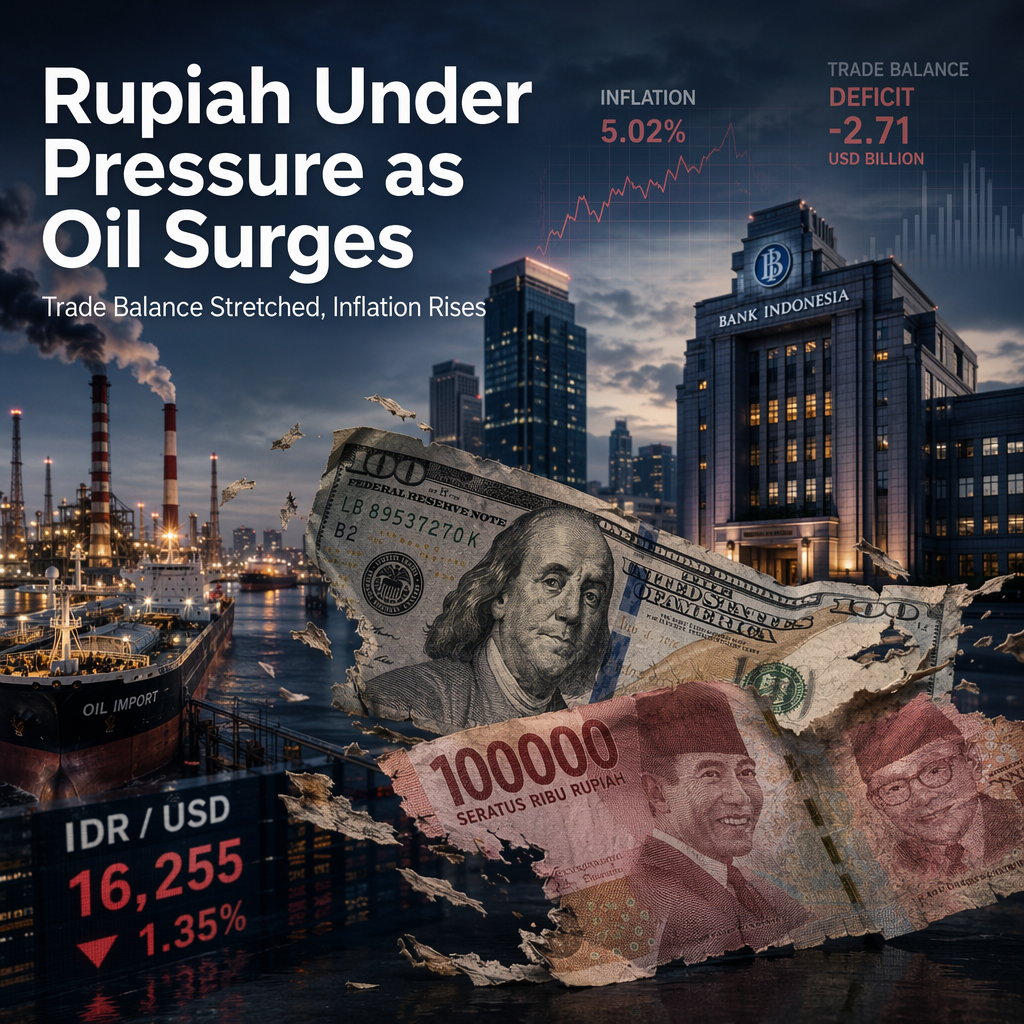
The Indonesian Rupiah (IDR) weakened against the US Dollar (USD), with the USD/IDR pair trading around 18,100 during Asian hours on Thursday, following two days of losses for the dollar. The IDR faces downward pressure due to surging oil import costs, which are stretching Indonesia's trade balance and fueling inflation concerns [1]. This situation has heightened market anticipation ahead of Bank Indonesia’s (BI) policy meeting next week, as traders speculate whether the central bank will implement further rate hikes to defend the currency after a cumulative 100 basis points of tightening in May–June [1].
Defensive monetary actions and upcoming government fiscal interventions aimed at capping food and industrial costs are expected to provide some support, but the Rupiah remains vulnerable to broader risk-off sentiment in global markets [1]. The US Dollar recovered its daily losses amid rising risk aversion, which is attributed to escalating US-Iran tensions that have boosted oil prices and sparked fresh inflation concerns. This geopolitical friction threatens to prolong the Federal Reserve's higher interest rate environment [1].
Traders are closely monitoring the Federal Reserve's policy outlook, especially after US inflation data softened. The US Consumer Price Index (CPI) declined to 3.5% in June from a three-year high of 4.2% in May, coming in well below the market expectation of 3.8%. This weaker inflation data initially reduced immediate concerns about a Fed rate hike [1]. According to the CME FedWatch Tool, the implied probability of a Fed rate hike in September fell to around 44% from 50% a day earlier [1]. However, the recent unraveling of the interim US-Iran peace agreement means that June’s inflation data does not yet reflect the economic impact of the latest military escalation between the US and Iran [1].
CONCLUSION
The Indonesian Rupiah remains under pressure due to rising oil import costs and inflation, with market participants awaiting Bank Indonesia's policy response. While defensive measures and fiscal interventions may offer some support, ongoing geopolitical tensions and global risk aversion continue to weigh on the currency. The outlook for both the Rupiah and broader markets hinges on upcoming central bank decisions and evolving geopolitical developments.