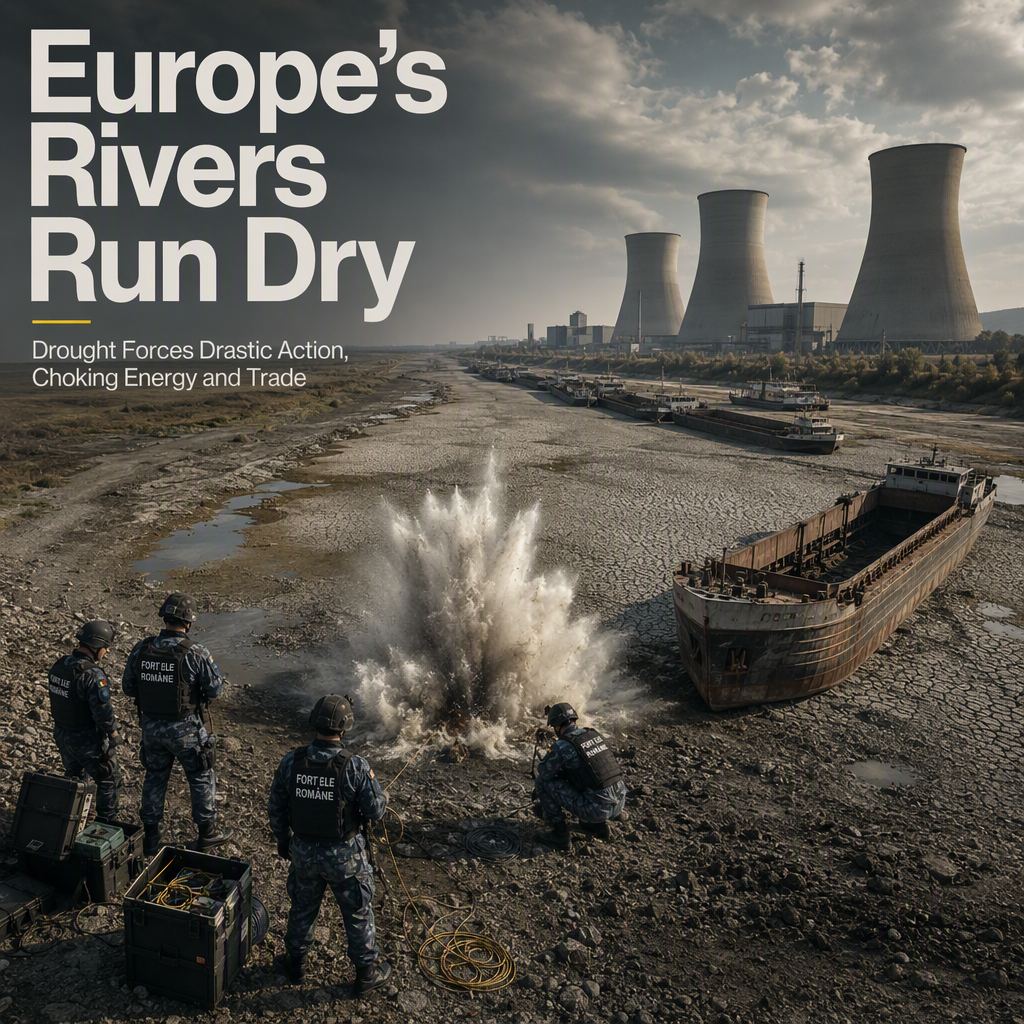
Europe is experiencing an extreme drought that has severely lowered water levels on the Rhine and Danube rivers, disrupting energy generation, freight, and river transport across the continent [1]. The drought has forced authorities to take drastic measures, including blowing up riverbeds to improve water flow. In Romania, the government shut down its only operational nuclear reactor at the Cernavoda Nuclear Power Plant, which is cooled by the Danube, for the first time. The Romanian navy conducted controlled underwater detonations in Izvoarele village to divert more water toward the plant's cooling systems [1].
The low water levels on the Danube have also threatened the closure of Hungary's Paks nuclear plant, which supplies approximately 40% of Hungary's electricity, and have forced Serbia to reduce hydropower generation [1]. In Germany, the Rhine River's water level at Kaub fell to 24 centimeters on Monday, its lowest since records began in 1880, far below the critical navigation threshold of 78 centimeters. This has resulted in increased freight transport costs and low-water surcharges, as cargo barges must be less heavily loaded [1].
Liz Saccoccia, water security lead at the World Resources Institute, emphasized that major rivers like the Rhine and Danube are essential trade corridors and sources of water for industry and energy generation. She noted that the current situation has already led to reduced electricity generation at nuclear plants in Hungary, Romania, and France, as well as hydropower facilities in Serbia, increasing the risk of blackouts and costly electricity imports [1].
The drought's impact extends to agriculture and tourism, with low water levels on the Danube preventing farmers from shipping crops and stopping cruise ships from reaching ports such as Budapest. These disruptions highlight the broader economic risks posed by increasingly unreliable water supplies, affecting trade, energy security, and supply chains across Europe [1].
CONCLUSION
The extreme drought in Europe is causing significant disruptions to energy generation, freight, and trade, prompting authorities to take unprecedented actions such as blasting riverbeds. With nuclear and hydropower plants reducing output and supply chains under strain, the economic risks are substantial and could lead to higher energy costs and increased risk of blackouts. The situation underscores the vulnerability of Europe's economy to climate-driven water shortages.