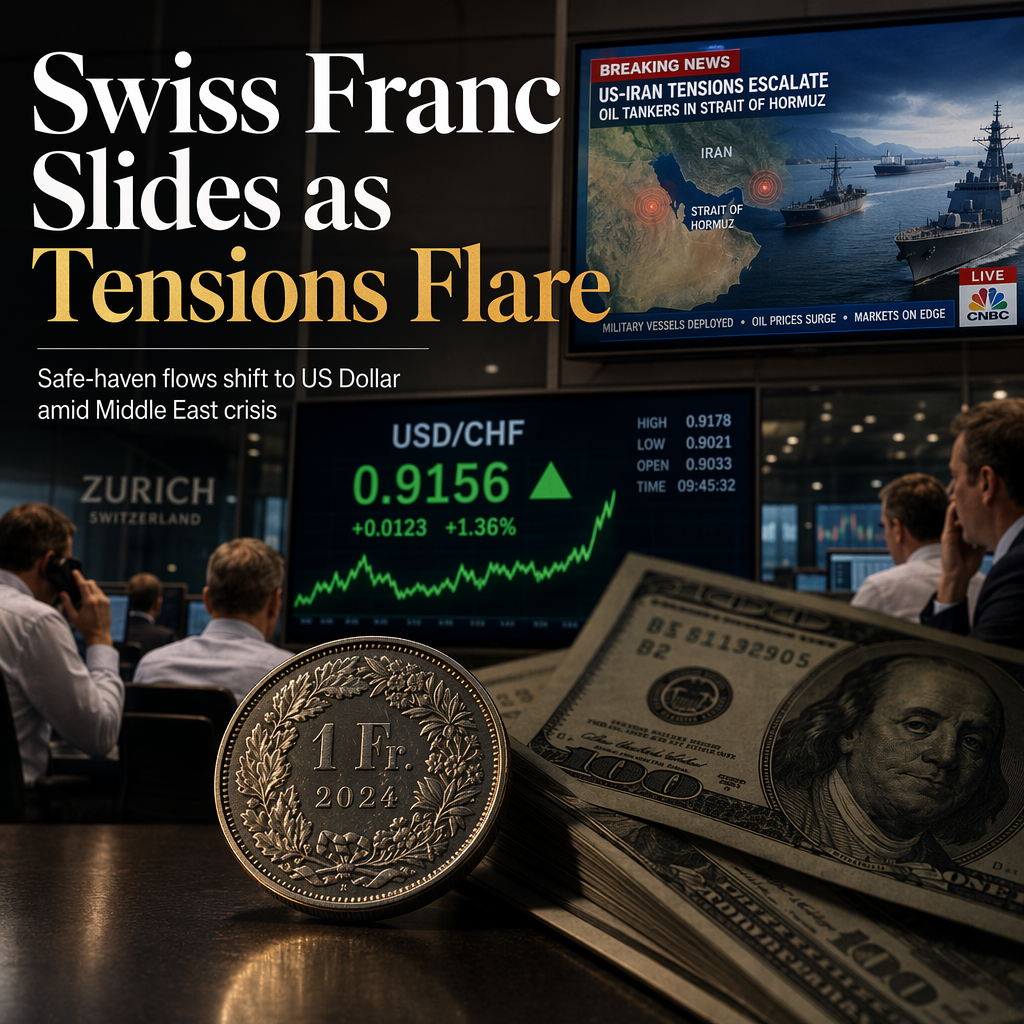
The Swiss Franc (CHF) weakened against the US Dollar (USD), with the USD/CHF pair extending its gains for the fourth consecutive day and trading around 0.8150 during European hours on Thursday [1]. This movement was driven by increased demand for the US Dollar as a safe-haven asset amid rising geopolitical tensions between the United States and Iran [1]. US Secretary of State Marco Rubio warned that military strikes against Iran could intensify if negotiations do not occur, stating, 'the price will get higher every night' until Iran yields, and also called on the Houthis to halt their attacks [1].
Regional tensions escalated further as US President Donald Trump threatened strikes on Iranian infrastructure in response to attacks on ships in the Strait of Hormuz, prompting threats of retaliation from Tehran against US-linked energy assets [1]. Additionally, Iran-backed Houthi militants launched missiles and drones at two Saudi oil tankers in the Red Sea, marking the first direct strikes on tankers in this critical waterway and opening a new front in the conflict [1].
Despite the Swiss Franc's traditional safe-haven status, Switzerland’s 10-year government bond yield climbed near a two-month high of around 0.49%, reflecting market anxiety over inflation and monetary policy amid the Middle East tensions and rising energy costs [1]. The Swiss National Bank (SNB) is expected to intervene in foreign exchange markets by selling CHF, which could limit further appreciation of the currency [1].
The article notes that the CHF is typically supported during periods of market stress due to Switzerland’s stable economy, strong export sector, and political neutrality, but current market dynamics and central bank actions are influencing its performance [1].
CONCLUSION
The Swiss Franc weakened against the US Dollar as geopolitical tensions in the Middle East drove safe-haven flows into the USD. Despite rising Swiss bond yields and the CHF's traditional safe-haven appeal, expectations of SNB intervention are capping gains. Market participants remain focused on developments in the US-Iran conflict and central bank actions.