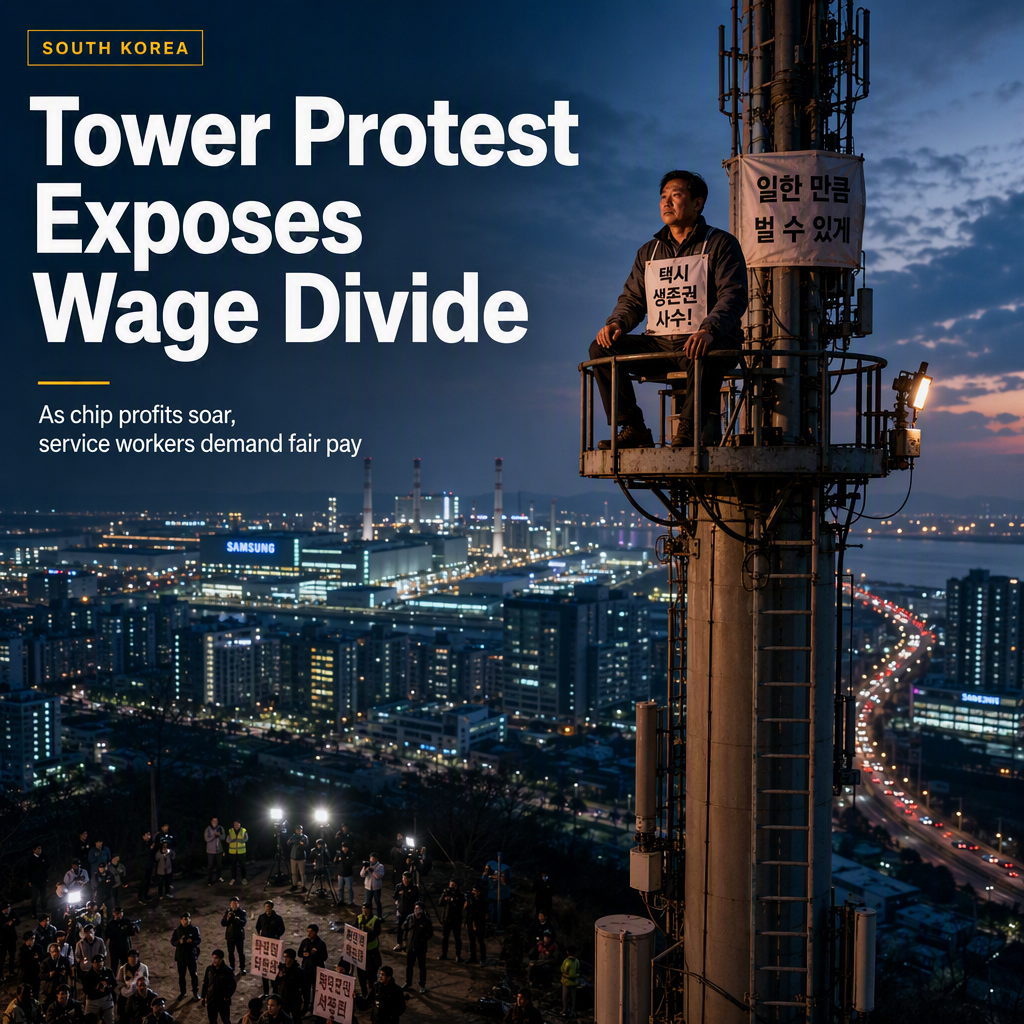
Ko Young-ki, a taxi driver in Incheon, South Korea, has been living atop a communication tower since March to protest the country's growing wage divide, which has become increasingly pronounced as the semiconductor industry posts record profits [1]. Ko's demonstration has drawn national attention to the plight of service sector workers, whose wages have stagnated despite South Korea's reputation as a tech powerhouse and the rapid growth of major chip conglomerates [1]. Ko stated, 'The chip companies are making so much money, but people like me are stuck. We work long hours, but our pay hasn't gone up in years' [1].
Government data cited in the article shows that wage growth for service-sector workers lags significantly behind that of manufacturing, particularly in high-tech fields. The country's Gini coefficient, a measure of income inequality, remains high, and labor advocates warn that the gap may widen further as automation and AI transform the economy [1].
Ko's protest has sparked debate in the National Assembly, with opposition lawmakers proposing measures such as increasing the minimum wage, expanding social safety nets, and encouraging profit-sharing schemes in large corporations [1]. As chip exports approach new highs and companies like Samsung Electronics and SK Hynix report double-digit profit growth, labor unions argue that frontline workers in other sectors are being overlooked. A spokesperson for the Korean Confederation of Trade Unions emphasized the need for broader distribution of prosperity from the chip boom [1].
Ko remains steadfast in his protest, vowing not to come down until workers like him receive a fair deal, keeping the issue of wage inequality at the forefront of national discourse [1].
CONCLUSION
Ko Young-ki's protest has brought renewed focus to South Korea's wage inequality, particularly as the semiconductor sector enjoys robust profits. The event has prompted political debate and calls for policy changes to ensure more equitable wage growth. While the chip industry continues to thrive, the challenge of sharing its prosperity more widely remains unresolved.