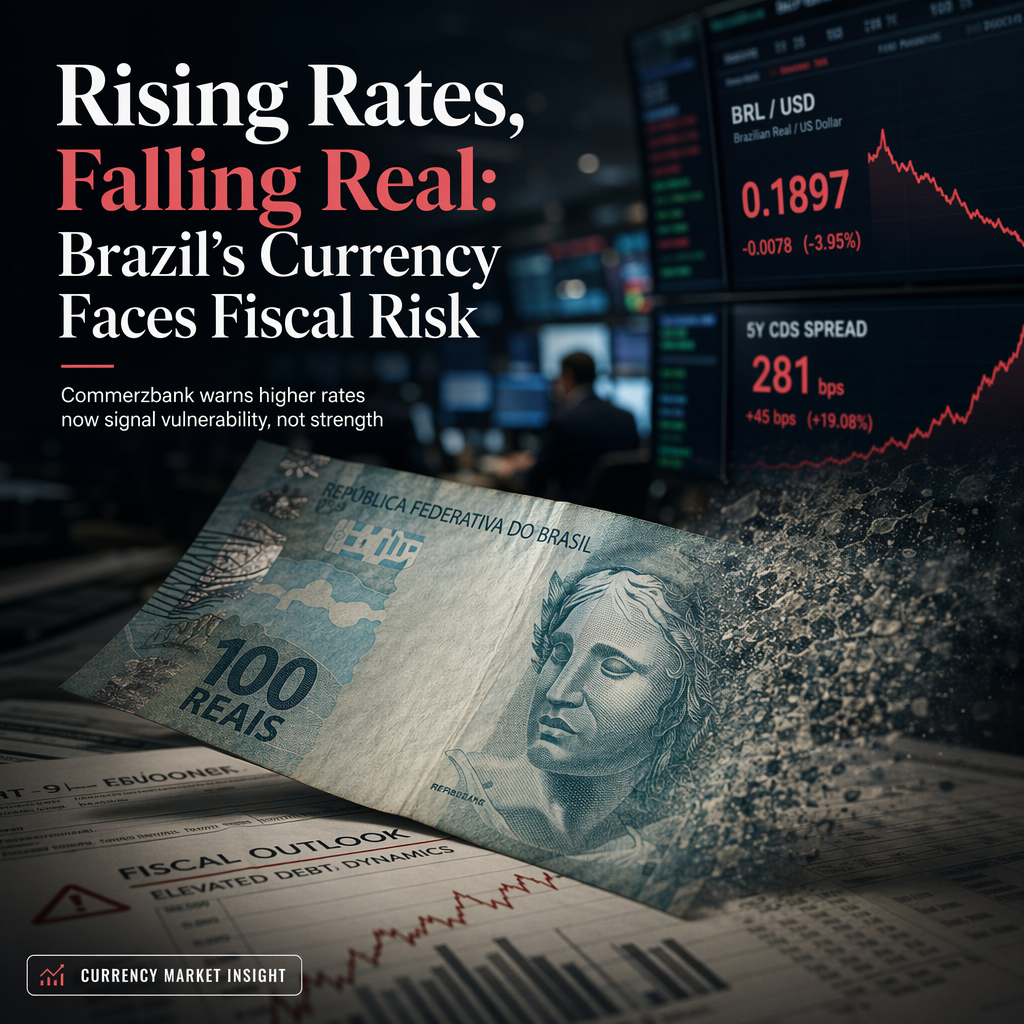
Commerzbank FX analyst Michael Pfister has highlighted an unusual dynamic in the Brazilian currency market, where rising expectations for higher Brazilian interest rates have led to depreciation of the Brazilian Real (BRL) rather than appreciation. According to Pfister, a one-percentage-point increase in interest rate expectations results in the BRL depreciating by more than one percent, contrary to conventional economic theory which would typically expect a currency to strengthen under such circumstances [1].
Regression analysis conducted by Commerzbank shows that if expectations for the Brazilian key interest rate two years ahead rise by one percentage point within a week, the BRL tends to depreciate by approximately 1.5 percent. This negative correlation is attributed to fiscal dominance in Brazil, where concerns over government spending and fiscal policy outweigh the positive effects of higher interest rates on the currency [1].
Further analysis reveals that an increase in interest rate expectations by one percentage point is associated with a 10.1 basis point rise in Brazil's CDS spreads, indicating heightened perceptions of fiscal risk. The report notes that expectations of a higher interest rate differential between Brazil and the US have been linked to higher USD/BRL levels over recent years, suggesting that the market views rising rates as a sign of increased fiscal vulnerability rather than a reason to buy the real [1].
Commerzbank maintains its forecast for higher USD/BRL levels, warning that if the Brazilian president's ambitious spending plans continue to elevate fiscal risks, the real is likely to face further downward pressure [1].
CONCLUSION
Commerzbank's analysis indicates that rising Brazilian interest rate expectations are currently a warning sign for the real, reflecting fiscal concerns rather than support for the currency. The bank expects further BRL weakness if fiscal risks persist, maintaining a forecast for higher USD/BRL levels.