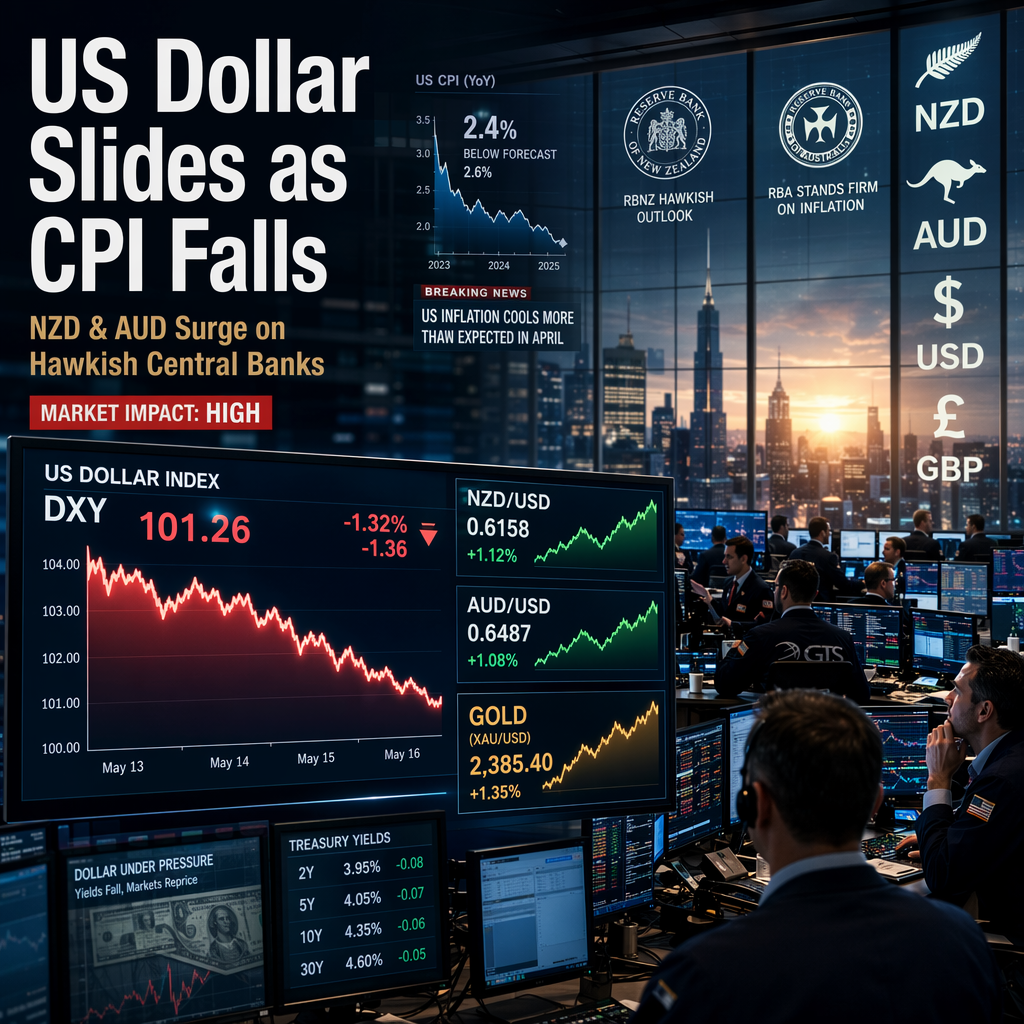
The US Dollar (USD) has come under pressure following a softer-than-expected US Consumer Price Index (CPI) report for June, which showed headline inflation easing to 3.5% year-over-year from 4.2% in May, below market expectations of 3.8%. Core CPI also slowed to 2.6% YoY from 2.9% in May, missing the consensus of 2.8% [4][6]. This data prompted markets to sharply reduce the probability of further Federal Reserve (Fed) rate hikes, with the implied odds of a July hike dropping to 16.6% from 35%, and September hike odds falling to 48% from 64% prior to the CPI release [4][6].
The New Zealand Dollar (NZD) has outperformed G10 peers, supported by hawkish rhetoric from the Reserve Bank of New Zealand (RBNZ) and improving domestic activity data. RBNZ Chief Economist Paul Conway warned that inflation could remain sticky, increasing the likelihood of additional rate hikes. Markets are already pricing in nearly 90 basis points of further tightening by mid-2027, and the RBNZ has not pushed back against these expectations. The next key catalyst for NZD is the 2Q26 Consumer Price Index release on 21 July [1]. Technical analysis shows NZD/USD holding above 0.5800, with resistance at 0.5845 and 0.5853, and support at 0.5809. The downside appears limited due to the RBNZ's hawkish stance and receding Fed hike bets, suggesting the path of least resistance is to the upside [2].
The US Dollar Index (DXY) extended losses for a second day, trading around 100.80, and was the weakest against the Australian Dollar (AUD), which strengthened to near 0.7000. The AUD/USD rally was also attributed to the softer US CPI, which tempered Fed tightening bets [3][4]. The DXY remains in a neutral to mildly constructive technical posture, but further declines below 100.80 could trigger a more bearish outlook [3].
Speculative long positions in the USD are at their highest since 2015, according to CFTC data, but the cooling inflation data has made these positions vulnerable. Fed Chair Kevin Warsh maintained hawkish rhetoric but provided no clear policy guidance, emphasizing the need for debate at the upcoming FOMC meeting and highlighting uncertainty in inflation metrics [6].
Gold rebounded from sub-4000 levels to an intra-session high of 4102 after the soft US CPI, as markets pared back Fed hike expectations and USD weakened. However, OCBC analysts see this as a reversal of excessive hawkish repricing rather than a macro regime shift, with further upside in gold contingent on softer oil prices and continued weak US data [7].
Meanwhile, the British Pound (GBP) advance against the USD has stalled, with analysts expecting range-bound trading between 1.3320 and 1.3445, reflecting a neutral stance amid the shifting USD backdrop [5].
CONCLUSION
Softer US inflation data has led markets to scale back Fed rate hike expectations, weakening the US Dollar and boosting currencies like the NZD and AUD, which are also supported by their respective central banks' hawkish stances. The market impact is high, with technical and positioning factors suggesting further USD downside risk if US data remains soft. Gold and other risk assets have rebounded, but further moves depend on upcoming data and commodity price trends.