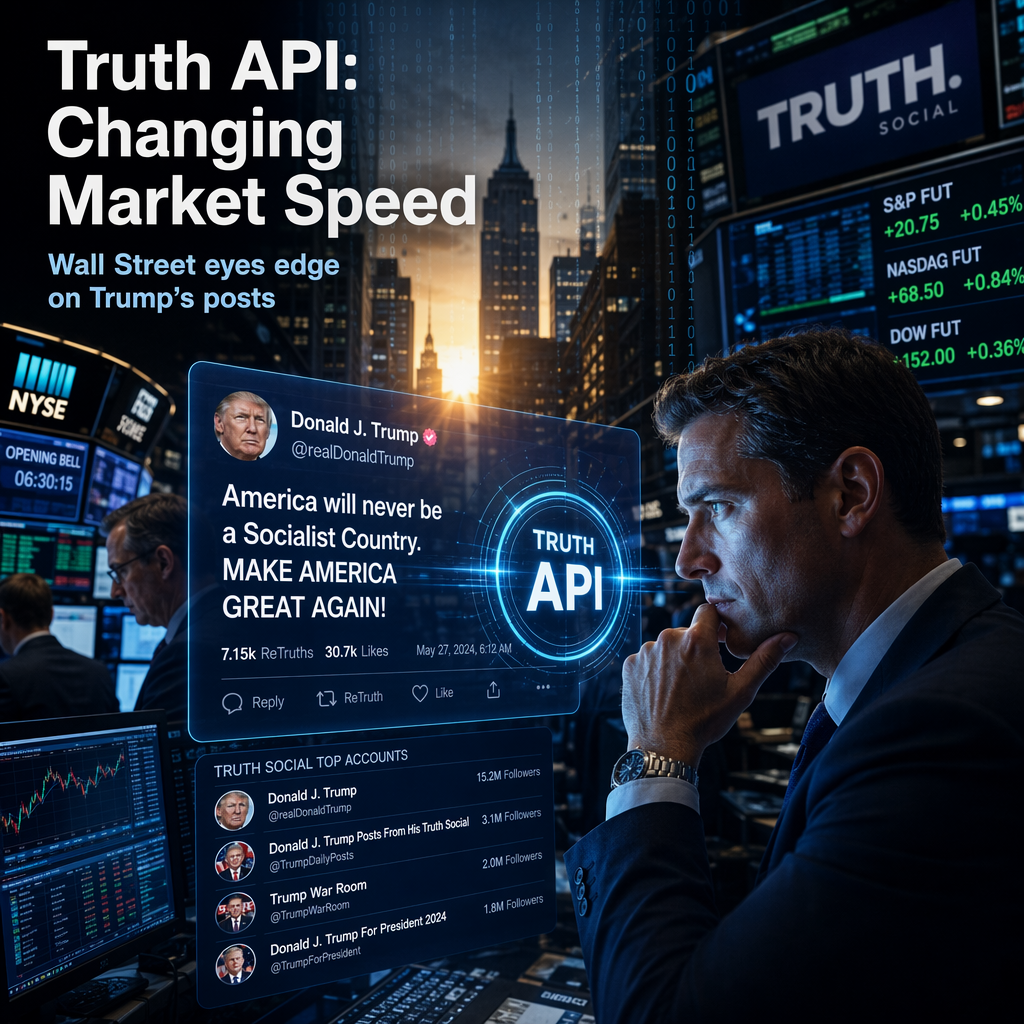
Truth Social has announced plans to launch a new product called 'Truth API,' which will provide Wall Street firms with significantly faster access to posts from President Trump and the nine other most influential accounts on the platform [1]. This service is designed to deliver these posts at a much quicker pace than standard push notifications, potentially giving financial institutions a critical edge in reacting to market-moving statements [1].
Market analysts highlight that the speed of information delivery is a crucial factor for trading strategies, particularly for high-frequency and algorithmic trading firms [1]. The introduction of Truth API could lead to increased volatility in sectors sensitive to political statements, such as defense, healthcare, and energy, as firms may be able to respond to presidential communications before the general public [1].
As of now, Truth Social has not disclosed pricing details or subscription levels for the Truth API, and traders are awaiting further information regarding technical specifications, including latency benchmarks and integration options with existing trading platforms [1]. Industry experts are divided on the potential impact: some believe that providing select firms with faster access could undermine market fairness, while others see it as an innovative step in financial information delivery [1].
Analysts advise traders to closely monitor support and resistance levels in politically sensitive stocks and volatility indices, anticipating increased market activity following the rollout of the Truth API [1]. Key indicators to watch in the coming months include changes in trading volume and price movements after major posts from the influential accounts featured in the service [1].
CONCLUSION
Truth Social's planned launch of the Truth API could significantly alter the speed at which market-moving information reaches Wall Street firms, potentially increasing volatility and trading opportunities in sensitive sectors. While the service is seen as innovative by some, concerns remain about market fairness and the broader implications for trading dynamics.