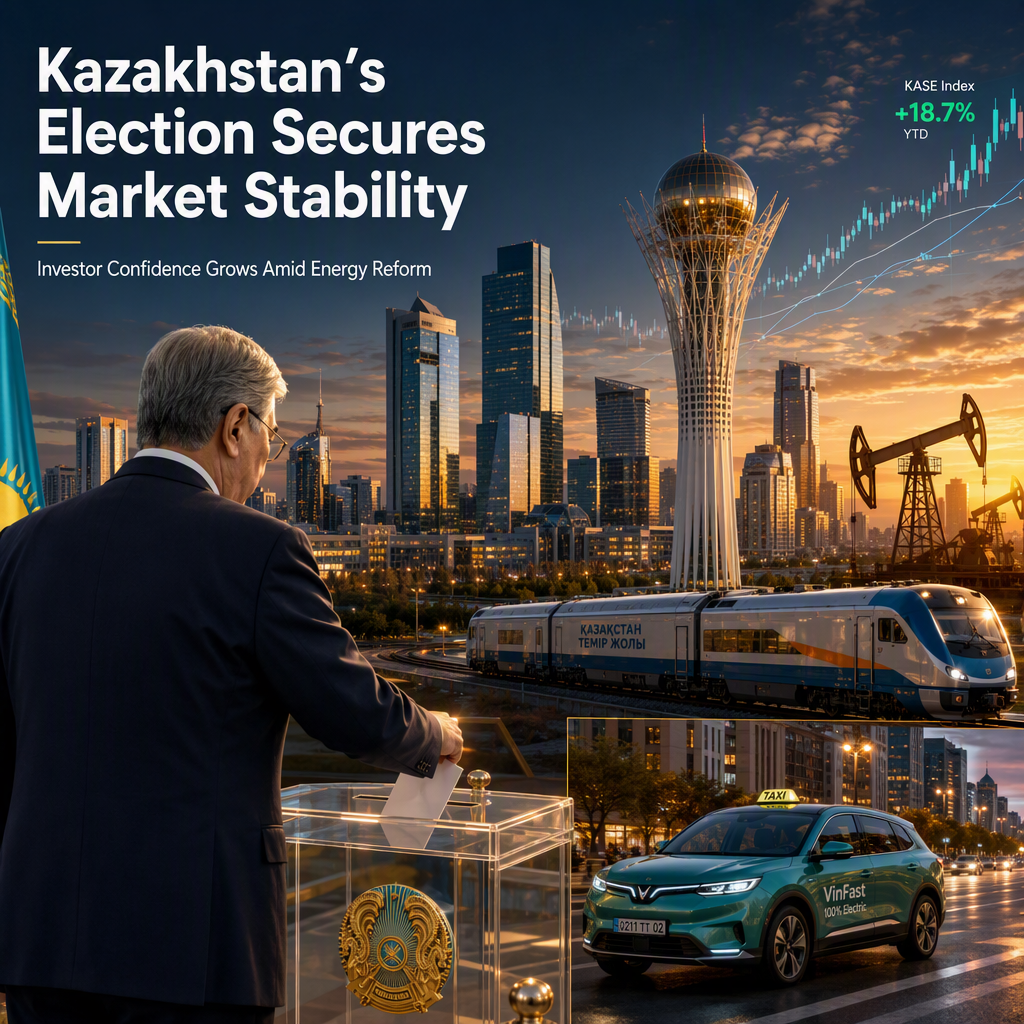
Kazakhstan has reaffirmed its role as a strategic 'hedger' between global powers following a recent snap parliamentary election in which President Kassym-Jomart Tokayev consolidated his authority by casting his ballot in Astana on August 23, 2026 [1]. Tokayev's decisive moves to preserve stability are seen as critical for maintaining Kazakhstan's independence and avoiding overt alignment with China, Russia, or the United States, especially given the country's significant energy resources and its position along key trade routes [1].
Market observers highlight that Kazakhstan's stability has direct implications for global energy markets, as the nation is one of the world's largest uranium producers and a major exporter of oil and gas [1]. Any political shifts could impact supply chains and commodity prices. The recent blackout in Central Asia underscored the importance of power grid integration and revealed risks for data centers and energy investors [1].
The parliamentary election results have strengthened Tokayev's mandate, paving the way for further reforms aimed at attracting foreign investment, particularly in new-energy sectors [1]. Technical analysis of foreign direct investment (FDI) trends indicates a steady upward trajectory, with resistance at previous geopolitical inflection points. Market sentiment is described as cautiously optimistic, with traders pricing in reduced risk premiums for Kazakh assets compared to regional peers [1].
Kazakhstan's railway operator has filed for a Hong Kong IPO, signaling confidence in the country's growth prospects, while the entry of VinFast-backed taxi services into the Kazakh market highlights the region's appeal for electric vehicle ventures [1]. Regional experts advise investors to monitor Tokayev's policy announcements for further liberalization, noting that Kazakhstan's sovereign bonds are supported at pre-election lows with upside potential if reforms continue and stability is maintained [1].
CONCLUSION
Kazakhstan's successful navigation of post-election stability has reinforced investor confidence and reduced risk premiums for its assets. The country's ongoing reforms and strategic balancing act are expected to support continued foreign investment and stability in global energy markets.