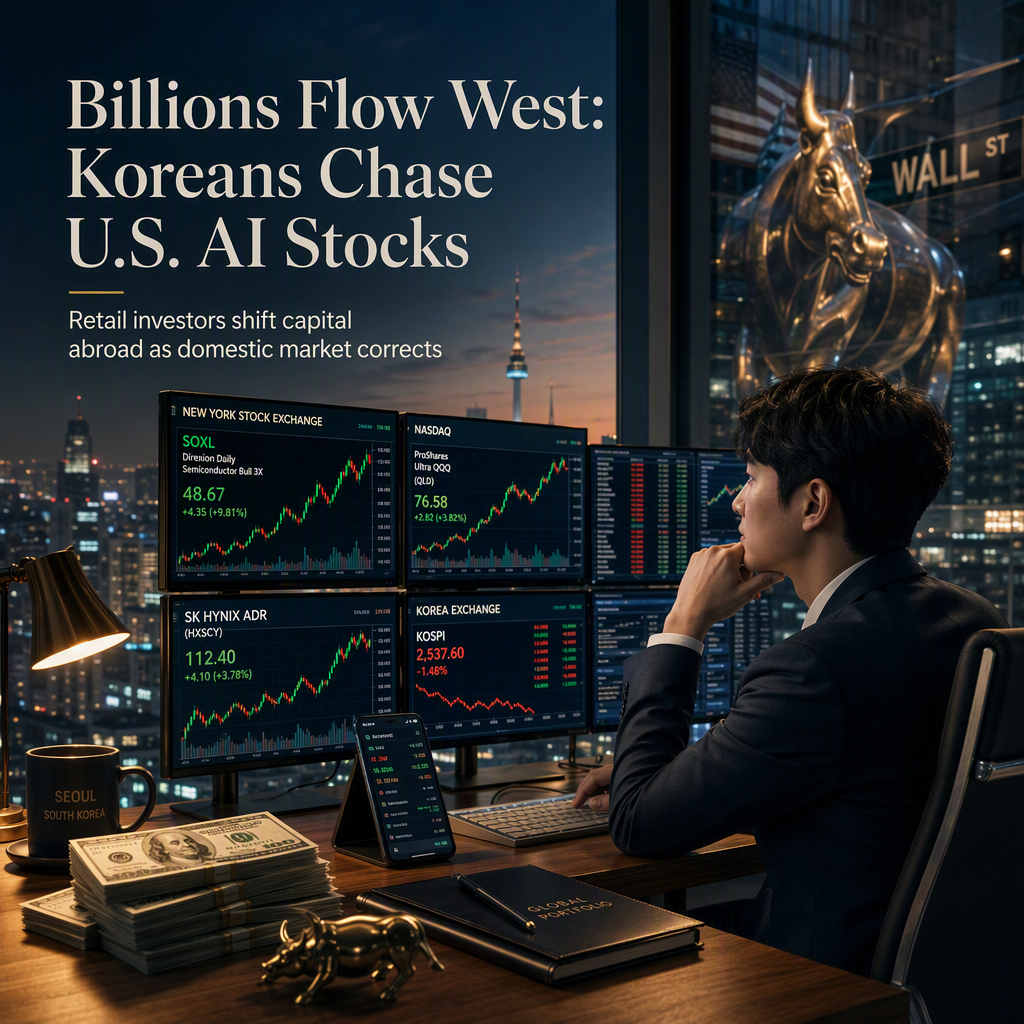
South Korean retail investors net bought $4.5 billion of U.S. stocks in July as their domestic market underwent a correction, according to Korea Securities Depository data [1]. This migration is characterized by a shift in geography rather than investment strategy, with investors maintaining exposure to AI and leveraged products through U.S.-listed securities [1]. Of the $4.5 billion, approximately $840 million was allocated to SK Hynix's U.S.-listed depositary receipts (ADRs), making it the second most net-purchased U.S. security by Korean investors, despite the ability to buy SK Hynix directly in Korea [1]. The ADRs have traded at a roughly 10% premium to the Korean shares and exhibit greater volatility, which Owen Lamont of Acadian Asset Management described as 'absolutely crazy' and indicative of speculative excess [1]. Lamont noted that such price discrepancies are unusual and may signal a bubble, referencing similar dislocations during the dot-com boom [1]. Leveraged products are also popular among Korean investors, with four of the ten most net purchased U.S. stocks in July being leveraged ETFs. The Direxion Daily Semiconductor Bull 3X Shares ETF (SOXL) was the most popular, aiming to deliver three times the daily performance of a semiconductor index, while ProShares UltraPro QQQ and ProShares Ultra QQQ ranked fourth and sixth, respectively [1]. Phillip Wool of Rayliant Global Advisors observed that Korean investors are largely buying shares tied to the same AI hardware theme that has been selling off in the local market [1]. Jung In Yun of Fibonacci Asset Management added that some traders, hurt by losses in Korean semiconductor shares or leveraged ETFs, may be shifting to U.S. AI stocks perceived as higher-quality or more liquid, without reducing their exposure to the AI theme [1]. While Korean flows are unlikely to sway broad U.S. markets, they could amplify volatility in individual stocks and thinner trades [1].
CONCLUSION
South Korean retail investors are moving significant capital into U.S. stocks, particularly AI and leveraged products, as their domestic market corrects. This shift may not impact the broader U.S. market but could increase volatility in specific securities. Analysts warn that price discrepancies and speculative behavior may signal bubble-like conditions.