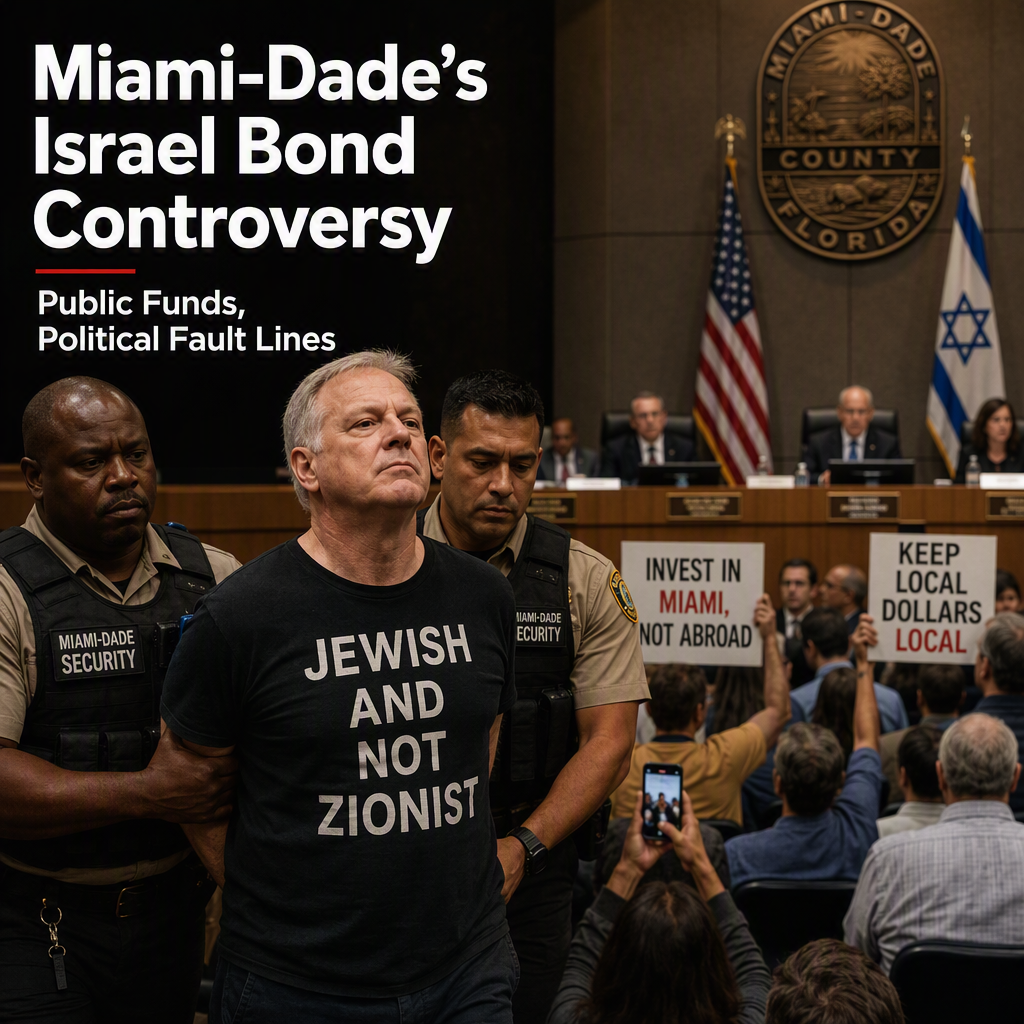
James Fischback, a former Florida gubernatorial candidate, was forcibly removed from a Miami-Dade Board of County Commissioners meeting after protesting the county's recent decision to expand its investment in Israel-backed bonds [1]. The county had earlier this summer raised its investment cap with Israel from 3% to 5% of its portfolio, enabling Miami-Dade to invest approximately $400 million to $450 million in these bonds [1]. Fischback criticized the move, arguing that public funds should be invested locally rather than in foreign government bonds, and highlighted that Florida law generally prohibits such investments except for Israel [1].
During the meeting, Fischback questioned the commissioners' priorities, asking whether they served local communities or Israeli interests, before being escorted out by officers [1]. He has previously declined contributions from the American Israel Public Affairs Committee (AIPAC) and pledged to divest from Israel-backed bonds during his gubernatorial campaign, where he received 10.4% of the vote in the August 18 primary [1].
The county's decision has sparked opposition from other members of the public as well, with some expressing disappointment over the allocation of public investment dollars to Israel, especially given the ongoing war in Gaza and the resulting political divisions in the U.S. [1]. Fischback and others have used the controversy to voice broader concerns about U.S.-Israel relations and the influence of pro-Israel lobbying groups [1].
No specific market reactions or analyst opinions were discussed in the article. However, the increase in the investment cap represents a significant shift in the county's portfolio allocation, potentially impacting local investment priorities [1].
CONCLUSION
Miami-Dade County's decision to raise its investment cap in Israel-backed bonds has ignited political controversy and public protest, with critics arguing for a focus on local investments. The move underscores ongoing tensions surrounding U.S.-Israel relations and the use of public funds, but no immediate market reactions were reported.