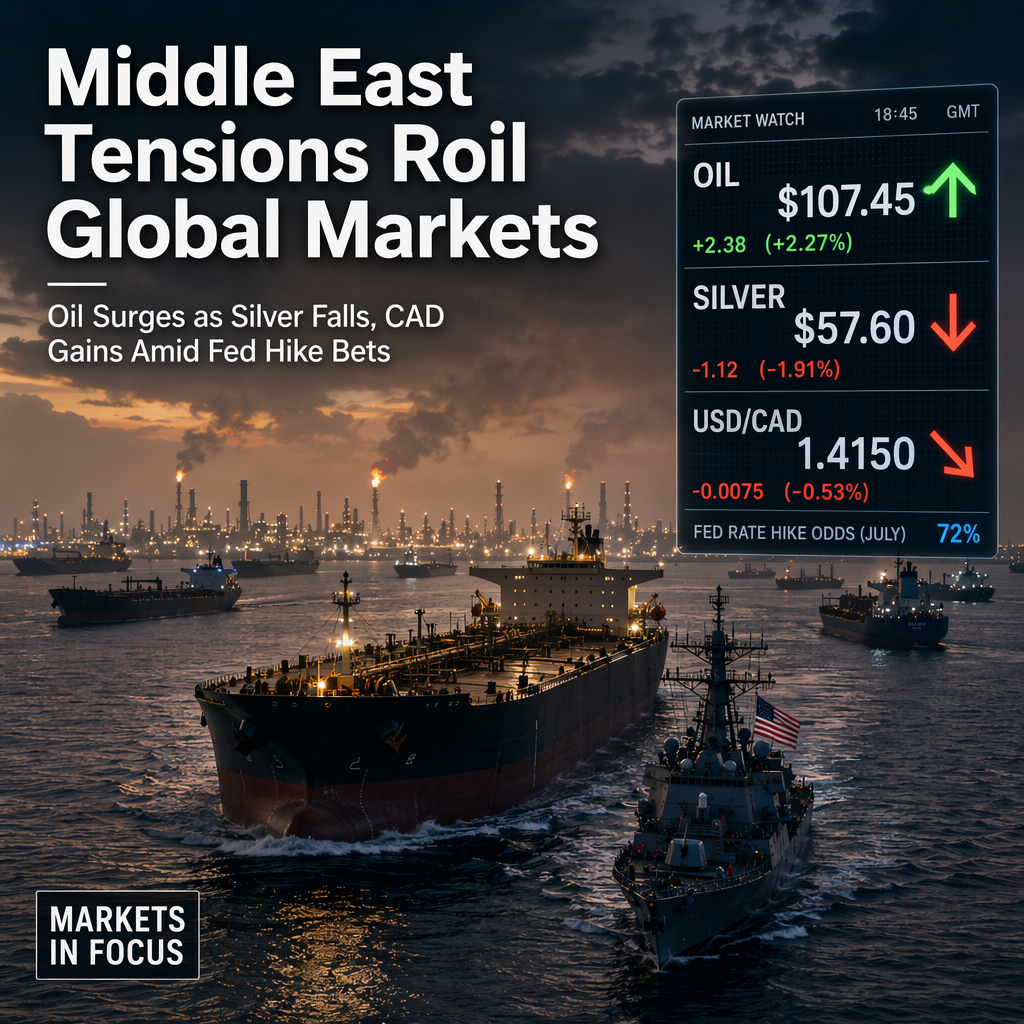
A sharp escalation of geopolitical hostilities in the Middle East has triggered significant movements across commodity and currency markets. US President Donald Trump has reinstated a naval blockade targeting Iranian vessels and customers transiting the Strait of Hormuz, and announced that all other commercial cargo passing through the waterway will be subject to a 20% reimbursement fee [1][2]. President Trump stated that the US must be financially compensated for its military efforts to secure the region, specifically referencing Saudi Arabia, the United Arab Emirates, Qatar, Bahrain, and Kuwait as beneficiaries [2].
These developments have driven oil prices higher due to mounting supply anxieties [1][2]. The surge in oil has had a dual impact: the Canadian Dollar (CAD), as the currency of the largest crude exporter to the US, has gained support, causing the USD/CAD pair to depreciate and trade around 1.4150 during Asian hours on Tuesday [2]. Conversely, the silver price (XAG/USD) has dipped for the third consecutive day, trading around $57.60 per troy ounce, as higher oil prices stoke fears of energy-driven inflation and the prospect of prolonged elevated interest rates from the Federal Reserve [1].
Market expectations for US monetary policy have shifted rapidly in response to these events. The CME FedWatch Tool now indicates a 51% probability of a Fed rate hike in September, compared to just a 23% chance that rates will remain on hold [1][2]. This shift reflects growing concerns that inflationary pressures from higher energy costs could prompt the Fed to tighten policy further. The outlook for both the silver and currency markets remains uncertain as traders await two major macroeconomic catalysts scheduled for Tuesday: the US June Consumer Price Index (CPI) report, where analysts expect a 0.1% month-on-month decline in headline inflation but a persistent 0.3% increase in the core reading, and congressional testimony from Federal Reserve Chair Kevin Warsh, which is expected to be closely scrutinized for policy signals [1][2].
While the Canadian Dollar benefits from higher oil prices, the downside for USD/CAD is limited by safe-haven demand for the US Dollar amid geopolitical tensions [2]. Meanwhile, silver continues to face headwinds from the prospect of higher US interest rates, which diminish the appeal of non-yielding assets [1].
CONCLUSION
Escalating Middle East tensions and the resulting oil price surge have had a pronounced impact on both the silver and Canadian Dollar markets. With market expectations now tilting toward a Fed rate hike in September, traders are closely watching upcoming US inflation data and Federal Reserve commentary for further direction. The interplay between geopolitical risk, commodity prices, and monetary policy remains a key driver of near-term market volatility.