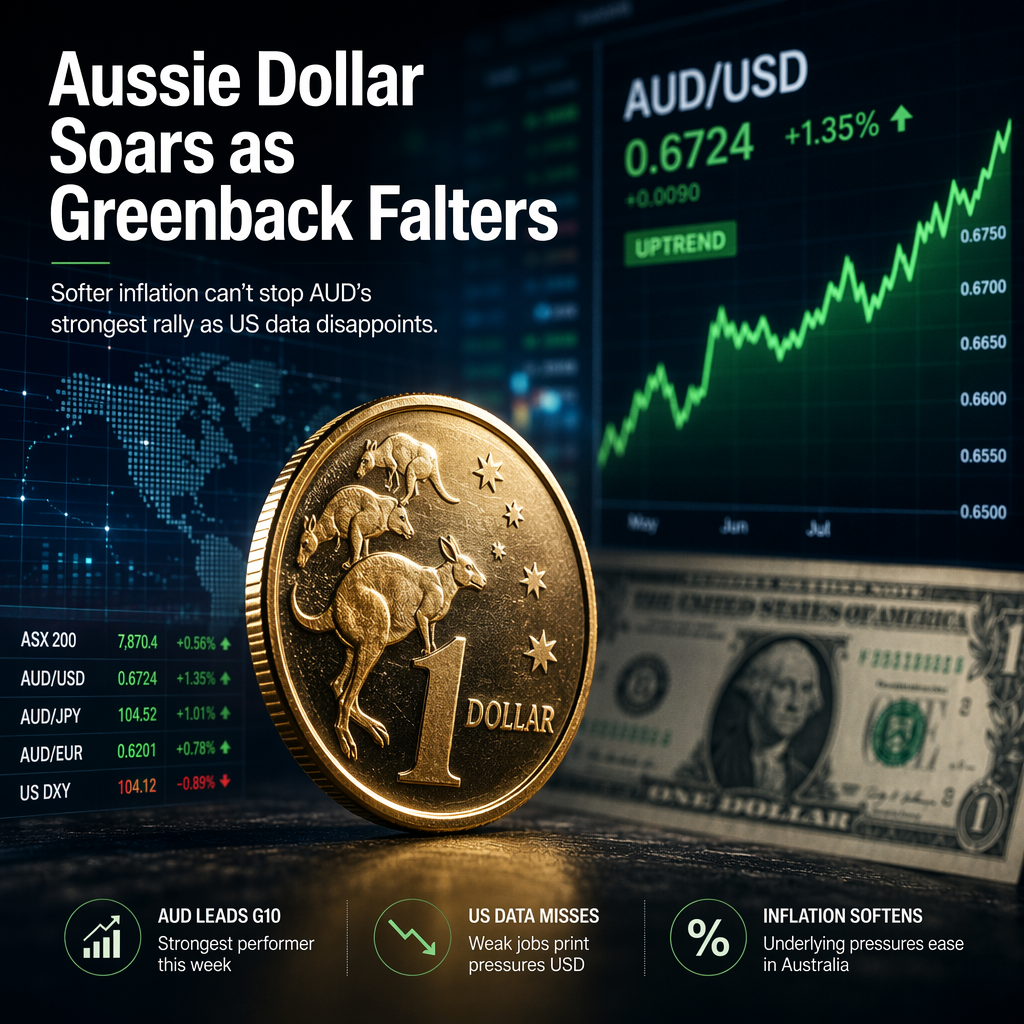
The Australian Dollar (AUD) rallied sharply against the US Dollar (USD) on Thursday, with AUD/USD trading around 0.7010, up 0.82% on the day, despite a softer-than-expected Australian Consumer Price Index (CPI) reading for June. Australia's CPI slowed to 3.8% year-over-year, down from 4% previously and below the 4% market consensus, leading investors to significantly reduce expectations for an imminent Reserve Bank of Australia (RBA) interest rate hike. Market pricing for an August rate increase dropped from nearly 21% to around 3%-4% following the data release [1].
The initial pressure on the AUD from the weak inflation data was reversed as the US Dollar weakened broadly after the Federal Reserve (Fed) left interest rates unchanged at 3.5%-3.75% and released a relatively hawkish statement. The USD's decline was further fueled by a series of softer-than-expected US macroeconomic data, including second-quarter GDP growth of 1.5% (below the 2.1% forecast and down from 2.1% in Q1), and a decrease in the Personal Consumption Expenditures (PCE) Price Index, which fell 0.1% month-over-month in June. The annual PCE rate eased to 3.7% from 4.1%, and the Core PCE Price Index slowed to 3.3% year-over-year from 3.4% [1].
The combination of weaker US economic data and ongoing disinflation trends led markets to question the necessity of further Fed monetary tightening, despite the central bank's hawkish tone. As a result, the Australian Dollar became the strongest major currency against the US Dollar on the day, appreciating by 0.84% [1].
No forward-looking analyst opinions beyond the market's repricing of RBA and Fed rate hike expectations were provided in the article [1].
CONCLUSION
The Australian Dollar's rally was driven by broad-based US Dollar weakness following disappointing US economic data and a dovish market interpretation of the Fed's latest decision, despite softer Australian inflation. Market participants sharply reduced expectations for near-term rate hikes from both the RBA and the Fed. The event had a significant impact on currency markets, with the AUD outperforming all major peers against the USD.