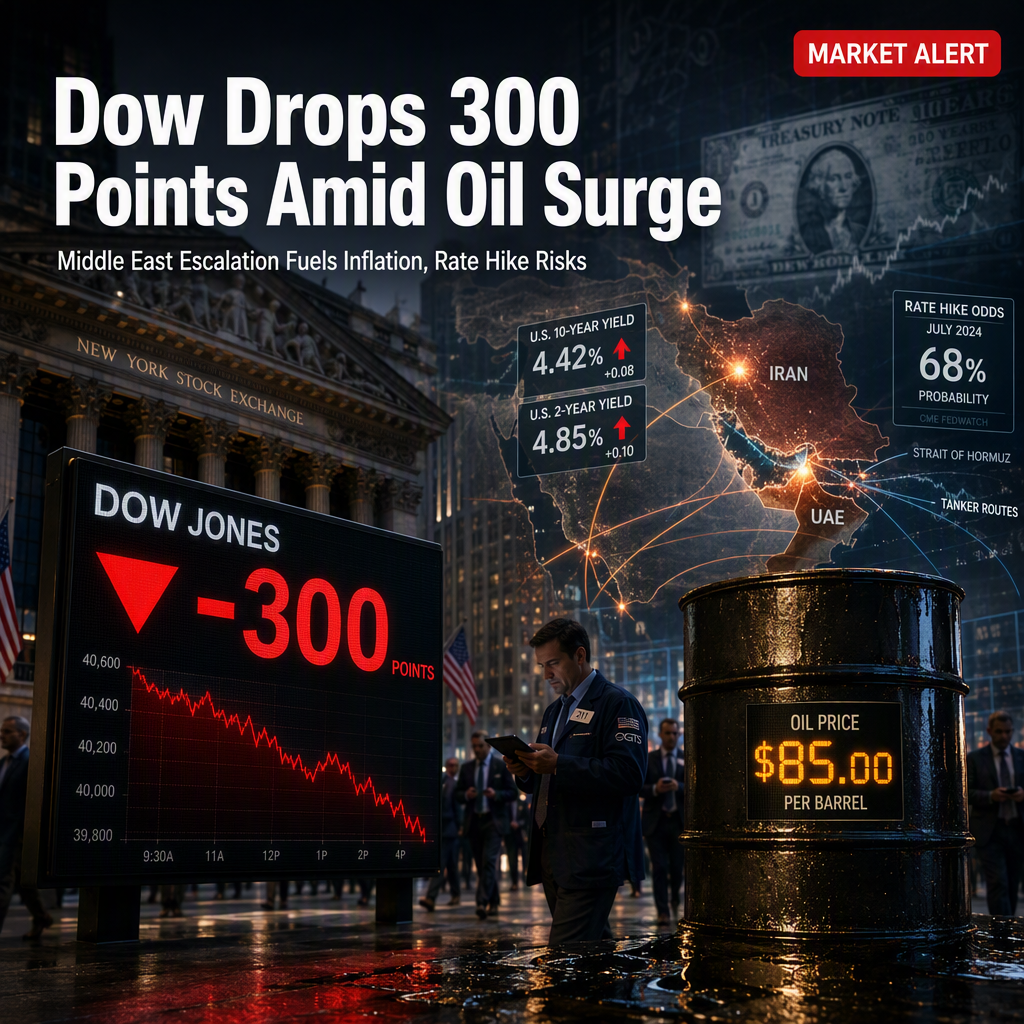
The Dow Jones Industrial Average traded near 53,250, approximately 300 points lower on the session, following news that American forces struck two Iranian rocket launchers on Larak Island, prompting retaliatory attacks from Tehran on bases in Jordan and assets in the United Arab Emirates [1]. This escalation in the Middle East drove crude oil prices more than 2% higher, pushing them above the $85.00 mark, while Treasury yields also rose, defying the typical risk-off pattern where equities are sold and government bonds are bought during geopolitical crises [1].
Instead, longer-dated Treasury yields increased throughout the session, short-term borrowing costs in Europe reached multi-year highs, and Japanese two-year government bond yields hit levels not seen in thirty-one years [1]. The bond market's reaction was attributed to the conflict being priced as a cost story—raising energy prices and goods inflation—rather than a growth story [1]. The benchmark Gulf-to-Japan large tanker rate set a record above $107 per metric ton on August 27, reflecting freight markets pricing in the risk [1].
Rate futures responded sharply, with the probability of a Federal Reserve rate hike in September rising to nearly 60%, up from about 35% before Friday. Such a move would lift the target range to 3.75% to 4.00%, reversing the direction assumed by equity models over the past two years [1]. The article notes that nothing in Monday's headlines suggests a different outcome, as the escalation and inflation risk are now intertwined [1].
Structurally, the Dow Jones is poorly positioned for this scenario. Chevron (CVX), the only energy company in the index since ExxonMobil's removal in 2020, represents just 2.2% of the index's weight, while financials make up over a quarter, with Goldman Sachs (GS) alone accounting for nearly 11.5% [1]. This means the index has minimal exposure to energy gains but significant exposure to rising rates, which negatively impact financials and duration-sensitive stocks like Alphabet (GOOGL), which replaced Verizon in June [1]. The same structural factors explain why the recent technology rally, including Nvidia (NVDA), largely bypassed the Dow [1].
CONCLUSION
The Dow Jones Industrial Average declined sharply as Middle East tensions drove oil and yields higher, increasing the likelihood of a Fed rate hike. The index's structure leaves it vulnerable to inflation shocks, with limited energy exposure and heavy weighting in rate-sensitive sectors. Market sentiment is negative, and the outlook remains cautious amid ongoing geopolitical and inflation risks.