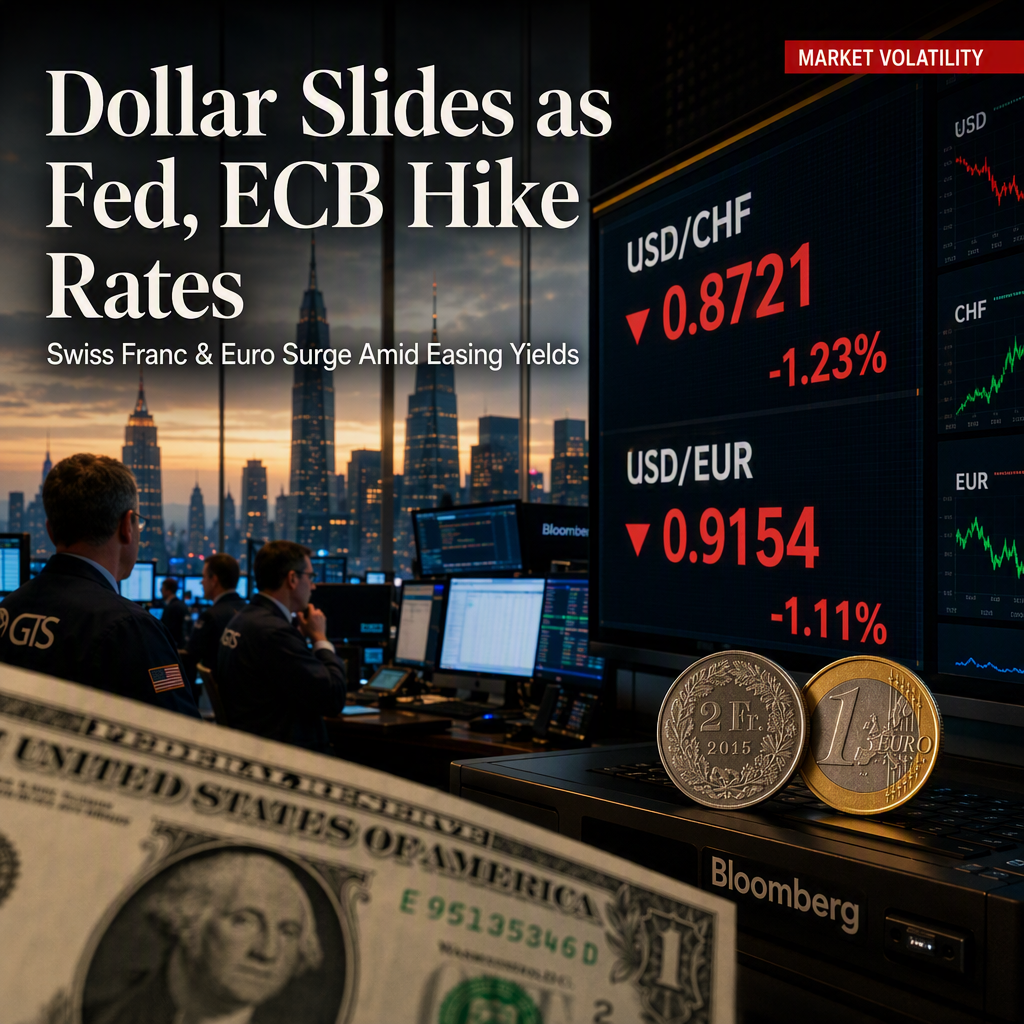
The US Dollar (USD) faced renewed pressure on Friday, with both USD/CHF and EUR/USD pairs strengthening as easing US Treasury yields and falling oil prices helped alleviate broader inflation concerns [1][2]. USD/CHF extended its losses for the second consecutive day, trading around 0.8230 during Asian hours, as the benchmark 10-year US Treasury yield retreated to approximately 4.93% after briefly breaching 5.0% earlier in the week [1]. Crude prices declined following Saudi Arabia's efforts to restore flows through its East-West pipeline, further contributing to the USD's weakness [1].
Meanwhile, EUR/USD traded in positive territory near 1.1490 during the early European session, supported by the softer USD. However, the upside for EUR/USD may be capped by the Federal Reserve's recent hawkish move, as the Fed raised its benchmark interest rate by a quarter-percentage point to a range of 3.75% to 4%, marking its first hike since July 2023 [2]. Market participants are also awaiting further cues from Fed Governor Michelle Bowman's speech later on Friday [2].
Market expectations for future Fed policy shifted rapidly following hawkish remarks from Fed Chair Kevin Warsh, who emphasized persistent inflation and lack of structural improvement in recent economic data. The CME FedWatch tool showed traders pricing in a 53.1% probability of another rate hike at the Federal Reserve's October meeting, up from 44% the previous day [1].
On the European side, the ECB recently raised its key deposit rate by 25 basis points to 2.50%, with Bloomberg economists expecting a further hike to 2.75% in December, skipping the October meeting [2]. Eurozone inflation remains steady, with headline inflation in the low 3% area and core inflation in the mid-2% range, supporting the ECB's hawkish stance. Market pricing reflects just over a 50% chance of an October hike and a cumulative 36 basis points of tightening by December [2].
Technical analysis indicates that EUR/USD maintains a bearish bias below the 100-day SMA, with immediate support at 1.1475 and resistance at 1.1550. USD/CHF's recent rally paused, with UOB strategists noting strong momentum but cautioning that a breach of 0.8185 would signal a loss of bullish impetus in the coming weeks [1][2].
CONCLUSION
The US Dollar's weakness, driven by easing yields and inflation concerns, has boosted both the Swiss Franc and Euro. While recent Fed and ECB rate hikes reinforce a hawkish policy outlook, technical and market signals suggest continued volatility and limited upside for USD pairs. Traders are closely watching upcoming central bank communications for further direction.